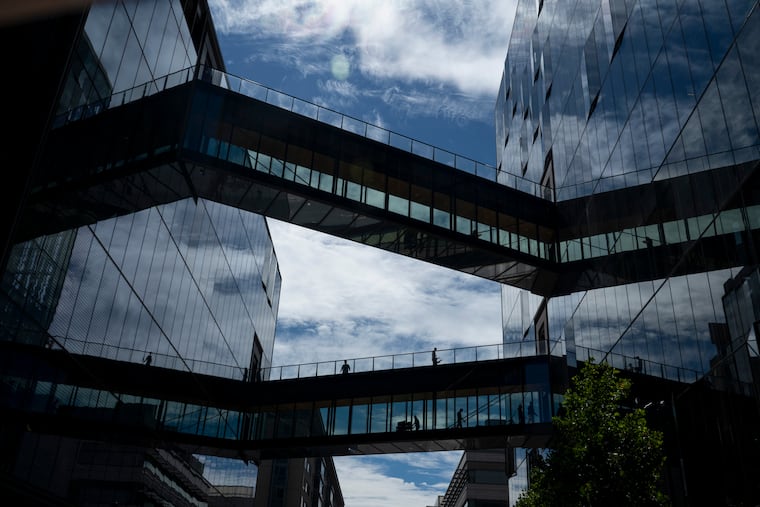
Sixers’ new sponsor Bloom Energy was long a money-loser and now soars with AI data center orders
A Silicon Valley company that makes off-grid mini-power plants in Delaware, Bloom just joined the S&P 500 and became a Sixers sponsor.
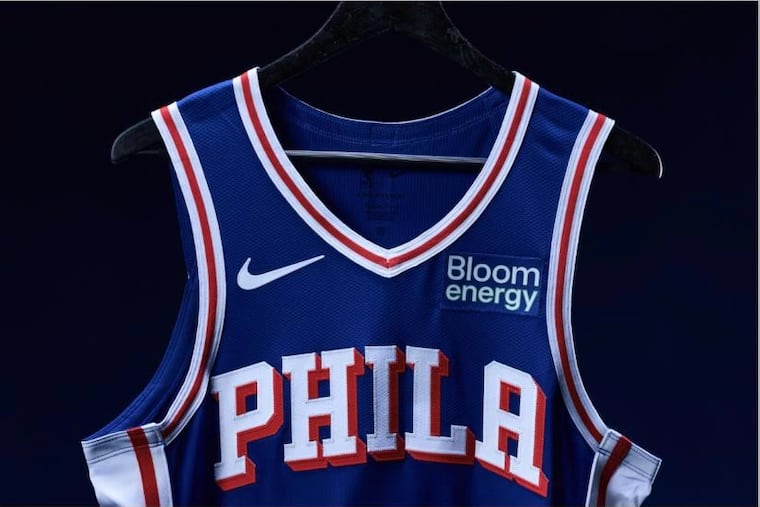
The logo of Bloom Energy, maker of mini-power plants, is replacing Crypto.com on the Sixers’ uniform advertising patch this season.
Bloom Energy is hiring and trying to raise its local profile, said vice president Barry Sharpe, who runs the company’s plant in Newark, Del. Bloom has stepped up recruiting in nearby Pennsylvania, New Jersey, and Maryland.
So what exactly is Bloom Energy, and why are they supporting the Sixers?
» READ MORE: Sixers name Bloom Energy as new jersey patch sponsor
Bloom is based in San Jose, but the Newark factory is its biggest employee center, which has languished for years but suddenly became profitable in 2025. That’s when Bloom began selling its modular, off-grid electric plants to power-starved high-speed artificial intelligence data centers.
The Newark plant, where 1,200 of Bloom’s 2,200 employees work, makes fuel cells, an update of 1800s technology that presses natural gas or other hydrogen-based fuels through battery-like metal plates at super-hot temperatures to generate electricity — at temperatures of around 800 degrees Celsius.
Fuel cells run independent of electric-power grids, which can take years to grant approval for new plants to power data centers.
AI data centers built for Oracle, Microsoft, Intel, and other giants, including the DataOne center in Vineland, have been placing orders with Bloom. That’s helped pack the Newark plant with a production backlog, new hires and new robots.
» READ MORE: Vineland AI data center hit with a $1 million fine
Bloom offers “reliable, clean power that can be quickly deployed and easily scaled,” Oracle Cloud Infrastructure executive vice president Mahesh Thiagarajan said in a statement.
Bloom joined the S&P 500 list of the most-valuable U.S. companies last week.
The Newark plant is located among labs and offices that have sprung up between I-95 and the University of Delaware. A warehouse, a repair center and other Bloom structures line a nearby road.
Besides data centers, Bloom says its boxes help power Urban Outfitters’ headquarters at the Navy Yard, as well as Coherent Corp.’s data center and telecom-equipment factories in Pennsylvania and New Jersey. Bloom also sells power to PSE&G in New Jersey and to Delmarva Power in Delaware — whose customers continue to pay monthly surcharges that cover certain Bloom costs, as part of the deal that brought the factory to Newark.
A sudden boom
Though the company opened the Newark plant in 2012 with state aid and went public in 2018, Bloom Energy lost money and its stock price languished below its original offering price.
The new orders have boosted Bloom’s share price from under $20 to around $300. As of Friday, the company was worth $85 billion on the stock market, more than Comcast or General Motors.
Short-sellers and subsidy critics have warned that Bloom’s data-center orders may not come in on schedule, or at all; that fuel cells aren’t always as efficient as claimed; and that the company’s proprietary metal-and-ceramic fuel-cell cores depend on specialized materials that are hard to find from U.S. sources.
But even as Oracle and other data-center boom stocks falter, Bloom shares have stayed close to their bullish high. On Friday, Bloom closed at $288.70.
Bloom has a smaller plant near its Silicon Valley headquarters. “We like to say that California builds the [fuel cell] engines; Delaware builds the cars,” Sharpe said, referring to the 30-foot-long, 8-foot-high, 4-foot-wide modular boxes installed on-site at users’ locations. Sharpe, a former Ford and Toyota executive, has run the Newark plant since 2012.
Each 325-kilowatt, 13-ton cell group is housed in one of metal boxes made in Delaware. As local power sources, they enable data centers to open without tapping the strained U.S. electric grid. As they wear down, the cylindrical fuel cells in these Bloom boxes are swapped out for easy replacement without shutting the system.
The Newark plant was built in anticipation of rapid growth that took more than a decade to materialize. Sharpe said the plant has only recently reached its limit, with the addition of an automated welding line that will enable a single controller to join plates, instead of the three-worker welding crews.
The company is making plans for a 125,000-square-foot addition.
How it started
Bloom was founded in 2001 by University of Arizona rocket scientist KR Shridhar, who remains the CEO. Early investors included Kleiner Perkins Caufield & Byers, a Silicon Valley venture capital firm. Kleiner Perkins helped secure government funding from the Barack Obama administration and state governments for energy projects that offered less-polluting alternatives than burning coal, oil, or gas.
Then-Delaware Gov. Jack Markell was eager to replace lost Chrysler, GM and DuPont Co. factory jobs in the state. Delaware power users have contributed over $200 million to their power company to cover certain Bloom costs — more than Bloom’s total profits to date — under a 21-year contract critics have failed to end in legal and regulatory challenges.
The first wave of Bloom Energy customers included Walmart, JPMorgan and other image-conscious companies that wanted credit for burning less carbon. Delmarva Power, the local utility, also uses some Bloom cells.
The assembly plant stood partly empty for its first decade, with a fraction of the projected workforce. In 2019, Bloom had to return a slice of its subsidy because it employed just 300 in Delaware, a third of its targeted 900.
The company has now passed that target and won’t have to repay more, Bloom officials say.