Citizens Bank says it has ended lending to private prison companies used by ICE
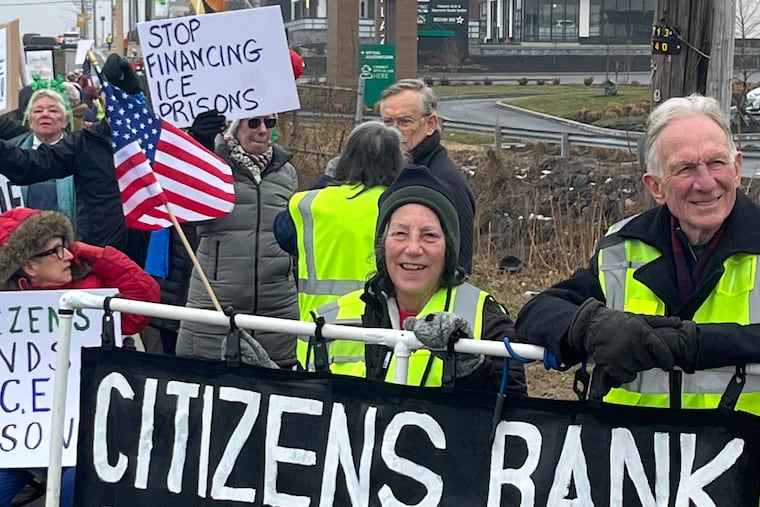
Protesters of Citizens Bank's lending to ICE contractors called it “an important victory for the people who refused to let a major bank finance human suffering."
Citizens Bank no longer funds two private-prison companies that house people detained by federal immigration services, the company said in a statement on its investor page Friday.
The federal government has purchased some facilities it had been using from private prison operator CoreCivic and plans to buy some from the GEO Group, so those companies no longer need as much capital, according to the bank. Citizens now finds it “appropriate to exit” those lending relationships, the bank said.
Citizens, based in Rhode Island, has the largest bank branch network in the Philadelphia area, according to FDIC data, and ranks among the dozen largest U.S. commercial banks.
Opponents of the facilities have asked for “assurances in writing” from Citizens Bank that the GEO Group and CoreCivic relationships are over, said Peyton Fleming, a spokesperson for De-ICE Coalition, which organized protests against the bank.
Earlier this month, CoreCivic announced the sale of two prisons in California to the U.S. for $1.5 billion.
Protests against Avelo Airlines’ role in transporting deportees for immigration agencies ended last winter after ICE purchased its own airplanes.
De-ICE in a statement Friday called Citizens’ decision “an important victory for the people who refused to let a major bank finance human suffering brought on by ICE detention activities of the current federal administration.”
De-ICE backers sponsored signs, trucks, a billboard on northbound I-95 near the Route 420 exit, a flyover banner before the Major League All-Star Game, and pickets in the region urging Citizens to drop the prisons. The group took credit for the decision, said Debbie Travers, a healthcare consultant and a leader of Indivisible Highlands and Beyond, a Wilmington-based group opposed to aggressive worker and family deportations.
Citizens, one of the few big banks to finance private prison companies, also was targeted in New Jersey and other states by local ordinance proposals urging towns to withdraw public accounts from Citizens. Jersey City and Montclair voted earlier this summer to withdraw more than $300 million in total from Citizens, according to NJ.com.
In its statement, Citizens said that due to privacy concerns, it hadn’t previously commented on its relationships with private prison owners and U.S. Immigration and Customers Enforcement detention center operators CoreCivic, which Citizens had served since 2011, and the GEO Group, which Citizens has financed since 2018.
Activists, including Philadelphia and Delaware chapters of Indivisible, complained that Citizens funding enabled the GEO Group, of Boca Raton, Fla., to operate the Moshannon Valley Processing Center in central Pennsylvania, Delaney Hall in New Jersey, and more than a dozen ICE prisons where conditions have been criticized. CoreCivic, of Brentwood, Tenn., ran the Elizabeth Detention Center in New Jersey, among others.
Protest organizers, including local branches of Indivisible, said they had marched outside at least 70 of Citizens’ 988 full-service branches, including locations in Center City and Northwest Philadelphia last winter and spring.
The bank said it has been “disappointed that the activists have dragged it into what is largely a political matter” and complained they mischaracterized the bank as anti-immigrant, pointing to its record of funding agencies that serve immigrants and other nonprofit support.
Citizens also said bank regulators don’t allow them “to deny banking services to individuals and to lawful businesses based on political or religious considerations, a practice referred to as ‘debanking.’”
The federal Office of the Comptroller of the Currency, a bank regulatory agency in the Treasury Department, is reviewing banks and has threatened to punish them for politically motivated debanking, citing private prison operators, gun makers, and oil companies among the industries the administration wants to protect.
Banks “must consider these regulatory and contractual frameworks in making decisions on who to bank or not bank,” Citizens said. “Fair access to bank funding should be something all should agree with. Political concerns should be addressed through political channels.”
De-ICE spokesperson Fleming said group members believe “public conscience and community resistance” helped change the policy, adding that “doing some good does not cancel out the harm caused by these business relationships.”
In 2019, eight large U.S. banks including JPMorgan Chase & Co. and Citibank agreed to stop funding private-prison operators.
In 2024, Citizens’ banking arm agreed to lead a group of lenders raising $1.3 billion for the GEO Group, which operates 82 prisons for state and federal agencies, some of which house immigration detainees.
Last year, Citizens led a group of lenders, mostly smaller Southern banks, in raising $500 million for CoreCivic, to pay down debt and “for general corporate purposes.”