U.S. grabs made-in-Philly training ship as Navy seeks to beef up bases after Iran hits
TS Empire State is expected to support U.S. forces stationed in the Indian Ocean after Iran bombed U.S. bases in the Persian Gulf.
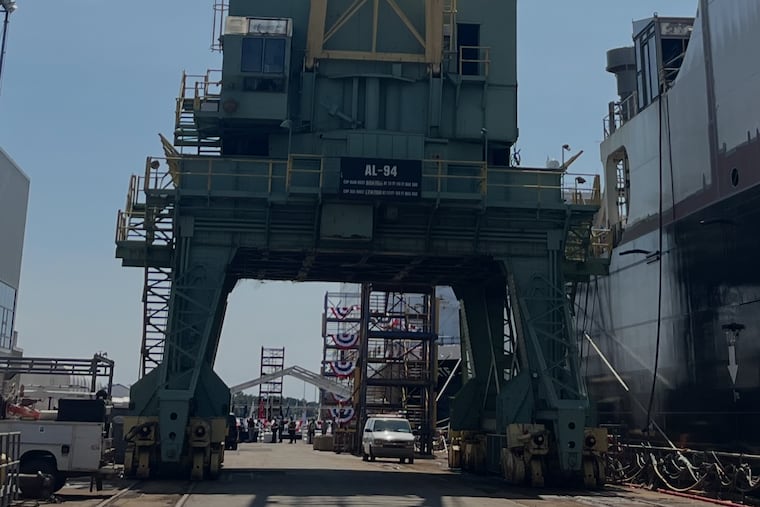
The first of the five $300 million-plus, 525-foot-long ships built at Hanwha Philly Shipyard has been reassigned to U.S. Navy duties for about six months.
The move comes as the U.S. military realigns resources to support U.S. bases now tasked with replacing military and supply facilities in Bahrain and other Arab countries, which were damaged this year by Iranian missile attacks in the war with the U.S. and Israel.
It also comes as shipbuilder Hanwha and construction supervisor Tote Services, which has overseen construction of the five National Security Multi-mission Vessels (NSMVs) in South Philly since 2021, have been seeking contracts to build more of the ships, as work on the last one draws toward a close next year.
TS Empire State will be sent over Tuesday for 170 days of “temporary federal service,” retired Rear Admiral John A. Okun, president of the Bronx-based Maritime College of the State University of New York, told faculty and staff in a memo Friday, confirming earlier reports from shipping and government sources.
“There is still much that we do not know” about how the ship, which normally carries hundreds of cadets on training voyages, will be used by the government, Okun said.
‘They should be up for it’
Military commenters linked the move to the U.S. military’s efforts to shuttle supplies to and from its base on Diego Garcia in the Indian Ocean and other far-flung stations, after stations in Bahrain and other Arab countries were damaged by Iran earlier this year in retaliation for U.S. and Israeli attacks.
The Navy’s Sealift Command, which carries military equipment and supplies, asked for Empire State and said no other available ship has its capabilities for an undisclosed strategic mission, according to an article Monday in GCaptain, published by merchant marine Capt. John A. Konrad V.
“The ship is likely headed to Diego Garcia,” according to Salvatore Mercogliano, a maritime historian at Campbell University in North Carolina, who reported in social media posts in mid-August that the move was likely.
The Empire State and its sister ships are oceangoing vessels, and “they should be up for it,” said Gary Kim, a shipbuilding and industrial scholar, reserve officer, and Wharton graduate student who as an active-duty Navy lieutenant worked for the unit that manages the base at Diego Garcia, among other installations.
The ship’s removal “is likely to cause anxiety and stress” at the academy, so mental health counselors have been made available to midshipman cadets to help them cope, academy president Okun said in his note.
He pointed out that a previous Empire State training ship — there have been six of that name before the current one — had supported U.S. forces in Somalia in the 1990s, as well as aiding relief work for Hurricane Sandy, which ravaged the Jersey Shore in 2012, among other storms.
“We will face whatever comes next together,” he said.
On time and on budget
Empire State was delivered to the Maritime College in the Bronx in 2023. The next ships in its class were sent to academies in Massachusetts and Maine. TS Lone Star was scheduled to leave Philly Shipyard for its new Texas home on Monday.
Empire State’s success on deployment could help determine the future of the construction program, which has kept many of Philadelphia’s workers busy since 2021. The yard now employs around 2,000, which Hanwha hopes to double.
In July, Transportation Secretary Sean Duffy and other federal officials came to Philadelphia to announce that the government planned to purchase two more NSMV-like hulls to be built at the shipyard and used to track enemy missiles, replacing ships built in the 1960s. Duffy praised Tote for building ships “on time and on budget.”
Tote has noted that the program has run modestly overbudget due partly to much higher steel costs added and other factors. Federal officials said it is far closer to target than recent Navy-run shipbuilding programs.
Hanwha’s expansion goals
Hanwha has sought additional contracts to build similar vessels for other federal civilian agencies and as potential replacements for the Navy’s aging hospital ships, USNS Mercy and USNS Comfort.
Hanwha has said it is losing money on the yard and that it will turn a profit only if it can expand ship construction from the current one ship every eight months or so to at least one every few weeks. Its shipyard on Geoje Island, South Korea, produces almost one ship a week, assembly line-fashion in contrast with the expensive ship-by-ship style that has characterized U.S. ship construction in recent decades.
Tote officials have said Hanwha needs more space if it is going to build more government ships in Philadelphia. Officials of the Philadelphia Industrial Development Corp., the city/Chamber of Commerce partnership that finds city properties and public financing for industrial users, say they have been helping Hanwha look for expansion sites nearby. In March, the company canceled a plan to add facilities in Paulsboro, Gloucester County, after it could not reach an agreement with port operator Holt Logistics.
Hanwha last year pledged to invest $5 billion in Philadelphia shipyard facilities. It has so far spent around $200 million, according to company officials.
Hanwha in August offered to spend over $1 billion for Australia-based Austal’s shipyards in Alabama, amid a boom in public and private military shipbuilding fueled by a record U.S. defense budget.
Besides finishing the last of the NSMVs, Hanwha is building three liquefied natural gas-fueled cargo ships for the Matson shipping line, which operates between the U.S., Hawaii, other U.S possessions, and China.
The company has said it would build its own cargo ships if necessary to keep the yard running.