How to shop for glasses and contacts and get the best price
It’s best to shop around for eyeglasses and contact lenses, as prices on the same frames can vary greatly store to store.
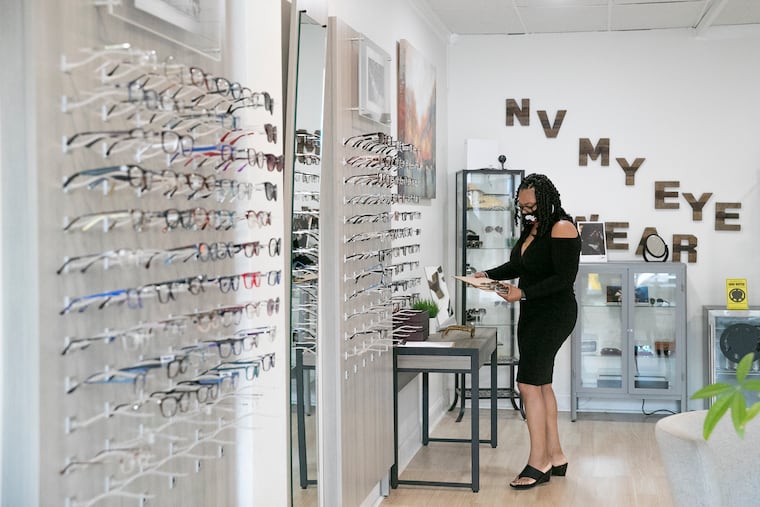
In one form or another, eyeglasses have existed for centuries.
Ancient Roman scholars and medieval monks used blown glass to magnify manuscripts. Paintings from the 17th and 18th centuries depict well-to-do folks sporting eyeglasses, including Benjamin Franklin, who invented bifocals. Leonardo da Vinci conceptualized contact lenses as early as 1508.
Glasses and contacts have come a long way since. The 75% of American adults who need some sort of corrective eyewear can choose between comfortable contacts and thousands of fashionable frames.
Still, shopping for new specs and contacts can be a hassle.
Nonprofit Delaware Valley Consumers’ Checkbook’s surveys of local consumers reveal sizable differences in customer satisfaction. In general, chains and franchise operations were rated lower than independent firms, but there was variation among each outlet type.

Until Dec. 5, Inquirer readers have free access to Checkbook’s ratings of local optical shops for quality and price at: Checkbook.org/Inquirer/Eyewear.
You’ll want to shop around for price. Checkbook’s undercover shoppers collected prices for 18 models of eyeglasses (with single-correction lenses) and found that some outlets charge twice as much as others. For example, for a pair of Ray-Ban RX5286 eyeglass frames with lenses, prices at surveyed stores ranged from $166 to $487. For eyeglasses, the least expensive sellers were usually online.
Not all eyeglass retailers sell the same products, so it’s difficult to compare prices among some of the largest chains for the exact same frames. Comparing costs is further complicated by the dominance of EssilorLuxottica, which not only manufactures millions of pairs of glasses from dozens of brands annually, but runs thousands of retail stores where it markets and sells eyewear, including For Eyes, LensCrafters, Pearle Vision, Sunglass Hut, and the optical department at Target.
For the limited selection of specs they carry, Checkbook’s shoppers found Costco, Walmart, and Warby Parker offer low prices, and Costco and Warby Parker also get fairly high ratings from their surveyed customers.
Checkbook researchers also collected prices for six brands and models of contact lenses and found even larger store-to-store differences. For example, prices for a one-year supply of Biotrue ONEday daily disposable contact lenses (plus exam and fitting), ranged from $460 to $1,150. Among brick-and-mortar outlets, BJ’s, Costco, For Eyes, and Walmart had the lowest prices for contacts.
We found the lowest contact prices online, but some internet sellers were more expensive than the lowest-priced local brick-and-mortars. If you’re replenishing a year’s supply and not changing brands or type, there’s little reason not to grab the savings by buying from a low-cost supplier.
If you are buying glasses, choosing the type of frame is a major decision. Consider comfort, positioning, durability, appearance, and price.
How they feel
Check for comfort at the bridge of the nose and ears, where glasses touch your face. The lightest glasses are usually the most comfortable. Look for thin plastic or metal frames.
With metal frames, know that they have a nosepiece of rocking pads (small adjustable plastic pads) that are unlikely to slip and can be easily adjusted — an advantage over plastic frames, which usually have a rigid nose support. But rocking pads concentrate the weight on a small surface, which is uncomfortable to some people.
How they are positioned
Eyeglass frames are designed to position lenses to provide maximum visual acuity. Some frames may position lenses too far from your eyes, or too high or too low. If the frames slide down your nose, you won’t get the full benefit. The stronger your prescription, the more critical the positioning.
If you wear your glasses for driving, sports, or other activities requiring peripheral vision, make sure the “temples” (the two side parts of a frame that extend behind the ears) are located above or below the eyes, not directly alongside them.
How long they will last
Barring accidents, glasses should last three or four years, and many wearers want to change styles at least that often. If you plan to keep the frames longer — or the frames get knocked around a lot — strength and durability are important. Both depend on the frame materials, thickness, and craftsmanship.
The strongest metal frames are usually made of titanium, with flexible hinges and smooth welding wherever two pieces of metal are joined. The strongest plastic frames are made of nylon, but these tend to be thick, heavy, and plain. Among other plastic types, the strongest usually have at least moderate thickness, metal reinforcing within the full length of the temple, and flexible hinges.
How they look
Whether you buy specs in person or online, you’ll need to try them on to ensure they suit the shape of your eyebrows and cheekbones, spacing of your eyes, height of your nose bridge, and size of your head.
The best approach? Try on multiple frames and choose what you like. Then look at prices, and if your favorite costs too much, ask a staffer to show you a similar-looking cheaper frame.
How much they cost
Frame prices vary tremendously. Prices for decent-quality frames range from less than $40 to more than $1,000.
Shopping around is key to getting a good deal.
Delaware Valley Consumers’ Checkbook magazine and Checkbook.org is a nonprofit organization with a mission to help consumers get the best service and lowest prices. It is supported by consumers and takes no money from the service providers it evaluates.