Philly shipyard owner Hanwha is shifting its investment focus to the South and West
Hanwha, which wants to expand in the United States, tried to buy facilities in Paulsboro, N.J., but couldn’t reach a deal with Holt Logistics.
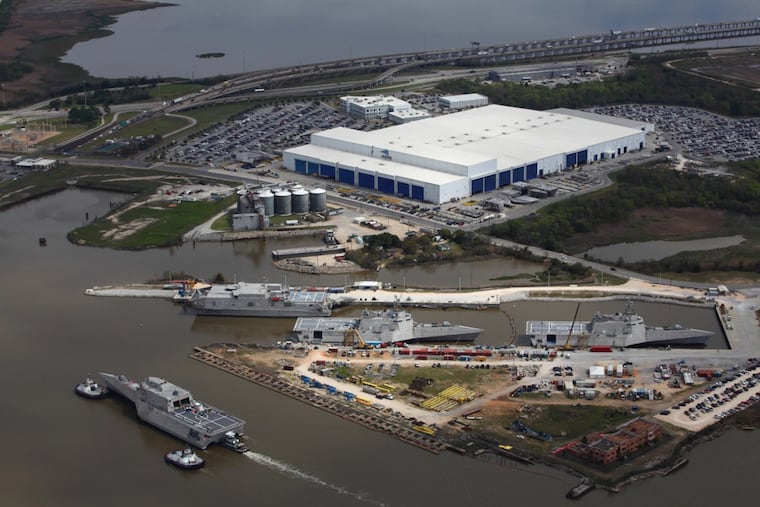
A unit of the Hanwha Group, which paid $100 million for Hanwha Philly Shipyard in 2024, has offered to pay more than $1 billion for an Australian company’s shipyard in Mobile, Ala., the company’s nearby nuclear submarine fabrication sites, and a San Diego ship repair facility.
Hanwha has four weeks to review the facilities and meet with the U.S. Navy and other government agencies before closing a deal, according to a statement from shipbuilder Austal USA.
The South Korean-owned Hanwha Group last year promised to pump $5 billion into the facilities it owns at the heart of the former Philadelphia Naval Shipyard to add a second giant Goliath crane, a second 1,000-foot dry dock, larger fabrication structures, and other portside facilities. The company also said it would hire thousands more workers, as part of a larger $150 billion investment by several South Korean companies to revive U.S. shipbuilding.
Hanwha Philly Shipyard has not added those major facilities. Company officials have since said their group is looking at other U.S. sites to build enough ships to turn a profit.
Hanwha “is exploring a range of options to expand our footprint in the United States,” said James Hewitt, Hanwha Defense USA spokesperson. The company declined to say more about its search.
The proposal fits with Hanwha’s ambition to be a leading global defense contractor, competing with General Dynamics and other big shipbuilders, said Gary Kim, a U.S. Naval Reserve engineer and Wharton graduate student who writes extensively on shipbuilding. The Philadelphia yard “would focus on surface auxiliary vessels, where Austal would focus on smaller warships and submarine modules.”
In Philadelphia last month, JPMorgan CEO Jamie Dimon said his bank looks forward to helping fund Hanwha’s expansion.
Hanwha last year had agreed to purchase portside facilities in Paulsboro, Gloucester County, four miles up the Delaware River from its South Philly yard. It pulled out of the agreement after failing to reach a deal with the port operator, Holt Logistics.
Hanwha has not ruled out developing another Philadelphia-area location but has been visiting southern facilities that are ready to run, such as the Austral yards. Austal USA employs around 3,500, compared to around 2,000 employees and outside contractors at Hanwha Philly Shipyard.
The former Philadelphia Navy Base covered a much larger area before it closed in 1994. Philadelphia Industrial Development Corp., a partnership between city government and the Chamber of Commerce that screens tenants for vacant land, has since committed much of the property to corporate offices, apartments, and other nonindustrial uses, though some waterside industrial property is still available.
Hanwha’s specialty at its main yard on South Korea’s Geoje Island is mass-producing cargo ships. Hanwha Defense said in a statement last month that building ships for the U.S. government is more profitable for the Philadelphia yard than commercial ships.
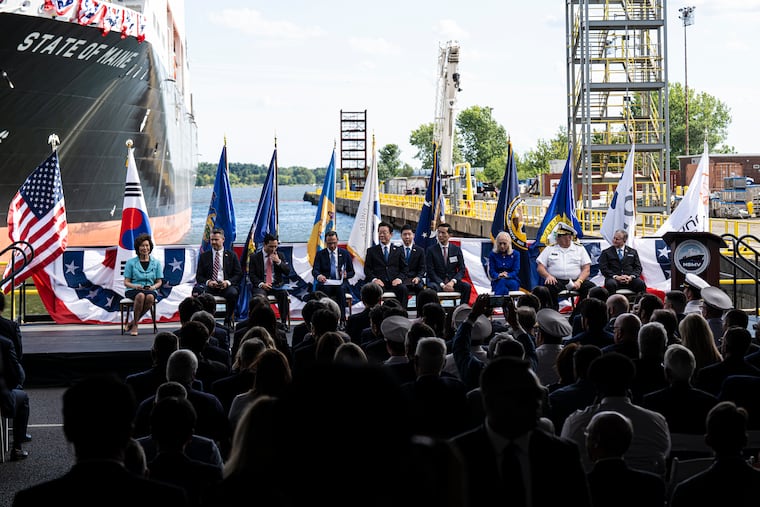
Hanwha is finishing work on the final two of five ships it is building for the U.S. Maritime Administration to use as state merchant marine trading academies. Secretary of Transportation Sean Duffy said last month that the Philly yard had built those ships “on time and on budget,” in part by hiring Tote Services of Jacksonville, Fla., to manage construction. Hanwha says it has lost money on the $1.7 billion program, which began in 2021.
The government said last month that Hanwha Philly Shipyard will also build two “tracking ships” replacing missile-defense ships from the 1960s.
Hanwha Philly Shipyard is also building three ships for a total of around $1 billion for the Matson container line to operate between U.S. ports under the Jones Act requiring U.S.-built ships between U.S. ports. The cost of those ships is more than double what Chinese yards are charging for similar ships.
The Trump administration suspended the Jones Act last winter, and foreign ships are now carrying cargoes between U.S. ports, including natural gas from Marcus Hook to ports in Puerto Rico and New England.
In a securities filing Tuesday, Austal USA’s owner, Austal Ltd., disclosed that its shipbuilding arm has lost $175 million in its recently concluded fiscal year, after the U.S. Navy last week refused to pay more for ships Austal has been building.
Austal has been building noncombat salvage, dry dock, and equipment-landing ships for the U.S. Navy. The company based its case for larger payments on changes in Navy orders and “deficiencies in design specifications.” Austal said it would “strongly pursue the claims” even after the War Department’s recent refusal.
At an Alabama facility near its shipyard that would be part of the deal with Hanwha, Austal USA constructs submarine modules for General Dynamics, which builds Navy nuclear submarines in Connecticut and Rhode Island. Austal says that business is profitable.
Rhoads Industries, Hanwha’s neighbor at the former Philadelphia Naval Shipyard, also fabricates nuclear submarine modules used by General Dynamics and plans to double employment to 1,400, as it builds new facilities for that business over the next few years.
Hanwha has said it wants to enter the submarine supply business as well. An Austal USA purchase would add that capability.