How local contractors and construction companies are leaning into AI | Expert opinion
Throughout an entire project, AI tools can help with accuracy and efficiency, Gene Marks writes.
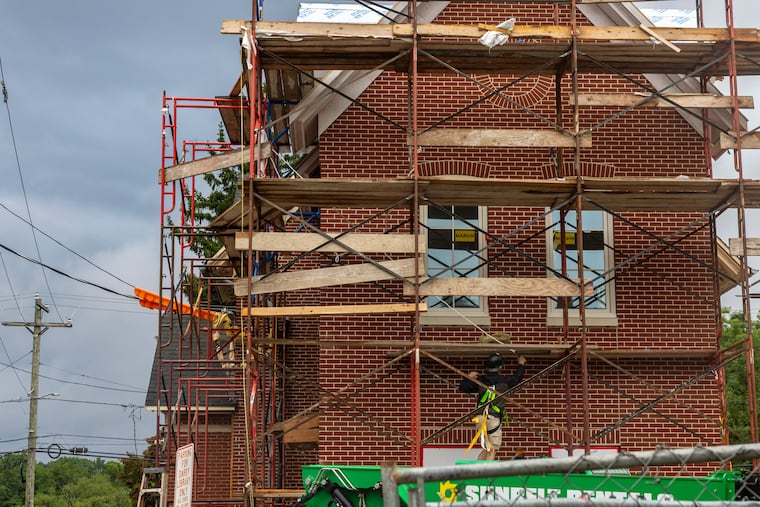
Painters? Windows installers? Flooring specialists?
These may not be the first people that come to mind when you think of AI. But many local companies in construction and contracting are struggling with a very tight labor supply and higher costs, so every dollar they save through automation can make a big difference.
This is why AI is producing a measurable business impact for approximately 38% of contractors, according to a 2026 survey of 1,000 companies by field service management software company ServiceTitan. That’s up from just 17% in 2025.
Takeoffs
Construction professionals know how important it is to get their estimates right. AI is quickly becoming integral to the process, beginning with the initial “takeoff” phase.
A takeoff is the process of reviewing construction plans to identify and measure the materials, surfaces, and fixtures needed to prepare an accurate project estimate or bid. AI is helping to improve speed and accuracy during this process.
AI is used in construction applications like Togai, Stack and On Center to read specification sheets, analyze photos, flag revisions, verify measurements and then set up estimates, produce reports, and recommend construction documents.
“When we receive a set of drawings, our team will upload the plans into our AI takeoff platform, which automatically identifies walls, ceilings, substrates, finish areas, and other relevant surfaces for painting or wall covering,” said James Geisel, a project manager at Philadelphia-based Hispanic Ventures, which does painting and wall covering. The AI tool “calculates square footage, linear footage, and quantities with a very high accuracy rate.”
AI does the “time-consuming measurement work,” Geisel said, while his estimators still apply their judgment to labor pricing, logistics, risk, and competitiveness.
Commercial flooring contractor Seamless Flooring Systems in Somerdale, Camden County, also relies heavily on AI for project takeoffs, said president Chris McDermott.
“It has really streamlined our production rate and has eliminated a ton of human error,” he said.
Estimating and bidding
In construction, after a takeoff comes estimating and bidding.
Applications like Procore, Autodesk, and Stack can advise an estimator on square footage and linear footage, material quantities, and cost-related inputs to draw up project estimates and determine pricing and bid preparation.
An application like this is “essential,” said Matt Biedekapp, a sales manager with Pella Windows & Doors in Scranton. It’s used when bidding on both residential and commercial construction projects because it helps with measurements, cost analysis, and timing of installation.
On the residential side, Biedekapp said his company uses AI tools to help with window measurements and hard-to-reach places, as well as overall quality assurance. For commercial customers with very large plans, they use AI software to identify, filter, and tag windows and doors for better accuracy and efficiency.
“Along with quickly getting window counts, we can also provide more accurate material lists using built-in formulas or even creating our own formulas,” he said. “Our AI-assisted measurements provide another layer of quality assurance and help us reduce remeasuring or reordering of materials, which can be costly.”
Geisel said AI also helps his team create standardized cost assemblies and recognize patterns from previous jobs.
“It recommends labor or material benchmarks based on similar projects,” he said. “It allows us to provide tighter, more accurate bids with less administrative work.”
Office automation
Like many of my clients, all three construction companies said they’re using AI in the office to help draft emails and proposals, summarize long email threads, prepare responses to requests for information, produce scope letters, and turn estimating data into professional reports.
Geisel said his team uses Microsoft Copilot.
“Copilot also helps turn raw estimating data into clean, professional reports that can be sent to clients,” Geisel said. “Instead of spending an hour formatting a scope breakdown or executive summary, you can generate a polished version in minutes and then refine it to your needs.”
Reporting and analysis
After projects are completed, companies can use AI to analyze and report on job performance in comparison to the estimates and evaluate overall profitability.
“Thanks to AI, we have been able to reduce our ‘recoveries’ significantly, which in our industry boils down to time,” Biedekapp said. “It helps us save the time spent to remeasure, reorder windows, parts, pieces, as well as the time spent tying up our project coordinators and carpenters.”
That translates to money saved too, he said, “but as a small business, the time is most valuable.”
As for staffing, McDermott said AI won’t be replacing any employees. But it will allow them to work better. “It will just give them a way to redirect their skills to strengthen on a different task and be more productive.”