Pennsylvania ended automatic life sentences for felony murder. Here’s what happens next.
The state Supreme Court ruled that mandatory life sentences for second-degree murder were unconstitutional. Then state lawmakers missed the deadline to write a new law. Now what?
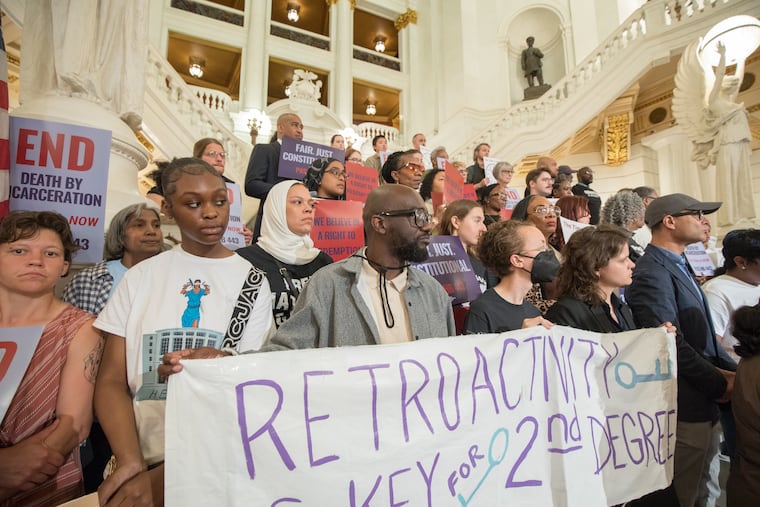
For decades, a second-degree murder conviction in Pennsylvania meant an automatic sentence of life in prison — even for people who did not kill anyone.
But in March, the Pennsylvania Supreme Court ruled that punishment unconstitutional in the case of Derek Lee, a Pittsburgh man who argued the mandatory nature of the sentence violated constitutional prohibitions against cruel punishment.
The high court gave the state legislature 120 days to devise an alternative and decide whether to apply it to those already serving the sentence.
That deadline passed without a resolution on July 24. And in early August, the high court rejected a bid by several district attorneys to give lawmakers more time.
So what happens now? Here’s what to know.
What was the maximum sentence for second-degree murder — and what is it now?
Before the ruling, the punishment was life without parole. Now there is no clear answer.
Setting criminal penalties is the legislature’s job, and lawmakers have not put in place a replacement.
The high court’s ruling did not abolish life without parole for felony murder; it only barred making the punishment automatic. A judge may still impose such a sentence, but only after weighing a defendant’s role in the crime.
The justices declined to say whether the ruling applies retroactively to people already serving those sentences, leaving that question to lawmakers, too.
How will judges sentence second-degree murder now that there’s no mandatory penalty?
With no law to guide them, judges are left to their own decisions. And without statewide guidelines, similar cases could end differently depending on the county in which a defendant is tried and on the judge who hears the case.
Philadelphia District Attorney Larry Krasner has expressed little concern about the lack of guidelines.
In an interview this week, Krasner, a Democrat who has forged a path as a progressive prosecutor, said “there’s nothing unusual” about asking judges to weigh the facts and use their discretion. “I’ve always believed that mandatory sentencing is problematic at best, usually a terrible idea, and that individual justice is what the system is supposed to be about,” he said.
But at a joint GOP policy committee meeting in Hazleton last week, several Republican prosecutors and lawmakers voiced concern about the lack of uniformity across the state.
Luzerne County District Attorney Sam Sanguedolce pointed to a case in which a defendant recently asked to plead guilty to second-degree murder.
“I can’t properly advise the defendant what the consequence might be,” Sanguedolce said. “Second [-degree murder] sounds like it’s better than first, but is it? We don’t even know.”
What happens to the people already serving life in prison?
For the nearly 1,100 people serving life for second-degree murder, nothing changes automatically.
The ruling made only one person eligible for resentencing: Lee. And even he could again receive life without parole, if a judge finds his role warrants it.
Others who wish to have their life sentences reconsidered have to go to court and ask to be resentenced. Bret Grote, a lawyer with the Abolitionist Law Center who represented Lee, said such petitions are likely to be denied by trial courts until retroactivity is settled.
Hundreds are expected to try anyway.
That flood could overwhelm courts and public defenders. Statewide, handling the cases could cost more than $34 million, the Public Defender Association of Pennsylvania estimates. In Philadelphia — home to more than 500 people currently serving such sentences — Chief Defender Keisha Hudson puts her office’s share at $40,000 per defendant, or $24 million total.
“We are going to need substantial funding,” she said last week, adding that she hopes to meet soon with city officials about how to pay for it.
Legal experts expect the question of retroactivity to reach the state Supreme Court again, either through an appeal of a lower court’s denial or a so-called King’s Bench petition asking the justices to take up the issue directly.
Lawmakers could also provide a quicker alternative by writing legislation that allows people serving second-degree murder sentences to seek parole, rather than requiring individual resentencing.
Can lawmakers still pass a fix, and what might that look like?
Lawmakers say negotiations will resume when they return in September. Each chamber has passed its own bill, but the two are far apart, with no compromise in sight.
The bill in the Republican-controlled Senate would set a 35-year mandatory minimum for most second-degree murder convictions, while keeping life without parole as an option. Current lifers would become eligible for parole after 35 years — or 20 years, if they are at least 70.
The measure in the Democratic-led House sets no mandatory minimum, instead directing the Pennsylvania Commission on Sentencing to write guidelines while keeping life without parole available. It would make current lifers parole-eligible after 30 years and add a medical parole option for the terminally ill.
Sen. Lisa Baker (R., Luzerne), who wrote the Senate proposal, said she is still hopeful that her caucus and House Democrats will reach a deal. But the parties remain far apart, she said.
“It’s difficult when you’ve got people whose priorities are no mandatory minimums for any crime,” she said. “I understand that we want to keep nonviolent first-time offenders [out of prison], give people second chances. But there needs to be accountability for these crimes.”
Few expect action before November’s midterm elections. “We can’t, unfortunately, make Harrisburg move any more quickly than they already are,” said Hudson, of the Defender Association. “And in the meantime, there are a lot of questions.”
What does all this mean for victims’ families?
Victims’ families are caught in a limbo of their own, said Melany Nelson, executive director of Northwest Victim Services, a Philadelphia nonprofit that assists crime victims.
Those whose loved ones’ killers have not been sentenced are now waiting to learn what punishment will come, and whether it will feel like justice. Those whose cases closed long ago face now the prospect of being summoned back — to a courtroom or a parole hearing — to confront the killer again and potentially watch them set free.
Nelson urged families to contact prosecutors’ offices and victim-advocate services now, rather than be caught off guard, and to weigh in with their state lawmakers.
“We do not want them to be blindsided by anything,” she said.
Correction: A previous version of this article incorrectly described what could happen to people who wish to appeal their sentences. Bret Grote, a lawyer with the Abolitionist Law Center, said such petitions are likely to be denied by trial courts until the question of whether a recent Pennsylvania Supreme Court ruling applies retroactively is settled.