She fought to bring the man she loves home from prison after a landmark court ruling. But lawmakers’ inaction has left her in limbo.
Matthew Garcia, who has been incarcerated for nearly three decades, and Cari Magobet advocated for legislation that would have given Garcia a chance to come home.
The phone rang at lunchtime, the way it did every day. Carisia Magobet answered within seconds.
An automated voice spoke first: This call is from a Pennsylvania state correctional institution.
Then his.
“May the peace, mercy, and blessings of Allah be with you, my love,” Matthew Garcia said in Arabic.
They had only 15 minutes, and for once, Magobet did not spend the first of them on small talk. There was no good way to tell him what she knew: State lawmakers had gone home the night before without taking the vote that the couple had hoped would bring him home.
Garcia was 18 in 1998 when he and four friends set out to rob a Hunting Park bar. He said he was the lookout and did not have a gun.
One of the teens pointed a sawed-off shotgun at a bartender and demanded cash. A retired Philadelphia police officer, Frank King, was inside the bar and grabbed for the gun. Another teen shot him with a pistol. King died on the floor.
By that time, Garcia said, he had already run.
It didn’t matter.
All five were convicted of second-degree murder — a killing committed during a felony, no matter who pulled the trigger — and sentenced to the only punishment Pennsylvania law allowed: life without the possibility of parole.
Magobet, who had known Garcia since they were kids in Hunting Park, was in the courtroom on June 21, 2000, the day he was sentenced. For decades, they did not see each other again.
Then, about two years ago, she found Garcia’s Facebook account, where he shared his writing and his work inside State Correctional Institution-Chester, the prison he called home. She reached out.
Garcia told her about a case before the Pennsylvania Supreme Court that could mean freedom for people serving life sentences in cases like his.
Derek Lee, a Pittsburgh man sentenced to life in prison for his role in a fatal robbery in which a coconspirator fired the fatal shot, had challenged the mandatory punishment as unconstitutional, saying it failed to account for individual culpability.
In March — six months after Magobet and Garcia wed in a prison visiting room — the high court struck down mandatory life sentences for second-degree murder.
It gave lawmakers until July 24 to write new sentencing guidelines for future cases and determine how, or whether, the ruling would apply to the roughly 1,100 Pennsylvanians already serving that sentence.
On Friday, the deadline arrived, but a resolution did not. On July 12, the legislature had adjourned without voting on a fix. And fresh efforts last week failed to produce a bill that Democrats and Republicans could agree on.
The stalemate places in limbo everything Magobet, 40, and Garcia, 45, have spent the last two years assembling in anticipation of a freedom both yearn for but neither can control.
Building together
She loved him first.
Magobet was 13 when Garcia’s sister got married and they were both in the wedding party. He was supposed to walk her down the aisle. But at the last minute, the pairs were swapped, and she walked with his brother instead. Magobet decided, quietly, that she was owed that walk one day.
She never told him. Not before his arrest, not for years after he went to prison. She found his social media accounts and saw what his life had become in prison.
He had earned college credits, started programs for young people, and launched a podcast to share his story.
In a prison foster-cat program, Garcia adopted a calico, named her Lil Mama, and fed her until the name stopped fitting. “It’s not Lil Mama now,” he said in a recent interview. “It’s Fat Mama.”
The orange-and-black foster fail appeared often in Instagram photos. In one, a full-bearded Garcia wrote: “Me and Lil Mama, patiently waiting on our moment.”
By then, Magobet had four children, a house, a dental office she managed by day, and a commercial cleaning business she ran at night. Yet she found herself thinking often about Garcia. Seeing him there — older, broader, smiling beside a chubby cat — made him less a memory and more real. She emailed him.
Not long after, she took over his social media accounts.
Together, they began building a growing audience for Garcia’s work, a network of supporters, and, eventually, a life that felt shared despite the prison walls that separated them.
She posted his poetry. She built a website explaining the Lee case and a guide to contacting lawmakers about sentencing reform. He wrote children’s books, including one about Lil Mama that Magobet’s 21-year-old daughter, a digital arts student, illustrated.
A chance for ‘FREEDOM’
Garcia proposed on Aug. 1, three months after they reconnected. But it didn’t feel fast to Magobet. She had been carrying that moment since the wedding party.
They wed on Aug. 23. She is still waiting on prison paperwork to make it legal. But to them, Magobet said, it’s official.
He calls at least four times each day — when his cell door opens at 7 a.m., at lunch, after his work shift at the prison’s reentry program, at night. Each call lasts 15 minutes, the maximum allowed under prison policy, plus six video calls and four in-person visits a month.
On a video call last month, the couple discussed Magobet’s plan to join other families, formerly incarcerated people, and advocates in Harrisburg to support legislation in response to the high court’s decision that would allow people like Garcia to seek parole after serving at least 25 years. Not guaranteed release, but a chance to make their case.
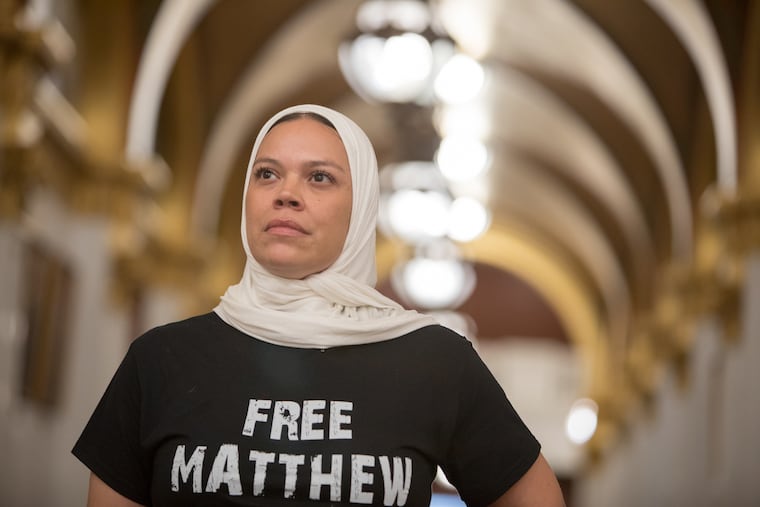
She told him about a poster she had printed to bring, with a photo of him holding Lil Mama and “FREEDOM” written in all capital letters. She had ordered a custom T-shirt, too, but it had not arrived yet.
“Will it come in time for Monday” for the trip to the Capitol? Garcia asked.
The call cut out before she could answer.
‘Do your job and legislate’
Magobet wore the T-shirt to Harrisburg two days later.
Beneath the Capitol rotunda, Magobet met Saleem Holbrook, the executive director of the Abolitionist Law Center, which represented Lee before the Supreme Court. He told Magobet he knew Garcia from their years in prison together.
“If there’s a person who’s earned being able to come home,” he said, “it’s Matt.”
In State Rep. Nikki Rivera’s office, Magobet read a speech from her phone. Her voice broke only once, when she told Rivera (D., Lancaster) that Garcia was her husband.
In the lobby of House Majority Leader Matt Bradford’s office, Magobet joined several others in a chant — “the time is getting late, do your job and legislate!” — that prompted the Montgomery County Democrat’s chief of staff to take Magobet and another person back to her office. The staffer had listened, Magobet said, promised nothing, and blamed the other side.
But Lil Mama made her laugh.
“The cat gets everyone,” Magobet said afterward. “We gotta get Lil Mama T-shirts for next time.”
Holding onto hope
Five weeks later, there was no next time to plan for.
Magobet learned that lawmakers adjourned July 12 without voting on the Democratic-sponsored measure she had supported, or the stricter Republican proposal.
She told Garcia on a phone call, and before the 15 minutes were up, he told her he couldn’t keep talking. It was the first time he had ever done that, she said.
A new measure, introduced by Democrats in an emergency session last week, did not earn a vote in the Senate.
The Supreme Court’s 120-day stay on new sentencings in second-degree murder cases expired on Friday, and judges can again hand out life sentences to people convicted of second-degree murder, but only in limited circumstances. But without a new law, there are no mandatory minimums or clear guidelines.
On Thursday, the Allegheny County District Attorney’s Office asked the high court to extend its stay until September, when lawmakers are scheduled to return to the Capitol. As of Friday, the court had not ruled on the request.
In the meantime, the next chapter will likely unfold in the courts for the more than 1,000 people already serving mandatory life sentences.
Bret Grote, an attorney with the Abolitionist Law Center who represented Lee in the Supreme Court case, said the high court has been asked in a separate case to determine whether the ruling applies retroactively.
He called the situation “a constitutional crisis.” But even under the most optimistic timeline, he said, a resolution could take years.
In the meantime, attorneys expect a wave of challenges from incarcerated people seeking relief. More than half of those serving the sentences are from Philadelphia.
Garcia said he will meet with his attorney to determine his next steps.
Magobet said she is holding on to hope — for the smaller things.
Walks together.
Coffee he brewed waiting for her in the morning.
Afternoons at a pool. (Garcia has not been in water deeper than a shower in nearly three decades.)
For months they talked about those plans as though they were approaching.
Now they wait. Again.