Budget likely to up taxes, lower everything else
MAYOR NUTTER is circulating a five-year budget plan that includes temporary sales- and property-tax increases, service cuts and projected union-contract savings, City Council sources tell the Daily News.
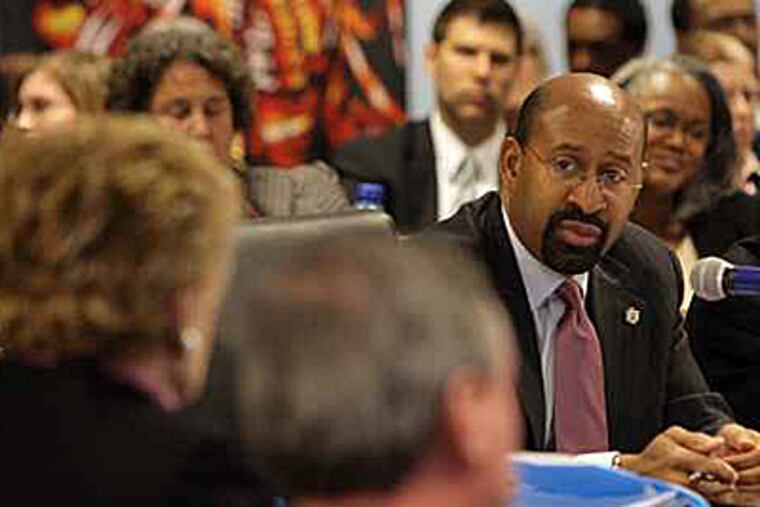
MAYOR NUTTER is circulating a five-year budget plan that includes temporary sales- and property-tax increases, service cuts and projected union-contract savings, City Council sources tell the Daily News.
The plan includes a three-year, 1-penny increase in the city sales tax, estimated to generate $335 million in revenue and a two-year, 17 percent increase in the city portion of the property tax, expected to bring in $272 million.
Property taxes are imposed by both the city and the school district with the city's portion amounting to 40 percent of a homeowner's tax bill.
Nutter, who is set to release his budget on March 19, must close a $1 billion shortfall over the next five years.
A longtime advocate of tax reduction, the mayor has made it clear that he wants to avoid wage- and business-tax increases.
Also included in the plan are $301 million in service cuts over five years, $254 million in savings through delayed pension payments and $125 million in anticipated employee-benefit savings.
There are a few steps the city would have to take to make some of these plans a reality.
Philadelphians pay a 7-cent sales tax on every dollar, with 1 cent going to the city and 6 to the state. An increase would need approval from the state Legislature and City Council.
The employee-benefit savings are contingent on contract negotiations with the unions representing nonuniformed city workers and on arbitration with the unions representing police and firefighters.
The primary plan under consideration by the administration also anticipates worsening economic problems. It reduces by $208 million the expected revenues over the next five years from taxes on business and real-estate transfers.
Service cuts would likely include reduced police overtime, cuts to the city vehicle fleet, a sliding fee structure at health centers and staff cuts in the mayor's office.
Nutter this week abandoned a proposed trash-pickup fee, which would have generated more than $400 million over five years.
Finance Director Rob Dubow declined to comment on the plan being floated among Council members, but stressed that the process isn't over yet.
"We're not done; we won't be done for a couple more days," Dubow said. "We're still working on what the budget is going to look like, but we have to get to the printer this week, so we're getting close to making decisions."
Some Council members expressed concern over the proposed tax increases. Others said that they wanted to see the proposals before making any decisions.
"If we trip him up, it will be ours," one member said of the proposed budget.
Nutter met yesterday morning with Council leadership. He declined to discuss details of the meeting, but stressed that Council must understand the economic peril facing the city.
"Change is hard," Nutter said. "But it also requires leadership. This is a time for elected leaders to lead. You have to do some things you don't like in bad times. You can't worry about your popularity."
The administration is also circulating a number of alternate options, which include either larger property-tax increases or more draconian service cuts.
One version reduces the temporary property-tax hike, but includes more than $400 million more in service cuts - ranging from layoffs of police recruits, possible deactivation of fire equipment and fewer trash pickups.
Another version gets rid of the temporary sales-tax increase, but massively increases the temporary property-tax increase, with a 26.6 percent jump in the next fiscal year.
None of the scenarios detailed to the Daily News touches the wage or business taxes. *