‘Mothball fleet’ of the Navy’s most embarrassing ships sits at Philly’s shipyard, hampering growth
Unwanted Littoral Combat Ships, aged guided-missile cruisers and destroyers, and former minesweepers are in the way of growth at the former Philadelphia Naval Shipyard.
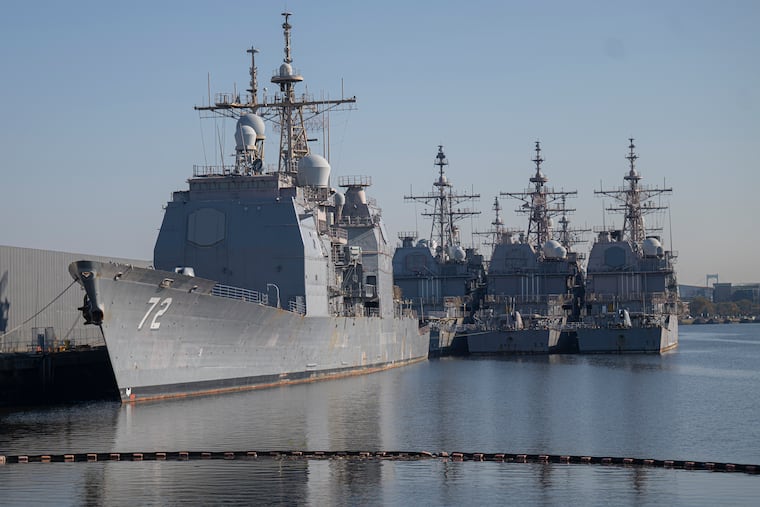
As Hanwha Philly Shipyard and Rhoads Industries seek to expand shipbuilding at the former Philadelphia Naval Shipyard, one obstacle is a moored flotilla of the Navy’s least-loved ships.
Built at a cost of billions, some were inactivated long before their projected retirement date. The “mothball fleet” of 25 ships sits in 30 feet of still water at the heart of the complex.
They are taking up wharf space, rusting more slowly in Schuylkill freshwater than they would in ocean saltwater, as they wait to be sunk or scrapped.
More than two years after Hanwha agreed to buy the heart of the former yard in mid-2024, the ship count hasn’t fallen.
Some supply and missile ships and patrol boats have been taken away — to be dismantled in Texas or sunk in Navy exercises in the North Atlantic — but others have arrived.
Four former guided-missile cruisers arrived in late 2024 and early 2025. Four former minesweepers were carried to the yard from Bahrain on a cargo ship in January, weeks before their base was wrecked by Iranian missiles. There are also former frigates, special-operations and supply and support ships.
The ships are moored in the Reserve Basin. This concrete-lined, three-sided harbor sits at the heart of the old yard, where a workforce of thousands built dozens of Navy ships and repaired more than 1,200 others. That work ended in 1995. The inactive ships and Navy design, testing and propeller facilities remain, mixed with private shipbuilders and other employers.
On the south side of the Reserve Basin sit four Freedom-class Littoral Combat Ships, designed by Lockheed Martin and built in Wisconsin at a cost of hundreds of millions of dollars each. When commissioned, one each year from 2015 to 2018, they were expected to give 25 years of service. But these vessels lasted just five to eight years until the Navy decommissioned them because they worked poorly and cost too much to fix.
The old ships are secured just offshore from prospective shipbuilding sites, including ground Hanwha leased in September from the Philadelphia Authority for Industrial Development to make way for modern shipbuilding works.
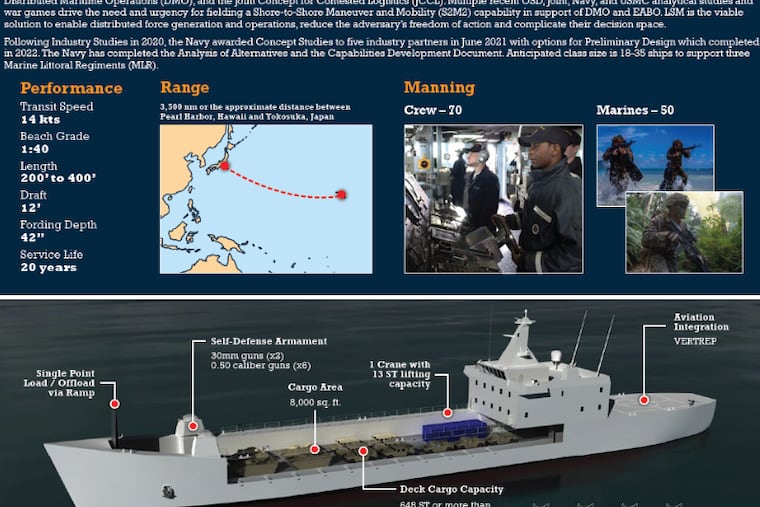
The Hanwha group, which bought the core of the old shipyard for $100 million from Norway-based Aker ASA in 2024, says it plans to invest an eventual $5 billion upgrading Philadelphia facilities. Construction manager Tote Services is scheduling work on the first of a possible three U.S. missile-tracking ships at the Philly yard, and Tote plans to use the yard to build at least one of the new landing ships ordered by the Navy and Marine Corps.
Hanwha is also bidding to buy additional shipyards, such as the Austal yards in Alabama.
The Korea-based, family-owned company’s goal is to boost Hanwha Philly Shipyard production, from its recent pace of about one ship every eight months, to one every few weeks. That would make the yard profitable, use workers and equipment more efficiently, and help meet U.S. government demand for a domestic-shipbuilding revival to face China’s expanding fleets.
Hanwha’s Philadelphia workforce counts around 2,300, up from around 1,800 workers, contractors and apprentices under the previous owner Aker.
Hanwha officials have said they hope to eventually employ 4,000 or more at the yard. The company is training welders and operators, and federal funds and bank financing is flowing to area community colleges and nonprofits for more training.
Hanwha says its Hanwha Defense USA unit will soon be the yard’s controlling owner, taking over from Hanwha’s electronics group, Hanwha Systems.
Family-owned Rhoads employs around 700 at its neighboring repair and construction works and expects to double that number as it expands its facilities and speeds production of nuclear-submarine modules for General Dynamics.
Hanwha has invested $350 million since 2024 in updated welding, painting and training equipment, plus “collaborative” robots, at the Philadelphia yard, spokesman James Hewitt confirmed.
Hanwha plans to invest an additional $400 million in reactivating and updating a second dry dock, replacing the training center, and adding new production sites so it can build more ships simultaneously.
Hanwha is already demolishing a decades-old industrial shed on the south side of the Reserve Basin, onshore from where two rows of three “inactivated” Navy guided-missile cruisers have accumulated since 2023.
The Navy has been using some of its Reserve Basin ships to “harvest” spare parts, but “most of that can be done in other places and doesn’t require holding onto the pier,” Tom Anderson, president of shipbuilding for Hanwha Defense USA, said in an interview last year. Moving the ships “is in line with the mission of getting ships built.”
End to end, the line of inactivated Navy ships sent to the Reserve Basin, and those departing to be scrapped or sunk in training exercises, since Hanwha arrived, would each total more than half a mile, not counting additional room needed to moor them.
The Reserve Basin is about a mile long, from the waters of the Schuylkill below the I-95 Girard Point Bridge, to a concrete bulkhead protecting South Broad Street.
Since Hanwha agreed to buy the yard, the Navy hasn’t been moving ships out of Philadelphia faster than it’s moving more ships in, according to a review of naval records. The Navy has had smaller squadrons of inactive ships at other facilities in Washington State and Hawaii.
Hanwha has met with the Navy and “is working closely” with the service “regarding the best use of space,” said Hanwha spokesperson Rob Loveless.
The most recent departures among the Philadelphia ghost fleet were the former USS Vicksburg, a guided-missile cruiser sent to be scrapped in Brownsville, Texas, in August. The Navy spent over $500 million on an overhaul of the ship that still didn’t make it service-ready and gave up two years ago. The ex-USS Klakring, a guided-missile frigate, was towed out to be sunk in a training exercise called Operation Atlantic Thunder last month.
Asked if the Navy has plans to move inactive ships from Philadelphia so Hanwha and Rhoads can more easily increase production, a Navy spokesperson pointed to a document appended to the Navy’s May shipbuilding report to Congress.
The document listed plans to “inactivate” an average of eight ships a year in each of the next four years.
The Navy didn’t respond to queries about how many additional ships it expects will join their mothballed sisters in Philadelphia.
Staff writer Jake Blumgart contributed to this article.