Affordability and democracy are inseparable. Democrats need to see that.
President Franklin D. Roosevelt exemplified how addressing economic suffering was essential to avoid extremist philosophies like fascism becoming attractive to Americans.
Democrats have settled on affordability as their midterm message.
This laser-like focus makes sense after 2024. Issuing warnings about the risk President Donald Trump and Republicans posed to democracy was ineffective for reaching swing voters focused on the cost of living.
But now they’re missing something important: affordability and democracy are inseparable. It’s true that for decades, Americans have heard politicians extol the virtues of democracy as a political system, while claiming that there is little they can do to provide economic help like access to secure jobs or reasonably priced essentials, including housing, food and energy.
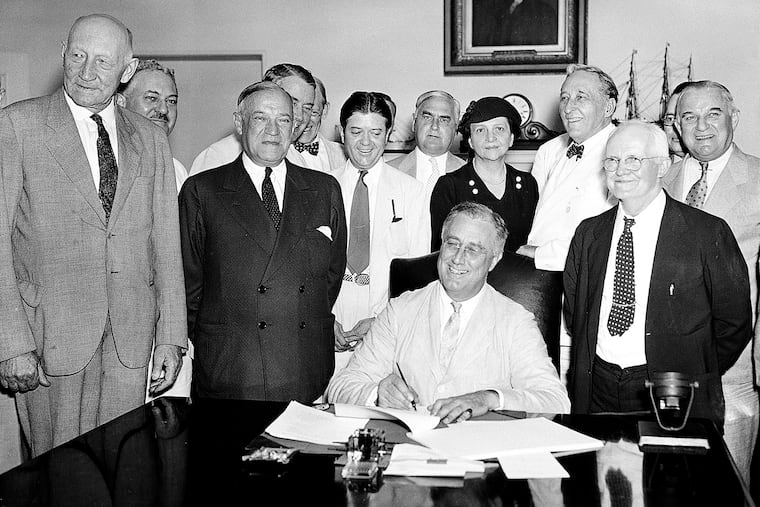
Yet, this bifurcation ignores the success of America’s longest serving president. Franklin D. Roosevelt grasped that democracy and economic security were intertwined. He built his presidency on the conviction that breaking with economic orthodoxy was a key aspect of what he called the “arsenal of democracy.” If people were suffering economically, it made them susceptible to the lure of demagogues who posed a dire threat to democracy.
In 1933, Roosevelt inherited an economy in free fall. Thousands of banks had collapsed, factories stood empty and unemployment was at staggering heights. A deflationary spiral seemed to leave no escape from what became the Great Depression.
Roosevelt understood that the Depression posed grave dangers to democracy. He needed to look no further than the rise of authoritarianism in Germany to recognize the risk. The Nazi Party had gone from receiving 2% of the vote in the 1928 general election to getting roughly 38% in 1932, making it the largest political party in the Reichstag.
Austerity politics played an important role in this sudden rise.
When Heinrich Brüning of the Center Party became chancellor in 1930, Germany’s economy was already burdened by high reparation payments for its World War I losses under the Treaty of Versailles. It had also fallen victim to the global fallout from the 1929 Wall Street crash along with the implosion of global trade that left rapidly shrinking export markets. Brüning responded by imposing emergency decrees cutting spending and hiking taxes to balance the budget. He failed to secure support in the Reichstag, but Germany’s business elites and orthodox economists cheered him on.
The results were disastrous — the economy collapsed, unemployment surged and living conditions deteriorated. Brüning became known as the “Hunger Chancellor.”
Adolf Hitler capitalized on Brüning’s disastrous economic policies. He fashioned himself a critic of austerity, asserting in a mass-produced pamphlet, “Although that was not the intention, this emergency decree will help my party to victory, and therefore put an end to the illusions of the present system.”
Meanwhile, at this critical crossroads, the Social Democrats endorsed Brüning’s fiscal onslaught under the leadership of Rudolf Hilferding, a famous Marxist economist. Hilferding believed that the contradictions of capitalism could not be resolved by government spending and supported sticking to the gold standard.
The center and the left consciously chose to ignore alternative options: the “Lautenbach Plan,” which called for issuing several billions of Reichsmark in credit for public works, and the Woytinsky Plan, a public employment program that union economists had developed, which aimed to create one million public works jobs and revive the economy through deficit spending.
In the U.S., Roosevelt’s predecessor, Herbert Hoover had followed a script similar to Brüning’s — raising taxes and cutting federal spending in 1932 even as unemployment climbed toward 25%. This left the country on a precipice of its own as the new president entered office.
Roosevelt recognized that fascist thought was in the air in the United States, too. The media mogul William Randolph Hearst printed columns by Hitler and Italy’s Benito Mussolini arguing that fascism was needed to oppose communism, a sentiment widely shared by the American public in the years around Roosevelt’s inauguration in 1933. The argument was that only a strong authoritarian hand could maintain order and protect property against the threat of communist revolution; democracy granted too much power to the masses.
Hearst’s newspapers carried the masthead “America First.” Antisemitism was rampant. Unambiguous fascists paraded in the uniforms of their European counterparts.
Roosevelt knew that allowing economic suffering to progress any further risked going down the German road. And so, he embarked upon a mission to use his first 100 days in office to demonstrate that democratic states could act in the interest of the people.
Roosevelt was not a theorist but he corresponded with famed Cambridge economist John Maynard Keynes about how to save civilization.
Keynes had predicted in The Economic Consequences of the Peace that the Treaty of Versailles, though it settled World War I, would push Germany into ruin. Economic insecurity would then create the breeding ground for extremism. He noted that “economic privation” would proceed largely unnoticed “until the limit of human endurance is reached.” That was the point, he argued, when the “power of ideas is sovereign,” and the deprived masses would listen “to whatever instruction of hope, illusion, or revenge is carried to them in the air.” That instruction might very well take the form of fascist demagoguery or nationalist scapegoating.
Roosevelt set out to take bold action before the U.S. reached that tipping point.
The new president was prepared to break with economic orthodoxy. “I took economics courses in college,” he once said, “and everything I was taught was wrong.” The New Deal started from the premise that when people were unemployed and factories lying idle, government spending could solve both problems by employing the workers at the idle factories. It would end the crisis and create prosperity.
Accordingly, Roosevelt set about creating new large-scale programs to provide economic relief. Through bold interventions such as the Federal Emergency Relief Act and the Civilian Conservation Corps, the Roosevelt administration directly provided employment for millions of people who would produce goods urgently needed by the impoverished masses — food, blankets, shelter — and build public infrastructure such as bridges and roads that would serve millions of people every day.
Roosevelt’s agenda centered on the public provisioning of essentials but also encompassed the arts. The Works Progress Administration’s arts projects put tens of thousands of painters, writers, musicians and actors to work, staging free performances in cities and small towns, and painting the murals that still hang in post offices and schools around the country.
Public job creation also lifted up the private economy. Public workers spent their paychecks, and their money created demand for private business and jobs.
Yet, the New Deal did much more than create government jobs. The National Industrial Recovery Act set wages, empowered workers to unionize and planned large segments of investment.
Together these measures amounted to a fundamental reshaping of the economy, shifting power away from capitalists and toward workers and the state, establishing the principle that the public good should drive economic life. For-profit companies should serve the public, not the other way around. In doing so, the New Deal built the federal administrative state.
The contrast between Roosevelt’s decisions and Germany’s fate show just how important understanding the role of economics in politics can be.
The lesson for Democrats from one of their most revered presidents is clear: pushing an affordability agenda is fighting to safeguard democracy. But to be successful, they have to break with profit fundamentalism and build an economy in which everyone can make a living.
In 1944, Roosevelt himself called for an economic bill of rights as key to his vision for a lasting postwar order. They included, among other things the right to a job that paid enough to afford necessities, the right to a “decent home,” the right to medical care and protection from “the economic fears of old age, sickness, accident, and unemployment.”
In pushing for economic rights, the president wrote, “If history were to repeat itself and we were to return to the so-called ‘normalcy’ of laissez faire capitalism — then it is certain that even though we shall have conquered our enemies on the battlefields abroad, we shall have yielded to the spirit of Fascism here at home.”
This vision should still be the North Star in fending off today’s threat of extremism. A focus on affordability is exactly what is needed amid a cost-of-living crisis and seems likely to deliver an election win for the Democrats. Yet, while short-term relief is crucial, sustaining democracy long term will require breaking with economic orthodoxy and finally achieving Roosevelt’s vision of economic rights.
Isabella Weber is the author of Anti-fascist Economics: In Defense of Affordability, Dignity and Democracy and an associate professor of economics at the University ofMassachusetts Amherst.
Made by History takes readers beyond the headlines with articles written and edited by professional historians. Opinions expressed do not necessarily reflect the views of The Inquirer.