Philly’s Mexican bakeries are whipping up pan de muerto, or bread of the dead
As Día de los Muertos approaches, pan de muerto has started to pop up on menus and bakery shelves.
If you peruse the shelves of a Mexican bakery or grocery store this weekend, you may happen upon rounds of brioche-like bread covered with white sesame seeds, coated in sugar (maybe dyed pink or red), decorated with strips of dough that form a knobby X pattern, and often scented with orange blossom water.
It’s pan de muerto, or bread of the dead, a traditional sweet bread to celebrate Día de los Muertos, the Mexican holiday observed every year on Nov. 1 and 2.
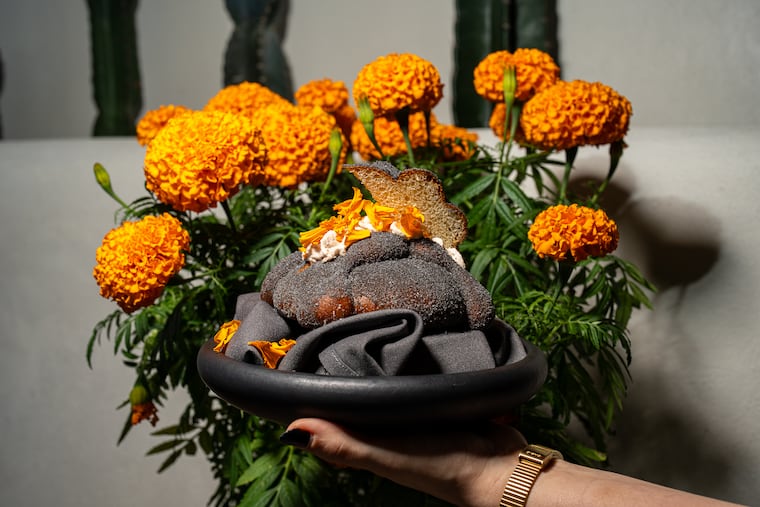
Traditional pan de muerto — round loaves with rolled strips of dough pressed onto their glossy tops in a cross pattern — are meant to evoke skeletons. (The central knob of dough symbolizes a skull, while the pink or red sugar scattered over the bread’s surface represents the heart and blood of those sacrificed in pre-Hispanic rituals.) The bread can come in individually sized buns or large, wheel-sized loaves.
You can of course eat pan de muerto right away, but it’s also placed on ofrendas (altars) decorated with marigolds, candles, and pictures of the deceased first, before being eaten.
Amigos Bakery makes pan de muerto at its two South Philly locations (1155 S. Ninth St., in the Italian Market, and 2327 S. 12th St., just south of Wolf Street). It’s part of the 12-year-old bakery’s traditional repertoire — they’re a neighborhood go-to for tres leches cakes and fruit-studded Rosca de Reyes bread.
At Amigos, the small, palm-sized loaves are shiny and sprinkled with sesame seeds. You’ll find them in the bakery case, along with happy face-decorated cookies and small cakes. They also make a sugar-coated variety in larger loaves that must be preordered.
In Mexico City, pan de muerto is scented with orange blossom water, though many different flavors and ingredients can be found in regional variations across Mexico. Pan de muerto also can often incorporate cempasúchil, or marigolds, which are central to Día de los Muertos: The flowers are believed to guide the souls of departed loved ones back from the spirit world to the living, to visit their family members. The flower petals also used as culinary ingredients.
Juan Carlos Aparicio, chef-owner of El Chingón, is baking cempasúchil-flavored conchas this weekend only, then switching to pan de muerto on Monday, Nov. 2. The bread will be available every weekend in November at the original El Chingón in South Philly, at 1524 S. 10th St.
Frankie Ramirez, the executive chef and co-owner of Amá, goes all out for Día de los Muertos, baking loaves of pan de muertos in various sizes, both as a menu special and as adornment for the ofrenda that takes over Amá’s lounge area. (Ramirez and his staff will start to build the altar on Saturday night; it will be complete by 5 p.m. on Sunday).
Last year, Ramirez baked 30 large loaves that sat on the ofrenda — then went home at the close of the holiday with very pleased staff members — and 30 smaller ones stuffed with chocolaty champurrado cream as part of a tasting menu.
This year, he will be serving pan de muerto as an a la carte special. “We do a traditional brioche with flour, sugar, butter, milk, yeast, and eggs, and infuse the dough with agua de azahar — or orange blossom water — and orange zest,” said Ramirez, who proofs the dough overnight. “Then we brush them with clarified butter and coat them with totomoxtle ash, which we make from burnt corn husks, tortillas, or canela [cinnamon].”
Ramirez plans on playing around with other flavors like butter-pecan this year, too.
Ramirez’s first job, at age 12, was at the erstwhile San Carlos bakery in Mexico City. “I started out by cleaning the floors, then the sheet pans, and then little by little they let me help shape the masa,” he remembers. “And then on holidays, the huge days, everyone would work overnight to make pan de muerto for Los Pinos [the historic official residence of the president of Mexico].”
Ramirez took what he learned about baking pan de muerto at San Carlos and has brought it to all the kitchens he has worked in, including Parc, LMNO, and finally, his own at Amá, baking the breads for his fellow staff every year for Día de los Muertos.
It’s a joyful, delicious way to remember those who have passed. “I’m not a baker,” said Ramirez. “But I absolutely love making pan de muerto.”
Inquirer Food Festival
Get your ticket to Philly’s ultimate food party! Join top Philly chefs and bakers for one unforgettable day of food.