Art: Of sailing ships, the sea and its creatures
A wave of "marine art" at Noyes Museum stretches the form beyond its usual limits.
As practiced today by members of the American Society of Marine Artists, the painting of ships and the sea has evolved dramatically since the Dutch invented the genre nearly four centuries ago.
Initially, "marine painting" consisted mainly of ship portraits, meticulously accurate in terms of rigging and how the vessels made headway in heaving seas and blustery winds. It was only natural that this specialty should be developed by the seagoing Dutch, whose patrons tended to be shipowners, naval officers, and wealthy ship captains.
Traditional marine painting continues to flourish among artists who enjoy depicting historic naval battles and creating flawlessly realistic images of famous ships or ship types. An exhibition at the Noyes Museum of Art of more than 100 paintings, sculptures and works on paper contains a generous sampling of ship portraits of a kind that would have been appreciated in 17th-century Holland.
Such pictures often are more interesting historically than aesthetically. For instance, the show includes a group of five warships, among them the American battleships Nevada and Arizona. The Nevada, painted by Richard Allison, is depicted under attack at Pearl Harbor. The Arizona is shown cruising at sea three years before it was sunk in the Japanese raid.
William G. Muller honors tradition in a more benign way, by painting a 19th-century paddlewheel passenger boat entering Narragansett Bay on its way to Providence, R.I., from New York. As with the warships, the artist's technique is fastidious, yet historical content, not bravura painting, creates the interest.
But if you're less than enraptured by this kind of painting, which seems to me mainly a male preoccupation, know that the exhibition is far from dominated by it. In fact, the artists on view have stretched the parameters of marine art so radically that some works seem only vaguely appropriate to the theme.
It would appear that "marine art" now can involve any subject even remotely connected with the ocean, or boats, or nature in the vicinity of the sea. The show includes pictures and sculptures of whales, lobsters, egrets, alligators and stingrays.
There are several pictures of boats without water, and more pictures of water without boats. The most enchanting of the latter is
After the Storm,
an oil of a roiled ocean under roseate clouds by Shirley Bicke'l Evans.
I was a bit surprised to discover a sizable cohort of women in the show because, as noted, I think of traditional ship portraits as the two-dimensional equivalent of model-making, which involves a dedication to getting the details perfect.
However, of the 15 or so women in the show, only one, Julie Sutherland, offers a classic ship portrait - an image of a 19th-century Gloucester fishing schooner in profile under full sail. It's an especially lush and poetic interpretation, particularly because of the richness of the deep jade-green water.
The other female artists, like many of the men, work the middle ground between portraiture and the more extreme expressions of "marine." These include sand-and-surf, or rocks-and-surf, coastal views; harbor scenes; pictures of individual boats, either in the water or on land; and pictures of sailboats under way, sometimes from unorthodox perspectives.
Most gratifying is the way many artists have worked to amplify the aesthetic dimension of what otherwise would be ordinary subjects, as Mary Louise O'Sullivan does in her oil of a bright green rowboat, the most humble of watercraft, floating on softly rippled water.
There's something in this traveling show, which occupies two of the museum's four galleries, for every taste and level of art experience. If you delight in crashing surf, glowing sunsets over the yardarm, and majestic sailing ships heeling in a stiff breeze, the Noyes delivers a satisfying holiday excursion.
Facing the camera.
Over the nearly 25 years that Bucks County resident Robert Infarinato has been collecting photographs, he has acquired more than 200, primarily portraits and almost all black-and-white.
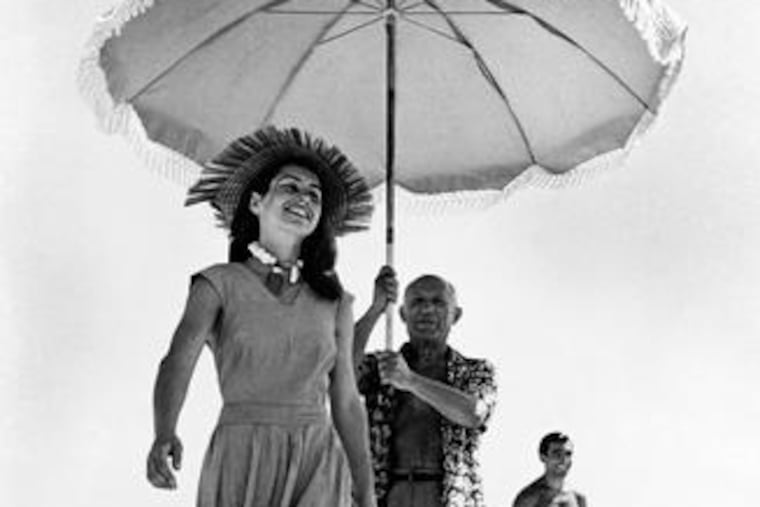
Many of these, as an exhibition at the James A. Michener Art Museum reveals, are celebrated images by famous photographers - Pablo Picasso walking on a beach with Francoise Gilot, by Robert Capa; Henri Matisse at home with his doves, by Henri Cartier-Bresson; and Georgia O'Keeffe in stark profile by Philippe Halsman being typical examples.
The Michener show, curated by Stephen Perloff, editor of the Photo Review, represents about a quarter of Infarinato's collection. It's all portraits, and not all the subjects are celebrities. This mix of the known and the unknown prompts one to recognize that a photo portrait can contain several layers of information.
For instance, a portrait such as Milton Greene's study of Marilyn Monroe sitting on a curb in peasant dress represents the convergence of three elements - the personality and/or fame of the sitter, the skill and fame of the photographer, and the viewer's experience and perceptual intelligence.
Some images, like the Picasso-Gilot, have become so familiar that the photographer's vision, or compositional luck, dominates. If you have seen this image many times, it doesn't seem to have anything left undiscovered.
Ultimately, this show poses the question, how much can we expect to extract from a single photograph? Do we learn more from a formal portrait, or from a casual or candid one? To what degree does our appreciation of a photo portrait depend on how much we know of the people on both sides of the camera?
Photographs in which both the subjects and/or the photographer are unfamiliar become the most useful in trying to determine what a portrait can communicate. Consider, for instance, a photo made by Jacques-Henri Lartigue of "the famous Rowe Twins of the Casino de Paris."
They were famous in 1929, perhaps, but not today. Lartigue poses them fashionably dressed and smiling, and standing next to a luxurious automobile. The photo piques one's curiosity, but also suggests that what we see is a staged performance.
A more contemporary portrait of a young African American girl, Kyia Jones, by Silvia Sensiper, provokes a similar response. It's a striking image, in large part because of the girl's unusual double-fan hairdo and serious demeanor. We search the image for information, but ultimately it's the confrontational boldness of her stance that holds our attention.
Each image invites its own set of questions: Why did the collector choose this photo? To what, exactly, am I responding, or not? Does the reputation of the photographer tend to override critical judgment? And finally, can any portrait really deliver anything significant, or do we respond primarily on the level of sensation, memory, or familiarity?
I realize, for instance, that Robert Frank's 1958 portrait of novelist Norman Mailer caught my eye not because both men are famous in their respective fields but because Mailer looks so young that at first I didn't recognize him.
This slice of Infarinato's collection includes a high percentage of artists, entertainers, writers, musicians and photographers. If this was Perloff's choice, it was a felicitous one: These concentrations impose a thematic consistency on the show, which otherwise might have felt fragmented.
"Saving Face" turned out to be a delightful encounter because a show of this kind could so easily have been a hodgepodge in terms of talent, subject matter and presentation. Much more than a celebrity parade, it offers viewers numerous opportunities to think seriously about the strengths and limitations of a popular art form.
Art: Boats, Portraits
The 30th anniversary exhibition of the American Society of Marine Artists continues at the Noyes Museum of Art, 733 Lily Lake Rd., Oceanville, N.J., through Feb. 22. Hours are 10 a.m. to 4:30 p.m. Tuesdays through Saturdays and noon to 5 Sundays. Admission is $4 general and $3 for seniors and students. 609-652-8848 or
» READ MORE: www.noyesmuseum.org
.
"Saving Face: Portraits from the Collection of Robert Infarinato" continues at the James A. Michener Art Museum, 138 S. Pine St., Doylestown, through March 15. Hours are 10 a.m. to 4:30 p.m. Tuesdays through Fridays, 10 to 5 Saturdays and noon to 5 Sundays. Admission is $6.50 general, $6 for seniors, and $4 for students and visitors six to 18. 215-340-9800 or
» READ MORE: www.michenerartmuseum
.
org.