Eat up, be well
The view of food as medicine is as old as Hippocrates. Fads confusingly come and go; healthy eating isn't as sexy.
Blame it on Hippocrates.
He's the one who said, "Let food be thy medicine and medicine be thy food," founding the food-as-medicine school of thought.
Were the great-great-grandchildren of this father of modern medicine (460-377 B.C) admonished to eat an apple a day? Did they feed a cold, or starve a fever?
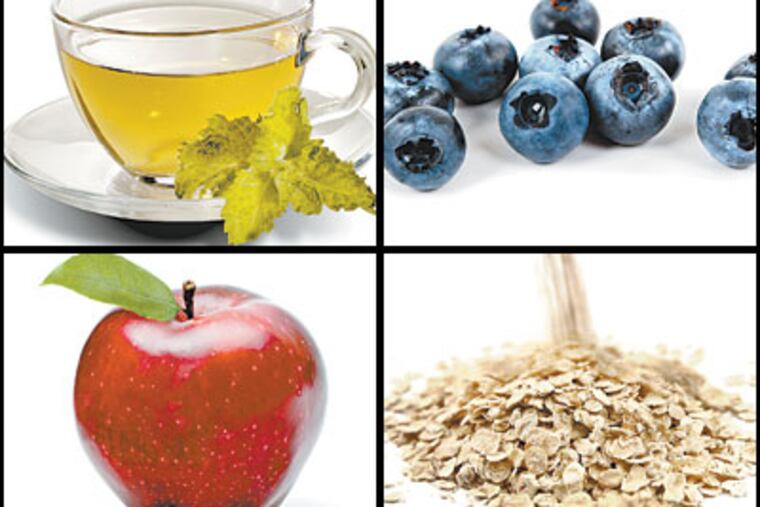
Those questions may remain unanswered, but we do know that these days marketing experts pitch food to us as either remedy or preventive. Oatmeal, green tea, dark chocolate, blueberries, pomegranates - instead of being savored for their flavors, they're swallowed for their presumed beneficial qualities.
Can't we just eat anymore?
We're told to eat fish, but only if the variety is not endangered or carrying a dose of mercury.
Some of us consciously stuff ourselves with fiber while others are on self-imposed eating plans (don't call them diets!) "free" of one ingredient or another (salt, wheat, fat).
And even as we strive to consume more fresh fruits and vegetables (less red meat and fewer processed foods), we wonder about the safety and sustainability of the food chain that brings those fruits and veggies to local markets.
Add it all up and in 2010 you could end up with a serious case of food confusion.
Even doctors and dietitians disagree about which foods to eat and which to avoid.
At one end of the spectrum we have Ann Louise Gittleman, a dietitian/author whose Flush books (Fat Flush for Life, The Gut Flush Plan), advocate detoxifying diets to rid the body of toxins and boost metabolism for permanent weight loss. And she sells millions.
Gittleman, who suggests probiotics and a gluten-free existence for all, is also a strong proponent of what she calls the DIY approach to diagnosing digestive problems.
"I don't think you have to go to all the trouble" of seeing a physician, Gittleman said in a recent telephone interview. "The good old elimination diets that allergists used to do years ago can be very fitting today."
She is not alone in her food-as-medicine mantra, of course. The self-proclaimed Chef M.D., physician John La Puma, champions the idea on Lifetime Television and in his Big Book of Culinary Medicine (Three Rivers Press, 2008).
Meanwhile, Joanne Linevsky, a gastroenterologist, is among doctors who spend the bulk of their time treating patients and almost none writing self-help books.
"Most fortified things are a gimmick," Linevsky said in a recent telephone interview. "You will urinate most of those vitamins and nutrients right out. So unless you are deficient in something, which most people are not, eating fortified foods is not going to be helpful."
"One size fits all" isn't true for most clothes, and Linevsky says it doesn't work for food choices, either.
Don't swill soy milk regardless of whether you've been tested for lactose intolerance, she says. And don't assume high-fiber is good for all.
High-fiber meal plans are not recommended for people with Crohn's disease, for example. And if diverticulitis is the problem, Linevsky says, a product such as Metamucil may be a better choice because it offers fiber in a more accessible form.
She's particularly frustrated by patients who go on self-imposed gluten-free diets.
"That's the big one, the celiac disease issue. That's what I think is the biggest trend in foods now."
"Maybe a gluten-free diet will help you, but I can't do a proper diagnosis of your problem if you are self-medicating by adding or subtracting foods."
As a nation of overweight, under-exercised individuals, we should know better because we've made food-as-medicine mistakes before by listening to advertisers. Did we not jump on the fat-free bandwagon in the 1970s and end up fatter than before?
In the span of five years, soy went from super-ingredient to breast-cancer trigger (because it might interfere with the drug tamoxifen) and back to breast cancer preventive.
Confused? Just last week my mailbox included a plea (from the makers of SoyJoy) to remind readers of soy's benefits - and the announcement of a new book, The Hidden Dangers of Soy.
"You can read three different studies," Linevsky says, "and get three different answers."
The culprit in all that confusion may not be soy itself, or the research studies per se. No, it seems the real culprit is good old American overindulgence. We just don't understand how to do anything in moderation and neither, it seems, do food manufacturers.
Green tea, for example, is high in Vitamin K (a good thing) but can interact negatively with the drug Coumadin. The problem is that the amount of Vitamin K in different brands of green tea can vary widely, so we don't really know what we're getting, says Andrea Spivack, a registered dietitian with the the Stunkard Weight Management Program at Penn Behavioral Health.
Her advice is to eat a balanced diet, get diagnostic workups where indicated, and seek individualized nutrition counseling and then group support to help you stick to whatever plan is right for you.
None of that is startling enough to warrant a best-seller.
Spivack recommends two Web sites as reliable: the National Institutes of Health site, Medlineplus.gov, and Eatright.org, which is the site of the American Dietetic Association.
"Eating right takes planning and consistency," Spivack says. And most often that burden falls on mothers.
"We've noticed that when mom is eating more healthfully, it makes the whole family eat better," Spivack says.
In the end, some ailments, such as diabetes and high blood pressure, can be prevented (and to some extent, treated) with diet and exercise, Spivack notes.
So, if huge numbers of healthy individuals reduced their intake of refined sugar, processed foods, carbohydrates, chemicals, and preservatives while increasing consumption of fruits and vegetables, that would be seen as a public health triumph.
And maybe then we wouldn't have to endure detox.