Mayor Nutter is deluged with visitors
On his first full day in office, as he hosted the City Hall open house that drew thousands, Mayor Nutter extended an invitation.
On his first full day in office, as he hosted the City Hall open house that drew thousands, Mayor Nutter extended an invitation.
"This is the people's hall, and I want them to know that they are welcome here, that I am listening," he said at the time.
The people are RSVP'ing in droves.
Civic groups, nonprofits, business leaders, pastors and activists have been banging on the doors of City Hall in huge numbers since Nutter took office, each pitching a program, pleading a case, or simply trying to connect to the new administration.
"I think we're all a little shell-shocked by it," said Everett Gillison, the deputy mayor for public safety, whose 14-hour days are crammed full of public appearances and sit-downs with an array of Philadelphians.
The early days of any new administration are busy, but the public clamor for face time with Nutter and his lieutenants has taken even veteran public servants by surprise.
"There is an amazing hunger out there, folks who want to talk to and touch base with the administration," said Rina Cutler, the deputy mayor for transportation and utilities. "I've truly never seen the phenomenon before, and I've worked for seven mayors in three different cities."
Leaders of local civic groups and nonprofits say there is a widespread perception that city government is more welcoming now than it was in the waning days of the Street administration, when senior staff defections and Mayor John F. Street's retiring ways left many feeling there was little point in bringing their concerns to City Hall.
"I didn't feel like I had the same access in the last administration. I didn't feel as welcome," said Sharon K. Easterling, executive director of the Delaware Valley Association for the Education of Young Children.
In areas like transportation and planning, the Street administration in its late second term simply did not
have
senior officials with real clout available to meet with community groups.
"The trouble was with accessibility to people who could make decisions. And the reason we didn't have access to those people was because they didn't exist," said Alex Doty, executive director of the Bicycle Coalition of Greater Philadelphia, noting that there was no transportation office in the Street administration.
Nutter has changed that by restructuring city government. He created four deputy mayor positions and endowed them with broad policy and operational authority that stretches across departments. Past administrations had deputy mayors as well, but they were not given as much decision-making power, Nutter said.
"There have been a lot of people in this city who just wanted to talk to someone with authority, and that's what the deputy mayors have," Nutter said. "It allows me to seemingly be everywhere."
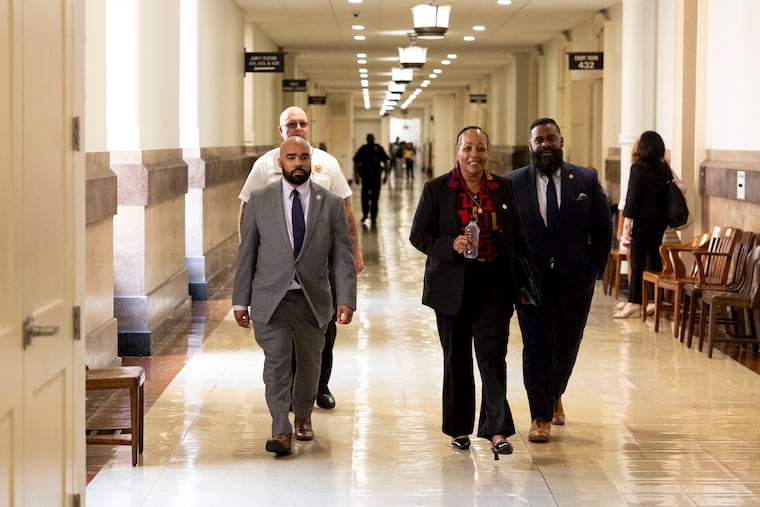
For instance, Gillison, the deputy mayor for public safety, met with 21 community groups and nonprofit organizations last week, many at neighborhood sites. On Thursday alone, he chatted with an antidrug activist, urged black clergy members at a West Philadelphia breakfast to support a new "peaceful surrender" program, and heard out early-childhood-education advocates and a lawyer who wants to create a "Parenting Court."
It was, if anything, a light day, Gillison said.
"You got to walk quick," he said, observing that his schedule is often too full to accommodate travel time between appointments.
It is much the same for the other deputy mayors. Andy Altman, whose massive portfolio includes commerce, economic development and planning, likened the public demands on his schedule to "drinking from a fire hose."
"I think we're all trying to be as accessible as we can," Altman said from his cell phone, as he rushed off to yet another community meeting. "I think we all feel it's important for people to see that you're engaged, that you're not in your office behind your desk."
So far, that approach seems to be working.
"We are over the moon. In terms of accessibility, we have nothing but absolutely great things to say," said Doty, the Bicycle Coalition executive director.
His organization got a meeting with Cutler three weeks before she'd officially joined the Nutter administration. Since then, Doty said, Cutler has spoken at the Bicycle Coalition's annual meeting and broken through a bureaucratic logjam that had prevented the launch of a biking-safety program.
Shawn Jalosinski, executive director of the Sports Complex Special Services District, said his organization was getting higher-level attention from City Hall now than it had since the new stadiums went up in 2003 and 2004.
And former Gov. Mark Schweiker, now president of the Greater Philadelphia Chamber of Commerce, said his members also seemed happy with the administration's openness.
"I haven't heard any complaints, and I would have if accessibility was a problem," Schweiker said, noting that Nutter's entire cabinet showed up at a chamber event last week.
Other civic leaders, including clergy members, urban planners, and neighborhood association volunteers, were similarly impressed by the Nutter administration's accessibility.
The question is: Can Nutter and company keep it up? The relentless public schedules clearly are already taking a toll on the deputy mayors (Cutler called the pace "exhausting"). But it is just as clear that Nutter doesn't expect them to cut back anytime soon.
"I'm out there a lot, and I want them out there, too," Nutter said. "This is a full-contact, full-engagement type of government. We want people to know who we are and what we're about."