The strange juxtaposition of Berlioz, Britten, Debussy
Do the musicians of the Philadelphia Orchestra want to play well for Christoph Eschenbach? That's always seemed like a germane question with an elusive answer, but the portrait of a relationship grew slightly more clear during Thursday night's strange juxtaposition of Berlioz, Britten and Debussy.
Do the musicians of the Philadelphia Orchestra
want
to play well for Christoph Eschenbach?
That's always seemed like a germane question with an elusive answer, but the portrait of a relationship grew slightly more clear during Thursday night's strange juxtaposition of Berlioz, Britten and Debussy.
There are, of course, places where it's impossible to know what Eschenbach is asking for. I am thinking mostly about transitional tissue, when the music is making the shift from one section to the next, and the tempo slows to a wobbly mess.
But then there are times - in Thursday's La Mer, for instance - when the orchestra seems to be so deeply in love with its own sound that musicians take matters into their own hands and could just as well be saying "Conductor? What conductor?"
This was a lovely La Mer, if not a highly evolved one on the interpretive scale. Eschenbach seems to see the work less as a sea picture than as a mirror - of how the sea makes him feel, which is to say sensuous. Often this meant an ensemble in less than fully first-rate form, though once again no one could blame the conductor for a piccolo tone more air than pure pitch. But the total ensemble sound was aglow with refined energy.
Debussy's Ibéria was mostly notable for some astonishingly effective woodwind playing in the second movement: Richard Woodhams' masterly oboe, and Daniel Matsukawa's brief, eerily high transformation of his bassoon sound into something alarmingly more naturalistic than one expects to hear emanating from an orchestra.
The Berlioz Roman Carnival Overture had the usual blaze of brass at the end to make the audience cheer, but Elizabeth Starr's dispassionate solo only made me miss the deep sound and expressive turns of retired English hornist Louis Rosenblatt.
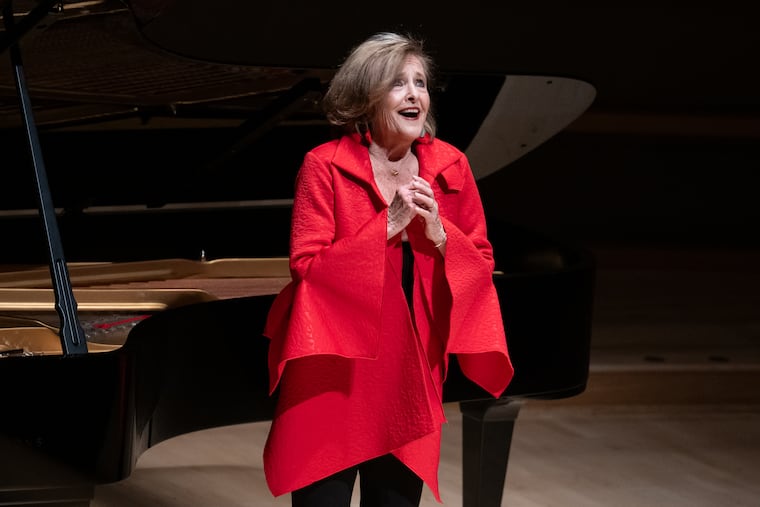
Midori brought with her Britten's Violin Concerto, Opus 15, an endlessly fascinating work for its strongly anti-cliché tendencies. Just from the cadenza - played with great intensity by the violinist - through the end of the piece, there's more substance to be mulled than in some entire violin concertos.
What's so great about it? An orchestra part of surprises, for one. The three trombones that come in at the end of the cadenza are exactly what you would not expect and, you realize, exactly what your ears want to hear at that moment. That the entrance was handled with such suddenly present surety by Matthew Vaughn, Eric Carlson and Blair Bollinger made the scoring decision sound even smarter.
The other aspect of the work that gives it greatness is its emotional ambiguity. To the end, which resolves only very reluctantly, the music makes you feel strongly - you're not always sure how.
Just one example: Britten in one passage argues that it's possible to feel totally defeated, even as triplet figures bubble beneath the surface, pulsing desire back to life.
Read his blog at http://go.philly.com/artswatch.
Additional performance:
At 8 tonight at Verizon Hall,
Broad and Spruce Streets.
Tickets are $10-$123. Information: 215-893-1999
or www.philorch.org.