The micro Museum of the Philadelphian celebrates Philly’s macro personality
The 300-square-foot temporary museum in Fishtown is an absurd and heartwarming love letter to the people who make Philadelphia, Philly.
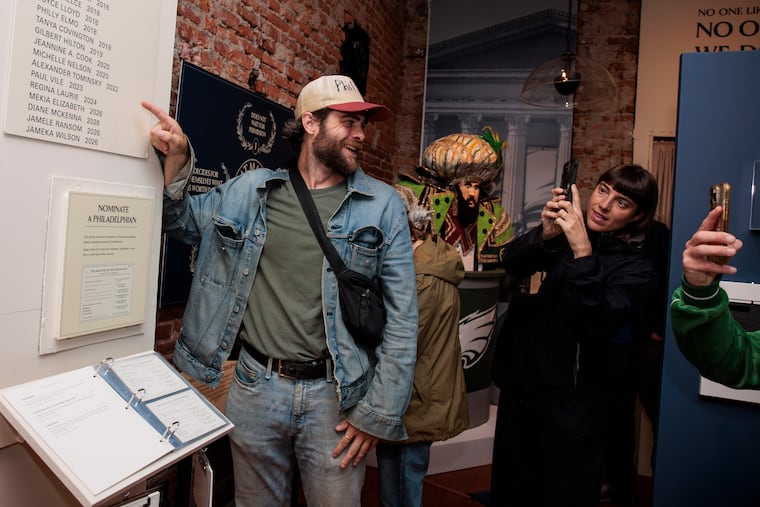
Alexander “Chicken Man” Tominsky walked into the Museum of the Philadelphian in a Canadian tuxedo and a baseball hat with “Phillies” handwritten on it in marker on Tuesday and was blown away to find his name on a plaque alongside other local legends like Benjamin Franklin and Philly Elmo.
“No way! Oh my gracious! Who would have known when I was a little kid crying in my pillow something like this would happen,” he said, pointing to his name.
Tominsky — who became renowned throughout the land in 2022 for eating 40 rotisserie chickens in 40 days, culminating with a public noshing of a chicken on an abandoned Walmart pier in South Philly — was invited to a preview opening for the museum by its founder and creator, Brian Adoff.
“The museum is about the personality and attitude and conduct of Philadelphians,” Adoff said. “My personal hope is that you leave inspired to really be the best version of yourself, the best Philadelphian you can be.”
Located in a 300-square-foot storefront that was previously Adoff’s office on East Girard Avenue in Fishtown, the free, temporary “micro museum” is just down the road from another Philly landmark — the “I Hate Bank of America” sign. The large, yellow banner was put up by a homeowner in 2007, after the bank branch across the street ticked him off. The branch closed many years ago, but the sign remains, a grand tribute to Philadelphians’ spite.
What makes Philadelphians this way? And what makes it so oddly endearing? These are questions Adoff explores in his absurd and unexpectedly heartwarming museum, which opens Friday.
“There’s an emotional narrative arc the museum takes in its 300 square feet, where it ends with literally a book of Philadelphians who exhibit five qualities that I’ve determined, with my crack team of curatorial advisers, that make up a Philadelphian,” Adoff said.
As of a student of the Philadelphian who’s written hundreds of profiles of the everyday people who make me love this city more every day, I thought Adoff had set a lofty goal for himself when we first met earlier this month. How do you distill what it means to be a Philadelphian in 300 square feet? And how do you decide who makes the cut?
At the preview Tuesday, I was pleased to find that over the course of about 20 exhibits in the space, Adoff skillfully addresses the Santa-hating-battery-throwing-robot-killing tropes that haunt Philadelphians, while also getting to the oddly-touching truths behind those, and other very Philly stories.
And while Adoff and his team have compiled a “Register of Philadelphians” with more than 50 names and stories of local folk heroes who epitomize what it means to be a Philadelphian, their best decision may have been to include cards for visitors to nominate their own quintessential Philadelphian. Because if one thing is certain, it’s that Philly is going to have thoughts.
Grease the pole
Guests are greeted in the museum’s front window by a recreation of the death of hitchBOT, the hitchhiking Canadian robot who traveled across the country on human kindness, only to be dismembered and beheaded in Philly. In the accompanying plaque, Adoff notes that Philadelphians offered to rebuild the robot, and that a Philly police detective jokingly blamed the crime on New Jerseyans.
Once inside the museum, two large papier-mâché sculptures immediately catch the eye — one, of a Philadelphian climbing a greased pole, and the other of Jason Kelce during his Eagles Super Bowl speech. In the first, guests are invited to “grease the pole” with a paintbrush and clear goo from a nearby can (you know I did it!), and at the latter, visitors can stand under a sound dome (fancy!) in front of the sculpture to hear Kelce’s “Hungry Dogs” speech.
In the center of the room is a freestanding wall with a rearview mirror on it. The accompanying plaque tells the story of Ted Passon, whose parked car was flipped in the aftermath of the Phillies 2008 World Series win. Passon created a blog asking Philadelphians who enjoyed the spectacle to help pay for his vehicle, and through the generosity of donors he was able to get a new car and give $3,000 to someone else whose car was flipped. On an iPad at the exhibit, visitors can play a YouTube video of the flipping and read Passon’s blog.
I remembered the story well because I interviewed Passon about it in 2008. Seeing him at the event Tuesday was a full-circle Philly moment for both of us. Passon, who’s now an Emmy Award-winning documentarian, said he was happy to loan the mirror of the vehicle Philly claimed from him to the museum.
“It’s an honor to be included in the story of Philadelphia,” he said. “If I can be a footnote in the city’s history, I did something right in my life.”
‘Booing is my love language’
Other exhibits explore Philadelphians’ history with booing, our history of throwing things, and the five qualities Adoff and his team have decided make a Philadelphian, with number one being, “Does not wait for permission.”
The “Register of Philadelphians” on the wall and accompanying detailed book begins in 1731 with Benjamin Franklin and ends this year, with Jameka Wilson, the woman who went viral for her TV interview about kicking a man in a Chucky mask who was terrorizing pedestrians.
I was excited to see a couple people I’ve written about on the list, including Paul “Jelloman” Vile and the late Gilbert Hilton, who turned heads across the city for years in his “Badillac” car, which was covered in items from Goodwill, and who was one of the most Philly people I’ve ever met.
There’s also a portrait gallery by Rev. Michael Alan of seven Philadelphians in the register that can only be seen through one of two old-school ViewMasters, which were a hit with the crowd.
“It was a small space and this was a way to make something look bigger without being bigger,” Alan said.
The tiny museum even has a gift shop with shirts that say “I greased the pole at the Museum of the Philadelphian” and bumper stickers that read “Booing is my love language.”
‘The most Philadelphian thing’
The museum was funded by Adoff through his experience design studio, Architects of Human Connection, and admission is free because he believes “the Philadelphian has paid enough.”
The museum is a culmination of Adoff’s many endeavors over the years, from music, clowning, absurdist theater, and working as a tour guide for the Greater Philadelphia Film Office, to managing a software business and, most recently, creating events that connect Philadelphians.
In 2023, he co-founded the Fishtown Choir and last year Adoff created Join Philly, which connects Philadelphians with area clubs and groups.
The idea for the museum came to Adoff in June, as he was trying to think of uses for his storefront office space. With the help of five paid collaborators, Adoff built the museum in less than three months, which is impressive, given the amount of research that clearly went into the exhibits, plaques, and bios.
“It started kind of absurd and silly until I was like, ‘Oh, this is just like everything else I do. It matters and it actually has heart and it has meaning,” he said.
Here’s the potentially scandalous thing — Adoff isn’t a Philly native. He’s originally from Long Island, moved to Cherry Hill as a kid, and came to Philly to attend the University of Arts. He spent time in Chicago then returned to Fishtown 20 years ago, where now lives with his wife and son.
Knowing how nativist Philly can be (my native colleagues said transplants can “never” say they’re from Philly if they moved after the age of 13), I had to ask Adoff what gave him the gall to open the museum.
“Because I express the qualities that make a Philadelphian,” he said.
“But you decided those qualities, right?” I asked. (They are: 1. Does not wait for permission 2. Decides for themselves what is worth doing 3. Keeps going whether encouraged or not 4. Does not care what anyone thinks 5. Believes, in their heart, the work is needed).
“Yes, which is the most Philadelphian thing I could have done,” he said.
Adoff wants people to leave his museum feeling as inspired as he did after watching the opening of the Obama Presidential Center on TV. He dreams of Rob Mac narrating an audio tour of the exhibit, like Steve Buscemi does for Eastern State Penitentiary. And his longterm goal is to open a more universal experience one day — a fart museum. Everybody isn’t lucky enough to be a Philadelphian, but everyone farts.
I imagine Benjamin Franklin, a fellow Philly transplant who wrote a satirical essay about flatulence once, would think that’s a gas.
Know before you go
The museum at 454 E. Girard Ave. is open Fridays (5 to 8 p.m.), Saturdays (noon to 5 p.m.), and Sundays (noon to 5 p.m.) Sept. 25 through Nov. 1.
Admission is free but timed reservations online are recommended. Opening night is already booked and only a few spots remain for this weekend.
Like Philadelphia, there is a lack of public bathrooms at the museum, in that there are none.
The museum is wheelchair accessible via a temporary ramp. Email visit@museumofthephiladelphian.org prior to visiting so staff can have the ramp ready.
All ages are welcome, but some exhibits do include profanity.