What do students lose when they stop writing?
Teachers are facing a fundamental question about AI in education: How will students ever know what they really think of anything if they ask a machine to spit out an answer for them?
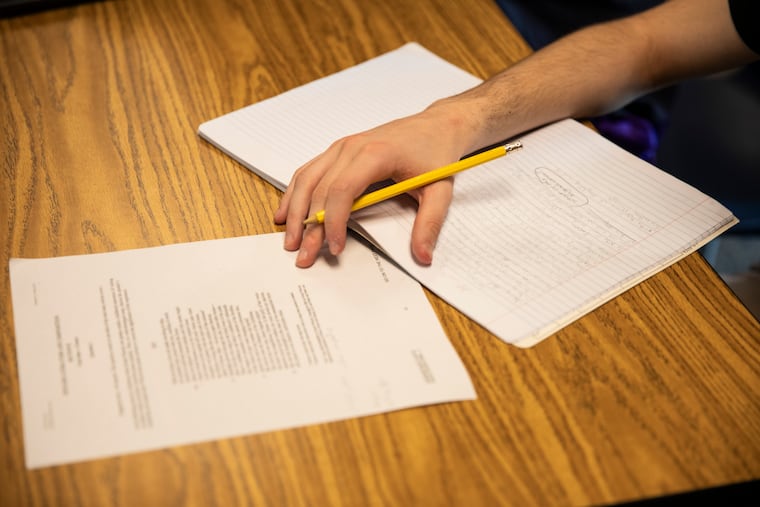
After years of studying how humans write, cognitive psychologist Ronald T. Kellogg concluded that drafting a basic persuasive essay was as mentally taxing as digging a ditch was physically exhausting.
Writing well requires a command of vocabulary, spelling, and grammar. It forces writers to comprehend a subject, to sift through their working memory of that topic, to organize and plan. Writing an essay is so difficult that a person in the throes of it can do hardly anything else — as anyone who has shushed a spouse or child while trying to compose a decent sentence can attest.
Very few people would volunteer to dig a ditch. Likewise, it is hard — almost impossible, many English teachers will admit — to turn a reluctant writer into an enthusiastic one.
Yet the American education system expects nearly all students to learn how to write an essay. It’s little wonder, then, that as soon as a tool arrived promising to lessen the pain people grabbed it.
Like it or not, artificial intelligence is now firmly embedded in how students produce text. Somewhere between two-thirds and 90% of high school and college students are already using AI for schoolwork, according to recent surveys, often requesting help with writing assignments.
A growing number of educators are alarmed, and insist that students should write without AI. These teachers are returning to handwriting, blue books, and proctored, in-class essay tests — all attempts to prevent students from outsourcing their writing to chatbots.
This is baffling to tech industry leaders, who see AI rejection as a form of educational malpractice. They point out that writing is already the leading use of AI in the workplace, and argue there is no need to continue suffering through the task without help. After all, they say, chatbots now exceed the ability of most humans to produce fluent prose.
All this points to some questions about writing itself: Why work so hard to learn it? And what do students stand to lose when they stop facing down a blank page, alone with their thoughts?
The scholars who study writing and cognition are rarely reflexively opposed to AI. Many have spent decades anticipating a leap in computer-assisted writing, just like the one we are living through. They tend to be excited by the technology’s potential.
Still, their work casts doubt on the tech-industry push to embed AI at every stage of the student writing process, from brainstorming to drafting to revising. Research shows that traditional, unassisted composition is valuable, not despite its difficulty, but because of it. Writing builds our working memory, executive planning skills, and metacognition — the ability to think about our thinking, weigh alternate viewpoints, and revise for clarity and style. It takes decades to develop writing skills, from toddlerhood into adulthood.
“Writing is a technology for thinking,” Kellogg said.
Writing substitute or helper?
Learning to write did not always matter so much.
Before the 1870s, American students were tested through oral exams. College seats were reserved for the elite — future ministers and lawyers, professions where public speaking dominated.
But the rise of the modern, urban economy, and the invention of the typewriter, produced jobs that dealt more heavily with the written word, like office clerks and advertising copywriters. Starting in the late 19th century, students needed to learn how to write more fluently, and school curriculums, tied closely to the demands of industry, adapted. As more students went to college, and class sizes grew, administering oral tests also became too time-consuming, according to linguist Naomi S. Baron, who traces this history in her book Who Wrote This?
Besides, teachers discovered that writing itself deepened knowledge. “If you want to think, understand, and learn something, text really is preferable,” Baron said.
Cognitive research confirms that writing is a powerful aid in helping us to retain information we read. The work of writing forces us to stress-test our ideas, allowing the writer to respond to counterarguments and cite sources. Revision is a practice of self-critique and self-improvement, and can be social, as well, if feedback is elicited. Writing can also be empowering, allowing us to share our experiences and express our views. It can even be healing, which is why therapists sometimes suggest keeping a journal.
It is not clear if these benefits can be fully realized when writing alongside artificial intelligence. There are reasons to be wary.
Last year, a small study from the Massachusetts Institute of Technology showed that individuals who wrote in partnership with AI chatbots recorded lower brain activity while they wrote, compared with those who worked without chatbots. The writers who used AI struggled to remember what, exactly, they had written, and felt little ownership over their work.
The findings join a growing body of research suggesting that frequent AI use can degrade critical thinking.
Nevertheless, tech companies are aggressively marketing AI writing assistants to students and schools.
Jenny Maxwell, general manager for education at Superhuman, the AI company that makes the popular writing app Grammarly, told me we are living through a “burn it down” moment for teaching and learning. Educators who try to withhold AI writing tools are essentially announcing to their students — “consumers,” she called them — that their coursework is irrelevant to the job market.
She did acknowledge that some basic, human writing skills remain valuable. Students need to write well enough to have a sense of which AI text suggestions to accept and which to reject, she said. Maxwell also insisted that creativity in writing would persist, because people would still want to express their personal voice and style.
To that end, companies such as Grammarly, Google, and OpenAI are creating so-called Socratic versions of their chatbots, sold to schools as writing helpers that will guide students through assignments without doing the work for them.
The need for limits
AI is already ubiquitous: on every device, in every web search, insisting that it can summarize for us, analyze for us, write for us. It steps in even when we have not invited it.
For students with still-developing minds, the most urgent question, then, is how to protect thinking in a world where it has become so easy to outsource writing.
We might begin by considering what AI is actually good at when it comes to composition. AI can be especially useful for those with disabilities or who are non-native English speakers, said Steve Graham, a writing expert and educational psychologist at Arizona State University. Chatbots can correct grammar and suggest potential trims or revisions for clarity. With AI, there have been immense strides in accurate voice-to-text transcription for writers who cannot physically type or write by hand.
And AI can offer all of this help privately, with no need to be vulnerable and expose a rough first draft to another person’s judgment. For many American students, especially the third with below-basic literacy skills, the writing process can be painful and embarrassing, and a reason many dread homework and exams.
But, Graham cautioned, there is no part of the writing process that can be handed over to AI without some cost. Intellectual growth occurs at every stage, from brainstorming to fine-tuning a final draft. If writing is thinking, then any part of the struggle that is outsourced to technology amounts to relinquishing some freedom to perceive. How will students ever know what they really think of anything — whether it’s The Crucible or AI itself — if they ask a machine to spit out an answer for them?
Last year, a group of writing experts, including Graham, assembled at the University of California, Irvine, to produce recommendations to schools.
They did not reject AI. Instead, they called on schools to resist the temptation to devote less time to writing — not because it will continue to be such a critical skill in the workplace, where it’s already waning, but to sharpen the mind.
Writing should be embedded across the curriculum, they advised. Students should continue to do the hard work of drafting their own sentences, paragraphs, and eventually full essays about their lives and about what they have read, both fiction and nonfiction. All this teaches grammar and vocabulary, certainly. But it also allows students to master the knowledge they are gaining.
There is room for AI, these experts suggested: The technology can help educators generate engaging writing prompts on whatever subjects they are teaching.
Teachers might also encourage students to use AI to get initial feedback on their writing before turning it in. Anna Mills, a writing instructor at the College of Marin in California, has developed detailed AI prompts that students can use to elicit useful feedback without outsourcing all the work.
Still, there is probably a need to limit access to the technology.
The University of Sydney has developed a policy known as the two-lane approach. Across every discipline, professors are required to give some assessments in person under secure conditions, limiting AI use. But they must also allow AI for other assessments, so students can show they know how to apply the technology.
Jessica Binney is dealing with AI as an English teacher at John Jay High School in the New York suburbs.
In a creative-writing class, she had students prompt a chatbot to write a poem. The results were predictably generic, so students then asked the chatbot to make revisions, considering where the bot performed well and where it fell short.
Still, like many educators, she had tired of policing AI misuse on take-home assignments. In her Advanced Placement English course, she moved much of the essay writing, produced inside the classroom, to pen and paper.
For the most part, students did not complain. Many had already been through an initial whirlwind romance with AI, before rethinking their relationship with the tools. Ainsley Graham, a junior, said she was thrilled by ChatGPT’s ability to help with data analysis in a science research class, but recognized the risks of using chatbots to write essays about literature.
“You’re not strengthening that muscle by actually analyzing these really hard texts,” she said. “They’re meant to be hard.”
When Cassady Tondorf, 17, learned how chatbots produced writing, she realized their utter lack of originality. “The entire internet is open to it,” she said. “It’s just regenerating the same things, over and over.”
If she wanted to be valuable on the job market, she felt, she would need to have ideas and skills that were uniquely her own.
This article originally appeared in the New York Times.