Cape Cod learns to live with sharks
Over the last several years, a resurgent seal population has turned Cape Cod into one of the world’s top seasonal hot spots for great white sharks. And some tourists are showing up just to see them.
On a cloudless afternoon in July, Nicole Sweeney was on a charter boat off the southeastern corner of Massachusetts’ Cape Cod, cruising through blue-green water as smooth as sea glass. Conditions were perfect for a dunk in the ocean, but swimming was resoundingly off the table.
That’s because if all went to plan, Sweeney would soon come face to face — or at least face to fin — with a great white shark.
“When I was a kid, sharks were not something we ever thought much about,” said Sweeney, 55, who has visited Cape Cod every summer since she was born. “Now you can’t go anywhere on the Cape without finding a coaster or a keychain or a mug with a shark fin on it.”
The onslaught of great white merch is more than mere leftovers from last summer’s 50th anniversary of Jaws.
Over the last several years, a resurgent seal population has turned Cape Cod into one of the world’s top seasonal hot spots for great white sharks. In summer and autumn, the stretch of ocean from the northern tip of the Outer Cape down past Chatham, on the Cape’s elbow, is now the best place on Earth to see great whites swimming — and hunting — close to shore.
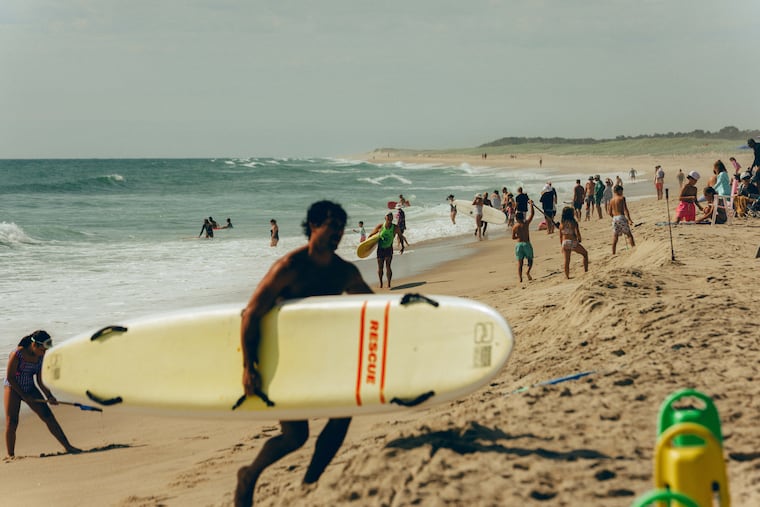
Back on land, the specter of sharks is inescapable. Beyond the shark-bite ball caps and the “Respect the Locals” shark bumper stickers, ominous shark flags and menacing warning signs, along with “Stop the Bleed” kits, have become summer fixtures on the Outer Cape’s beaches.
Even so, the seasonal shark surges have seemingly done little to dampen overall enthusiasm for Cape Cod, where the median single-home sale price nearly doubled from 2019 to 2025 and hotel prices can top $2,000 a night during high season.
The sharks have, however, changed people’s behavior. Demand for swimming pools has spiked. Beachgoers now keep a close eye on the shark-tracking app Sharktivity. And shark-spotting tours regularly operate within striking distance of some of the Cape’s most popular beaches.
Greg Skomal, a marine biologist with the Massachusetts Division of Marine Fisheries and New England’s leading authority on white sharks (as scientists typically call great whites), has seen the shift in beachgoers’ habits from his shark-tagging trips up and down the coastline.
“We observe it from the research vessel,” Skomal said. “We don’t see the same number of people in the water at great distances from shorelines.”
From a conservation perspective, the sharks’ return to these waters is a success story, the result of the Marine Mammal Protection Act of 1972, which rescued the region’s gray seal population from the brink of extinction. (A 2017 study estimated Cape Cod’s gray seal count to be between 30,000 and 50,000, up from about 2,000 in 1994.)
The sharks soon followed, leading to increasingly frequent beach closures and, inevitably, run-ins with humans. In 2012, a bodysurfer was bitten by a white shark off a Truro beach. He survived, as did a swimmer who was bitten at a neighboring beach in 2018. But a month later, a 26-year-old boogie boarder was killed by a white shark at Newcomb Hollow Beach, in the town of Wellfleet — the first fatal shark attack in Massachusetts waters since 1936. Two years later, a white shark killed a swimmer off the coast of Maine.
Yet in recent years, Cape Cod’s tourist economy has grown to nearly $2.8 billion (up from nearly $2 billion in 2019 per the Cape Cod Chamber of Commerce), even as the U.S. National Park Service has recorded a drop in recreational visits to the Cape Cod National Seashore, a 40-mile stretch of coastline that includes six beaches frequented by white sharks.
Although the sharks may have pushed some beachgoers away, one thing is certain: They’re also luring people in.
Ten years ago, the world capital of white shark tourism was that other Cape at the bottom end of the Atlantic: Cape Town, South Africa, whose resident great white population had long supported an enormous cage-diving industry. But those sharks have since disappeared, possibly driven away by commercial overfishing or perhaps shark-liver-hungry orcas, the subject of an unsettled scientific debate. Guadalupe Island in Mexico, another white shark hot spot, had its shark tourism and cage-diving operations shut down in 2023 by the Mexican government, which cited practices in the industry that were putting sharks and humans at risk.
At the same time, Cape Cod’s star began to rise as a white shark ecotourism destination, specifically the town of Chatham, where shark seekers can choose from a growing number of private shark charters — generally costing north of $2,000 — that employ spotter planes to locate the animals, which passengers can then observe from the boat. (Cage diving, which typically involves chumming the water to attract sharks, is illegal in Massachusetts, though at least one Cape Cod outfitter runs shark cage-diving tours offshore in federal waters.)
And while you can still cage-dive with great whites off the remote Neptune Islands in South Australia and off the southern edge of New Zealand, those experiences require all-day or even multiday tours. Only on Cape Cod can you spend a morning observing white sharks in the wild and be back on the beach by lunchtime.
“The fact that we can go out and see them in a 2½-hour charter is incredibly unique,” said Hannah Leary, ecotourism coordinator for the Atlantic White Shark Conservancy, a research and education nonprofit in Chatham that operates the Sharktivity app. “We can just come out of the inlet and they’re all right there.”
Its “open boat” shark charters, which offer “a shared adventure with Cape Cod’s apex predator,” run several times a week and regularly sell out (at a slightly more accessible $530 per person, with up to six people sharing a boat). Lately, Leary said, she has noticed an uptick in international guests and travelers who’ve come to Cape Cod specifically to see great whites.
At Cape Cod’s surf shops, though, the sharks are old news.
On a recent Sunday morning, Pump House Surf Shop in Eastham, which sells $20 miniature lifeguard-spec shark flags and last month shared a winking social media post about sharks, was packed with shoppers. Across the street at the equally crowded Nauset Surf Shop, the oldest surf shop on the Cape, longtime owner Phil Clark said shark-deterrent products started flying off his shelves after 2018, but they’re not selling much anymore.
“Everybody is kind of used to it,” Clark said of the sharks’ presence. “They’re buying surfboards. The kids are taking surf lessons.” Indeed, Sugar Surf, an all-female surf school, is still holding classes at Marconi Beach in Wellfleet, where a white shark took a bite out of a stand-up paddleboard in 2017.
“It’s not the same business it was 30 years ago, but there’s still tons of business,” said Clark, who noted that boogie boards and skimboards have become his bestsellers. “People are still here, and they’re having fun and enjoying themselves.”
For Suzy Blake, co-head lifeguard of Wellfleet’s beaches, the shark risk is “part of our lives now as lifeguards and residents of the Outer Cape.” She and her team are now armed with an arsenal of shark-specific equipment and protocols, including tourniquets and “Stop the Bleed” training, as well as a direct linkup to real-time shark detector buoys, which send push alerts to the lifeguards when tagged sharks are in the area.
Later that afternoon, at Newcomb Hollow Beach, Lisa DonDiego sat on a beach blanket with a friend a few yards away from the lifeguard stand, looking out at the ocean.
“I understand the fear,” said DonDiego, 37, up from Philadelphia for her family’s annual summer pilgrimage to the Outer Cape. “And at the end of the day, I recognize that the ocean belongs to them. But I still want to come to Cape Cod.”
She said she consulted the town of Wellfleet’s shark updates and the Sharktivity app, which logs crowdsourced shark sighting data and any buoy pings by tagged sharks, to help make an informed decision about getting into the water. Quitting the Cape’s beaches altogether, though, is out of the question. “Basically nothing could keep us off the beach,” she said.
The next morning, the sun was shining, and Paul Bordé, a local real estate agent, was out for a joyride out of Chatham Harbor on his Boston Whaler, keeping his eyes peeled for “one of the big boys.”
“Sharks have changed behaviors and conversations more than they’ve changed demand,” Bordé said. A noticeable trend has been an increasing appetite for swimming pools; one Cape Cod pool builder even advertises “shark free swimming” on its trucks.
That said, nothing has shaped the Cape’s real estate market in recent years as much as the pandemic. And while the COVID-19-era buying frenzy has cooled a bit, Cape Cod is still a seller’s market. Even the swimming pool surge is part of a broader pandemic-era trend toward creating “backyard oases,” Bordé said, adding that heated pools in particular were allowing families to extend the outdoor season by several months.
As for the sharks, Bordé called them “magnificent,” though he said the closest he came to a sighting that morning was a tagged white shark named Tarly pinging a nearby detector buoy.
On the charter boat, Sweeney had better luck. Less than half an hour into her shark tour, she found herself tearing up. Five decades after watching her first Jacques Cousteau film with her father, kick-starting her enduring fascination with great whites, Sweeney was gazing down through clear, shallow water at a 10-to-12-foot male white shark.
This time, there was no need for a bigger boat.
“Just to be in that small boat, looking over the sides at this massive, powerful, beautiful animal,” she said. “It was awe-inspiring.”
This article originally appeared in the New York Times.