The disappearing women of the Trump administration
In the spring, four of Trump’s eight female Cabinet-level officials resigned or were fired in just three months. All were replaced by men.
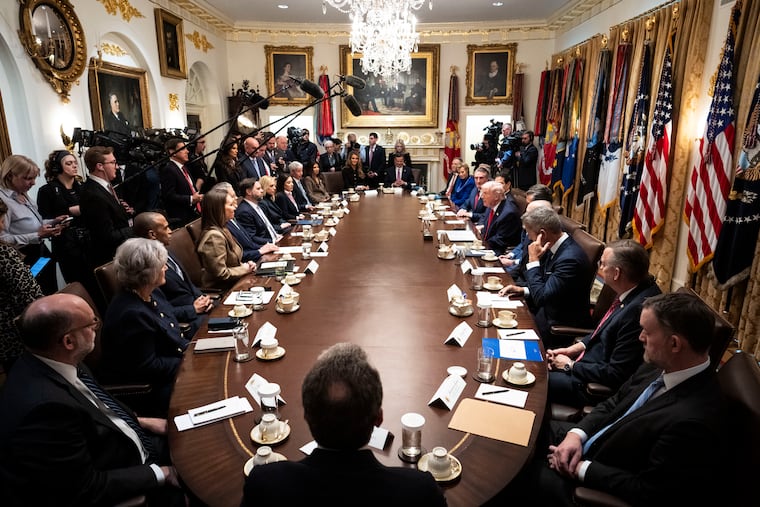
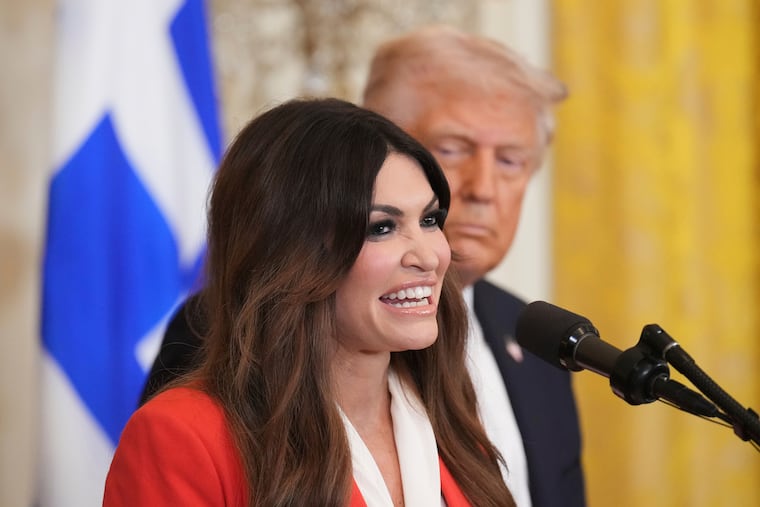
WASHINGTON — The ouster of Kimberly Guilfoyle, who until this week was the U.S. ambassador to Greece, was surprising in its particulars. It was announced on live TV, during the first-ever briefing by the new White House press secretary.
But Guilfoyle’s forced resignation also was part of a larger pattern in President Donald Trump’s second term: The prominent figures who have departed the administration, either voluntarily or involuntarily, overwhelmingly are women.
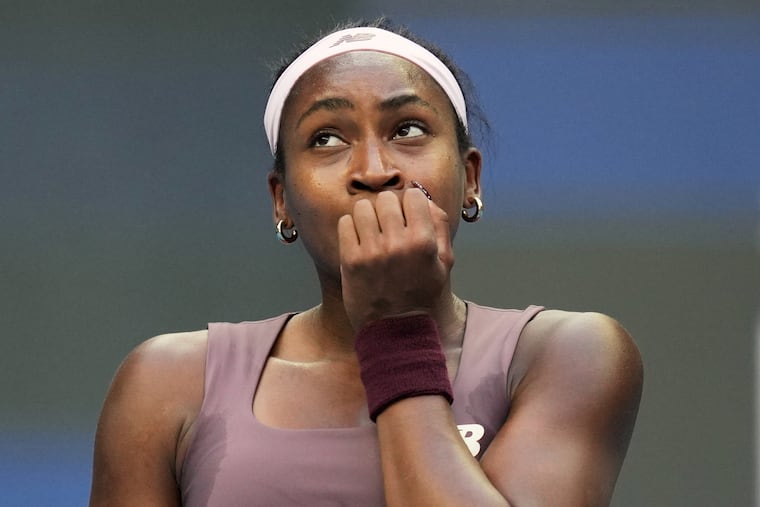
Guilfoyle was the latest high-ranking woman to leave this year. In the spring, four of Trump’s eight female Cabinet-level officials resigned or were fired in just three months: Attorney General Pam Bondi; Labor Secretary Lori Chavez-DeRemer; Homeland Security Secretary Kristi Noem; and Tulsi Gabbard, the director of national intelligence.
All were replaced by men.
Guilfoyle was asked to resign after The Wall Street Journal reported that she had asked a donor to pay off her $100,000 American Express bill before her confirmation vote. Guilfoyle has denied the allegation. But on Tuesday, Trump said that while Guilfoyle “was doing a good job,” he “didn’t like what I read.”
He also downplayed the idea that he had any substantial connection with Guilfoyle, who is one of the president’s staunchest defenders and was at one point engaged to Donald Trump Jr., the president’s eldest son. “She wasn’t a member of my family,” he told reporters. “She, I guess, dated my son a long time ago.”
The women in Trump’s orbit do not seem any more inclined to controversy than the men; his male appointees have repeatedly drawn scrutiny and calls for their ouster.
FBI Director Kash Patel has been forced to confront questions about his conduct, including allegations of excessive drinking, assigning a SWAT team to protect his girlfriend and using a government plane for his personal use. (He has denied the allegations.)
Commerce Secretary Howard Lutnick surfaced in files released by the Justice Department as one of the visitors to the private island owned by sexual predator Jeffrey Epstein. Defense Secretary Pete Hegseth disclosed secret war plans in a conversation on a private messaging app that inadvertently included Jeffrey Goldberg, the editor of The Atlantic.
Trump did punish one male appointee related to that text chain: Mike Waltz, the national security adviser, who had added the journalist to the chat. But Waltz had a soft landing. He was appointed to serve as the ambassador to the United Nations, a position that Trump had promised to his longtime female ally in Congress, Elise Stefanik.
Stefanik, a self-proclaimed “ultra MAGA” warrior, ended up politically adrift and ultimately quit Congress.
Experts on presidential appointments said the single-gender exodus was highly unusual.
“I’ve never seen a situation where all of the first set of Cabinet departures have been of one gender — all women,” said Kathryn Dunn Tenpas, a nonresident fellow at the Brookings Institution who has tracked diversity in presidential administrations since the Reagan era.
Women in the top ranks
As Trump assembled his top brass shortly after clinching the 2024 election, several women were among the ranks. He appointed Susie Wiles as chief of staff, the first woman to hold the powerful, Cabinet-level position. Karoline Leavitt was the youngest person to serve as White House press secretary before she left her job in August to raise her two young children. She was replaced by another woman, Katie Zacharia.
In a statement for this story, Taylor Rogers, a White House spokesperson, said, “President Trump has assembled the greatest administration in history, selecting each member of his incredible team based on one criterion: their ability to deliver for the American people.”
“Unlike the identity politics-obsessed Democrats, the president judges individuals on merit and qualifications, not immutable characteristics,” Rogers added.
At a Women’s History Month celebration last year, Trump declared that he was “thrilled to say that we have more women in our Cabinet than any Republican president in the history of our country.”
That is no longer the case. There are now four women remaining in Cabinet-level positions.
In many instances, the female officials who departed appeared to have failed some kind of loyalty test to Trump.
Bondi came under fire for her handling of the release of the Epstein files, and for falling short of Trump’s demands for retribution against his enemies. Trump was also dissatisfied with her performance in congressional hearings and on television.
Testimony before Congress also appeared to be a catalyst for Noem’s firing, particularly her statement that Trump had approved of tens of millions of dollars of government ads in which she was prominently featured. Trump denied that account.
Gabbard resigned to care for her ill husband. But her announcement came amid a strained relationship with the White House, and after she refused to testify to Congress that Iran had posed an imminent threat, as Trump had asserted to justify his war against the country. Trump said she was “softer on that” issue than he was.
Chavez-DeRemer resigned after becoming embroiled in scandal amid allegations that her agency was rife with toxicity and dysfunction, and that she had grossly abused her power by having an inappropriate relationship with a staffer and by using public funding for private purposes.
But even some of Trump’s fiercest critics, who were glad to see the female Cabinet members go, called out what they saw as a glaring double standard.
“Is he out of women?” Rep. Alexandria Ocasio-Cortez, D-N.Y., said after the departures of Bondi and Noem, when asked by a reporter whom the president should fire next. “Trump only seems to have the capability to fire female secretaries.”
Rep. Jasmine Crockett, D-Texas, who is a frequent target of the president’s mockery, wrote in a social media post that Hegseth should be the next to go. “I see a theme,” she wrote of Trump. “He will throw the incompetent women under the bus a lot faster than the incompetent men.”
In April, Rep. Madeleine Dean, D-Pa., grilled Lutnick about the double standard during a congressional hearing, pointing to revelations about his connection to Epstein.
“Is the president concerned about your continued relationship that you had with Mr. Epstein?” she asked.
“I am not going to discuss conversations I have with the president,” Lutnick replied.
“President Trump has just fired three Cabinet secretaries — three women,” Dean responded. “If President Trump has even a shred of concern about accountability for Jeffrey Epstein’s enablers, he would fire you too.”
May Mailman, director of the Independent Women’s Law Center and a former senior White House official in both Trump administrations, said that there were plenty of powerful women serving in key roles.
She pointed to Wiles as well as to appointees such as Erica Schwartz, who was recently confirmed to lead the Centers for Disease Control and Prevention, and Harmeet Dhillon, who leads the civil rights division at the Department of Justice.
“There’s no loneliness of the female conservative in the Trump administration,” Mailman said. “There’s only empowerment. You’re a necessary member of the team for who you are, not your sex.”
This article originally appeared in The New York Times.