This may be one of the most mysterious parts of a total eclipse
Scientists are eager to study the sun's corona, visible only during total eclipses and much hotter than the sun itself.
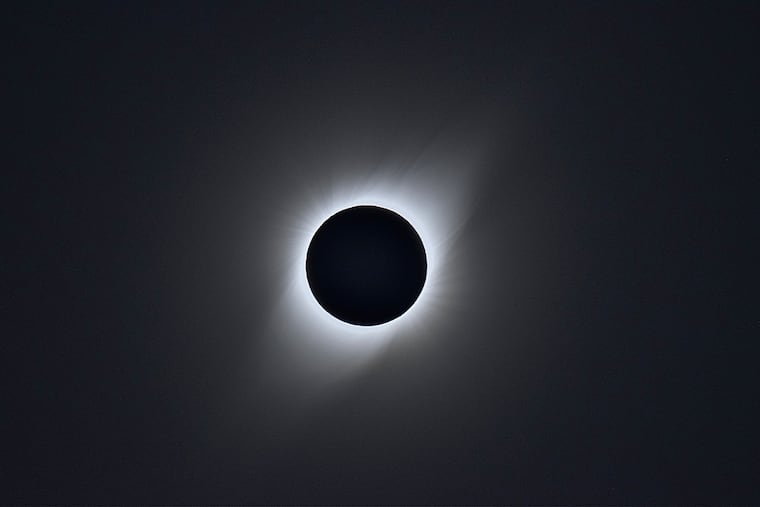
On Wednesday, a total solar eclipse will plunge a swath of Greenland, Iceland, and Spain into a sudden midafternoon darkness. A deep twilight azure will descend over the landscape. Venus will shine as daylight disappears.
But the most stunning spectacle will be as scientifically valuable as it is visually scintillating: the corona, or the sun’s atmosphere.
The corona is the outermost part of the sun’s atmosphere. It’s normally obscured by the sun’s brightness. It’s never visible from Earth unless the sun’s light is somehow extinguished. That can happen only during a total solar eclipse. (The northern portion of the United States, from Alaska to North Carolina, will see only a partial eclipse.)
The corona is beautiful. It radiates millions of miles into space, appearing as hairlike silver tendrils blowing away from the sun. The light is sculpted by the sun’s ever-evolving magnetic field; it traces currents of the solar wind. Witnessing it is magical.
But despite advances in science, the corona remains mysterious. Heliophysicists, or scientists who study the sun, still aren’t sure why it’s so hot. The visible surface of the sun, known as the photosphere, is about 10,000 degrees Fahrenheit. But the corona? About 1.8 million to 5.4 million degrees.
“It’s a fundamental question that we’re still working on,” said Jon Linker, a heliophysicist and the president of Predictive Science, a group that models the sun’s magnetic field. “It’s called the coronal heating problem. I think to a large extent that we know that heating is coming from the solar magnetic field itself, and that also ties into how the solar wind is accelerated.”
The solar wind carries high-energy particles and magnetic energy toward Earth. That can have implications for terrestrial navigation systems, satellites and aviation.
“On a very large scale, [magnetic fields] get twisted up, and we see flares and coronal mass ejections,” Linker said. Coronal mass ejections, sometimes nicknamed “solar storms,” are akin to shock waves in the solar wind. Strong coronal mass ejections interact with Earth’s magnetic field, often producing widespread displays of the aurora.
But on the small scale, Linker said, contortions in the sun’s magnetic field help to dissipate heat, potentially making the corona hotter.
“The field is also getting braided and twisted and things, and that leads to current sheets that can then dissipate heat,” he said.
That’s why scientists are anxiously awaiting this latest eclipse, eager to get a glimpse of — and document — the intricacies of the corona. In the meantime, Linker’s team has built an ultracomplex model to predict what the corona will look like.
After all, as the sun’s magnetic field changes, so does the shape of the corona.
“We model that with what are called the magnetohydrodynamic equations,” Linker explained, likening the process to how meteorologists use weather models. “But [solar magnetism] equations are actually far more complex, and have more surprises and difficulties.”
The sun’s magnetic field is most complicated every 11 years, at the peak of the solar cycle. During what’s known as solar maximum, the sun is blotted in sunspots, or bruiselike discolorations that spew magnetism. The more sunspots, the more chaotic the magnetic field and the wonkier the corona.
The last solar maximum was in late 2024. We’re now in the descending phase of the solar cycle, but there are still lots of sunspots.
“We’re still in a phase of the sun that is very active” Linker said. “I think it’ll probably still have more of a structure … with perhaps some [streamers] that are a little bit more pronounced.”
That’s exactly what Linker’s model depicts — the north and south poles of the sun’s magnetic field are visible, but lots of loops and hairlike streamers fan out in all directions. That should make Wednesday’s eclipse memorable.
In the meantime, Linker is looking forward to watching the eclipse in — of all places — the town of A Coruña, Spain. That’s where a cosmology, or solar physics, conference will be running from Monday to Friday.
A Coruña translates to crown, or corona, and the town is in the heart of the path of totality.