Neighbors question what they really knew about their Olney block amid ‘House of Horrors’ probe
Olney neighbors question what was happening right in their backyard as authorities probe inside the West Chew Avenue property linked to drugs, sex, violence, and missing women.
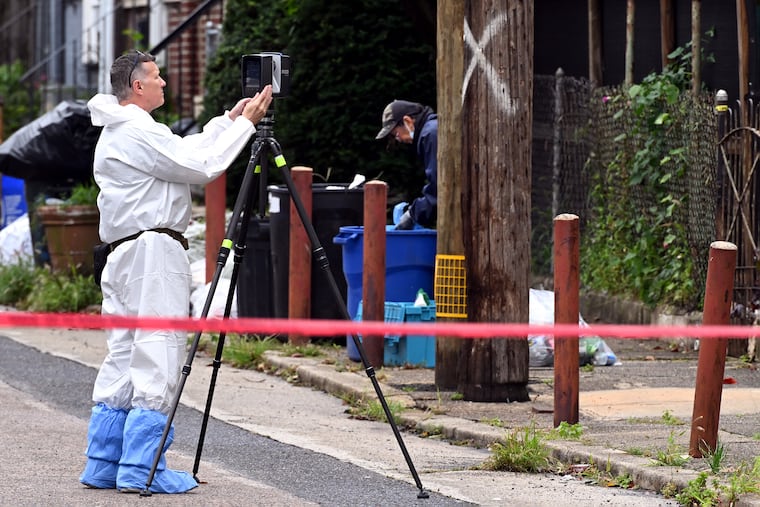
On Monday morning, a gray speckled cat stretched two long paws up the steps of the sepia-toned three-story home at 417 West Chew Ave. Moments later, a man dressed in a white suit gently kicked a blue-bootied foot in its direction.
No unauthorized personnel would be entering the Olney “House of Horrors” anytime soon — feline or otherwise — not on the watch of the FBI and Philadelphia police.
Monday marked the beginning of a fresh week of investigative work inside the home that became known for the drug, sex, and porn enterprise Raymond “R.C.” Horsch ran inside the brick walls. Horsch, who died last year at 82, is now linked to at least seven missing women, and left behind a trove of photos and videos investigators believe show real and staged violence and, possibly, murders.
Police declined to discuss what investigators are looking for, only revealing that law enforcement would be in the area until around mid-October.
However, yellow and red crime tape and police cars around the perimeter wouldn’t curb the curiosity of pedestrians, workmen, food delivery drivers, students, children, and former neighborhood residents who passed by the scene Monday.
Throughout the morning, residents ducked under crime tape only to be chastised by police. Cars slowed to a stop as they drove perpendicular to West Chew and caught a glimpse of the law enforcement vehicles clustered around the home. When a toddler wearing a backward baseball cap and plaid shirt pointed at the home, his guardian turned their walk around.
Around noon, 31-year-old Fernanda Gabriela Armijos Nugra parked her car around the block and got out wearing white sweatpants, a scrunchie in her hair, and turquoise bands in her braces. She lives seven houses away from Horsch’s, she said.
Knowing what went on so close to her and her girls, ages 5, 8, and 15, has transformed her attitude about the neighborhood, she said.
“I walk around here with my daughters, and we really are afraid about what happened in that house,” she said in Spanish.
Though she never suspected the home could be linked to violence or murders, she said she had a bad feeling about the men who lived there, Horsch and his son, Eugene. Eugene Horsch is now in prison on federal charges from a June car stop near Independence Hall in which authorities recovered the fake ID of a missing woman.
“I used to see the son sitting on the steps of that house all the time and I’d tell my husband, ‘There goes a man with a really mean look on his face,’” she said. “When I saw the news, I was in shock.”
She’s only lived in the area two years and is now contemplating moving. The same is the case for Imani Hardy, 30.
“I don’t want to be here,” Hardy said from her parked car as she watched investigators come and go. “I just want to provide a different life for my kids.”
She and her sons didn’t encounter Horsch, as far as she knows, but the knowledge that his operation was so close is haunting, she said.
It’s chilled the atmosphere in the neighborhood. And something about that change feels permanent, she said.
“We still have to live our normal lives, but being as though we were in a neighborhood where someone was doing horrific things to people ... It makes people be more alert,” Hardy said.
Officers and reporters lifted police tape to help people on the cordoned-off block get out in their cars. Police kept watchful eyes over everyone who came and left, whether it be a neighbor on a bike or two workmen rolling boxes on a dolly up to the front door of a home beside Horsch’s. A squirrel darted toward the Horsch home on a telephone wire and turned back once the whirring of a drone grew louder.
Alexis Velez, a befreckled 18-year-old with Shirley Temple-esque corkscrew curls, lives about five minutes from the Horsch house. It’s smack between her and her grandmother’s home. She used to walk by the Horsch house daily to catch the bus to get to high school. She thinks about what could have been if she’d been in the wrong place at the wrong time.
“It’s terrifying, just thinking about it. I could have been one of those victims. I’m in the vicinity,” she said.
She’s now a freshman at La Salle University studying psychology, she said. Maybe one day she’ll come to learn what possesses the human mind to pursue violence. But, for now, it’s hard to wrap her head around it.
“I just think it’s insane,” she said.
The neighborhood had felt like a safe place where people looked out for one another, Velez said.
As she headed home, she struck up a conversation with two women. Sisters Theresa Yantz, 64, and Diane Matynka, 68, grew up in the Olney neighborhood but both now live in Lebanon, near Hershey. The two wanted to show Yantz’s daughter, Cara, 35, where they grew up and just how near it was to the Horsch house.
“We wanted to drive by and show her, how close that we hung out,” Yantz said after she and her sister whipped out their phones and started taking photos. “That’s why we’re here being so nosy.”
Yantz, Matynka, and Velez chatted about how the neighborhood changed since the sisters were children. Both sisters lived in Olney in the mid-1960s to late 1970s, and Yantz did another stint there in the early 1980s.
When Yantz and Matynka were young girls, they’d play on their bikes outside until the street lights came on. Decades later in the same neighborhood, Velez has had to persuade her protective father that he doesn’t need to chaperone her to class each day anymore.
Lately, though, she’s had a change of heart.
“After this, I might have him walk me a couple times,” she said.