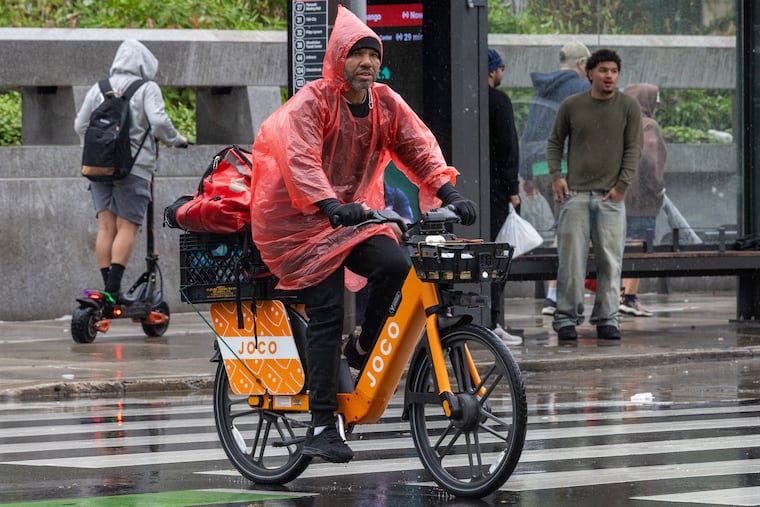
Do DEI bike paths exist? The Trump administration says yes
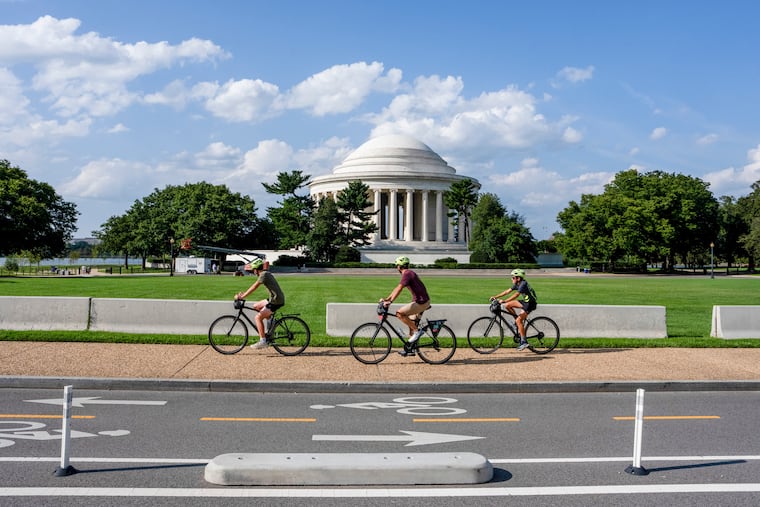
In a high-profile move this year, the administration even tried to remove a bike lane near the White House.
Four years ago, after Joe Biden fell from a bike, Donald Trump made a pledge to the American people.
“I will never, ever ride a bicycle,” he declared.
The joke landed because Trump is known to be more of a limo-and-golf-cart sort of guy. But more recently, his administration has begun acting on its deep aversion to cycling, revoking federal grants for what it calls “DEI bike lanes.”
In a high-profile move this year, the administration even tried to remove a bike lane near the White House.
Sean Duffy, Trump’s transportation secretary, has argued that when bike lanes cut into space for cars and trucks, the result is more congestion, “longer travel times and wasted fuel.”
But Duffy and his colleagues have also deployed rhetoric that suggests the bicycle is hopelessly lefty, belonging in the same category as green-haired baristas, Rosie O’Donnell, and yard signs professing that love is love.
Last month, the Transportation Department told National Public Radio that liberals believe “that everyone should ride a bike to their shoebox-sized apartment to eat crickets to achieve a phony climate agenda.”
The attacks are depressing to longtime cycling advocates like Bill Nesper, executive director of the League of American Bicyclists. “There is something there that they’re playing on, which is ‘Look at that dork on a bike,’” Nesper said.
Whether this strategy pays off politically remains to be seen. A 2025 YouGov poll showed that 76% of Americans supported bike lanes in and around places where they live, including 66% of Republicans. But it also showed that only one-third of Americans are pining for more.
As it is, many communities in the U.S., regardless of politics, have embraced bike-friendly policies, on the grounds that bikes are good for the planet and for the body, and address congestion by taking cars off the road. Often inspired by bike-friendly European cities such as Copenhagen and Amsterdam, the moves are a major shift in the way communities in the U.S. approach transportation planning.
There are 4,400 directional miles of protected bike lanes today, up from 108 directional miles in 2000, according to PeopleForBikes, an industry trade association and advocacy group. (Directional miles are miles that can be traveled in one direction; with a two-way bike lane 1 mile long counting as two directional miles.)
The group notes that more than 25,000 miles of rail beds have been converted to bike-friendly trails, double what it was two decades ago.
But the Trump administration is trying to put the brakes on the trend.
In Nashville, Tenn., the future of an ambitious series of bike lanes, called the East Nashville Spokes project, is up in the air after the Trump administration froze a $9.3 million grant, prompting a court battle that remains unresolved.
In Washington this year, the administration announced it was tearing out the 15th Street bike lane as “part of the president’s initiative to revitalize” the city. But in a 61-page ruling in April, Judge Amy Berman Jackson temporarily blocked the demolition plan citing an “absence of reasoned decision-making” in justifying the removal.
In Fairfield, Ala., a majority Black city of 9,500 people southwest of Birmingham, the administration canceled an $11.7 million grant for a bike and walking path, originally awarded under the Biden administration as part of a “sustainability and equity” program. Advocates had said that 17% of the families in the area do not have access to a car.
In an interview, the city’s mayor, Herman Carnes Jr., said he did not know why the grant had been canceled. “It got ripped away from us,” he said.
Bike lanes have long enjoyed bipartisan support. In 1967, Ronald Reagan, then the Republican governor of California, signed a law that for the first time allowed city governments to create bicycle lanes.
Ray LaHood, a Republican who served as transportation secretary under President Barack Obama, avidly supported federal money for bike projects. He once wrote of “the end of favoring motorized transportation at the expense of nonmotorized.”
But as the bike-lane revolution picked up steam — along with calls to make cities more walkable — some conservatives feared that it amounted to a series of intrusive social engineering schemes.
In a few conservative circles, city planning even became falsely linked to dark conspiracies about Agenda 21, a nonbinding United Nations resolution encouraging sustainable development, and the voguish concept of the “15-minute city,” which said that people should be able to walk or bike to amenities such as grocery stores in 15 minutes or so.
It was not long before the bicycle itself was portrayed as a political cause supported by left-wing dingbats.
In 2020, Matt Walsh, the right-wing pundit, painted cyclists as childish hobbyists.
“If you want to play with your bike, go to a park, or a bike trail in the woods, or maybe Daddy can take you down to the tennis court near the playground so you can ride your Big Wheel,” he said.
Last year, Trump poked fun at Pete Buttigieg, the Biden-era transportation secretary, for riding a bike, tossing in a gratuitous reminder that Buttigieg is gay.
“Buttigieg, who has no clue, you know, he drives to work on his bicycle, in all fairness, with his husband on the back, which is a nice, loving relationship,” he said.
At a conference last year, Duffy suggested that the idea of European bike-friendly cities were unsuitable for Americans. “We’re not Europe,” he said, citing vehicle sizes. “I don’t think we should necessarily buy into the European model.”
This summer, Duffy pushed for more change. On July 22, Duffy wrote a letter to a group of senators, urging them to restrict future funding for bike lanes and support removing ones “that contribute to congestion.”
To Nester, the letter represented something “much worse” than canceling or stalling individual grants. Duffy, he said, was now calling for ripping out existing lanes and advocating for “a systematic change in transportation law to restrict the funding of bike lanes overall.”
Hostility to bike lanes, in fact, can be found in surprising places.
In Boston, Mayor Michelle Wu, a progressive Democrat, had put in miles of lanes, but eventually slowed down because of complaints.
Her administration is navigating opposition in some traditionally Black neighborhoods to a plan to redesign Blue Hill Avenue, a major thoroughfare. Much of the criticism has been directed at a proposal for a center-running bus lane, which some say will create new traffic problems.
But a plan to add bike lanes has also rankled such critics as Reggie Stewart, a real estate agent and climate and environmental justice chairperson of the Boston NAACP.
“You’re taking away parking and adding to an already congested corridor,” he said.
Stewart and others are now asking the Trump administration to rescind an $80 million grant to fund the project.
“Ironically, in my climate and environmental justice work, we’re opposing a lot of what Trump is for,” Stewart said.
But in this case, he said, the president might be an ally.
“Mayor Wu,” Stewart said, “falls into that category of liberals who think they know best without having real conversations with the people affected.”
Marcela Dwork, a spokesperson for the city of Boston, said officials would continue “to work with community members” on the design proposal, with a number of meetings scheduled for September.
This article originally appeared in the New York Times.