Ukraine weighs legalizing pornography to raise tax revenue and buy drones
With Ukraine facing giant military expenses and a $27 billion budget gap, lawmakers are moving to decriminalize pornography and tax its content creators.
KYIV — For years, Ukraine’s huge but illegal porn industry has operated in the shadows. Law enforcement generally looked the other way, while some officials abused their power to extort bribes from people found to be skirting the law.
Then, two years into Russia’s full-scale invasion, the federal tax authorities discovered that nearly 8,000 Ukrainian OnlyFans creators had made more than $131 million during 2023 alone.
Now, with Ukraine facing giant military expenses and a $27 billion budget gap, lawmakers are moving to decriminalize pornography — a momentous step for a country long stained by a reputation for exploiting and exporting women as sex workers.
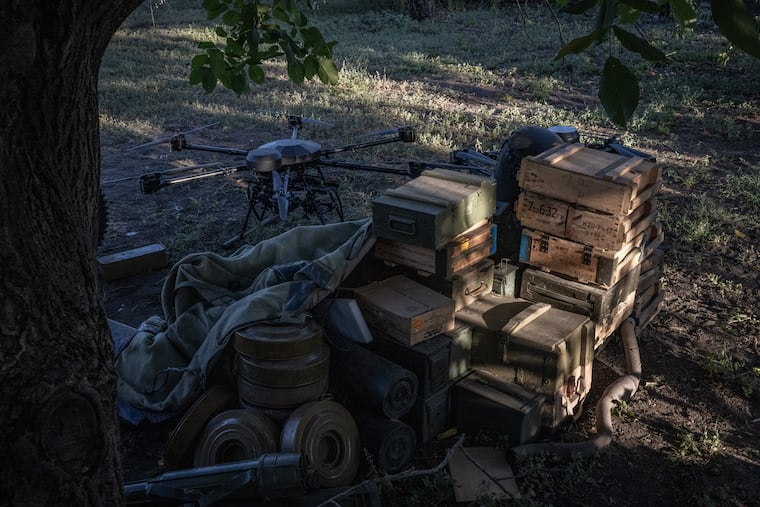
The legalization of porn is expected to generate roughly $25 million in tax revenue that Yaroslav Zhelezniak, a co-author of the bill in the Ukrainian parliament, said would be enough to purchase 30,000 drones for the war effort.
“Ask yourself … who benefits,” Zhelezniak said in a speech during the first reading of the bill in July. “Unfortunately, it’s not the Ukrainian state budget. And we can’t use that money to increase funding or raise salaries for our defenders; all that money remains in the shadow economy.”
He added, “I believe we are already mature enough as a nation to acknowledge that sex exists.”
Raising money on the backs of adult-content creators, however, is a fraught proposal in Ukraine, where the women’s protest group Femen rose to worldwide fame by demonstrating topless to decry sexual exploitation and patriarchal authoritarianism.
Critics of the bill fear that it could undermine public morality, as well as increase the risk of human trafficking and child sexual abuse.
Former Ukrainian prime minister Yulia Tymoshenko has criticized the bill in parliament, raising concerns about child abuse and arguing that the law could turn Ukraine into a “pornographic hub.”
The All-Ukrainian Council of Churches and Religious Organizations, meanwhile, has called for the bill to be withdrawn and has issued a statement saying it poses significant harm to the morals and health of Ukrainian society.
A push by the Ukrainian government to lay claim to tax revenue instigated the legalization campaign after creators suddenly found themselves under pressure to pay back taxes, though doing so could be an admission that they broke the law by making porn.
Svitlana Dvornikova, who has 1 million subscribers on OnlyFans, said she received a letter from tax authorities demanding that she pay up — which she did, by filing about $900,000 in taxes retroactively even as she suspected a trap.
Sure enough, last year the police raided her home, as well as the home of her elderly parents, looking for phones, laptops, video equipment — anything that could prove that she was involved in the illicit production of pornography.
Dvornikova is now facing a criminal case.
“We paid these taxes with one eye open, suspecting it might end badly,” she said in a phone interview. “I wanted to support my country, give more money to the war, to our soldiers — we really thought this would contribute something.”
Dvornikova estimates that the taxes she filed alone could finance 100 new military pickup trucks or 2,000 drones.
Following her encounter with the police, Dvornikova launched a petition to legalize pornography, which has since garnered more than 25,000 signatures. Her petition triggered the formulation of the bill, which passed its first reading by a vote of 231-8 with three abstentions, and is now awaiting its second reading.
Oksana, the head of management at OFM Models, an agency that manages adult-content creators in Ukraine and abroad, told the Washington Post that since the bill’s first reading, the number of women contacting her agency to apply for work had doubled.
Oksana, who spoke on the condition that she be identified only by first name because of the risk of criminal prosecution, said decriminalization would empower, not exploit, women in the industry.
“Women were waiting for a signal from the state; this is the moment when the state finally saw these women as taxpayers rather than criminals,” she said. “Adoption would mean one simple thing: The fear would disappear. Women would be able to work openly with lawyers and banks and defend their rights.”
Meanwhile, however, more women are under legal pressure.
The number of criminal cases under Article 301, the law that bans pornography, has increased in recent years, according to Ukrainian media reports.
In the first six months of 2025 alone, 2,368 criminal proceedings related to pornography were opened in Ukraine.
In May, police chiefs in three regions were exposed in a massive corruption scandal and arrested on suspicion of accepting bribes to provide “protection” to two dozen webcam and adult-content studios. According to investigators, the police chiefs demanded $20,000 per month in bribes from each studio.
The threat of arrest and coercion hangs over every woman, Oksana said.
“Anyone who finds out about her work gains leverage over her,” she said. “Their biggest fear isn’t even about money. It’s that their families will find out about their work. … As long as it remains in the code, most women simply stay in the shadows.”
For years, Dvornikova said, she traveled from her frontline town to luxury villas in Europe so she could work, operating in disguise, under a pseudonym. She said she lived in constant fear of police harassment and blackmail.
“If we end up legalizing this, it means we can work calmly, make money properly and pay taxes to the state — that’s what it means to us,” she said. “We want to do our duty, like a gentleman, as they say.”
But if legalization doesn’t happen, Dvornikova says, she will probably have to leave the country for good. Her criminal case has been paused as the bill proceeds.
Another creator, Anastasia, 29, also received a letter from the tax authorities. Anastasia said she has been working in the industry for three years, has a young son, and wants to stay out of the limelight. So far, by keeping her earnings modest, she said, she has managed to avoid any harassment from the authorities.
“The tax authorities are primarily interested in those who are making serious money: The more you earn, the more attention you attract,” she said. “What matters most to me is that a model is treated with respect and seen as a person, rather than simply as a tool for making money.”
“This all genuinely made me angry because it’s simply unfair,” she said. “They don’t want to legalize it, but they want you to pay taxes.”
Supporters of legalization say that it will protect women, not encourage abuse.
“Human trafficking is based on coercion: A person is deceived; their documents are taken away,” Oksana said. “The modern creator economy is completely different. An adult woman verifies her identity and age on the platform and determines her own boundaries.”