As Iran proxies activate in Yemen and Iraq, Trump’s Mideast morass deepens
The war with Iran was supposed to bring peace, but more than six months later, turmoil in the Middle East is only growing, while President Donald Trump seems to have no path out of the quagmire.
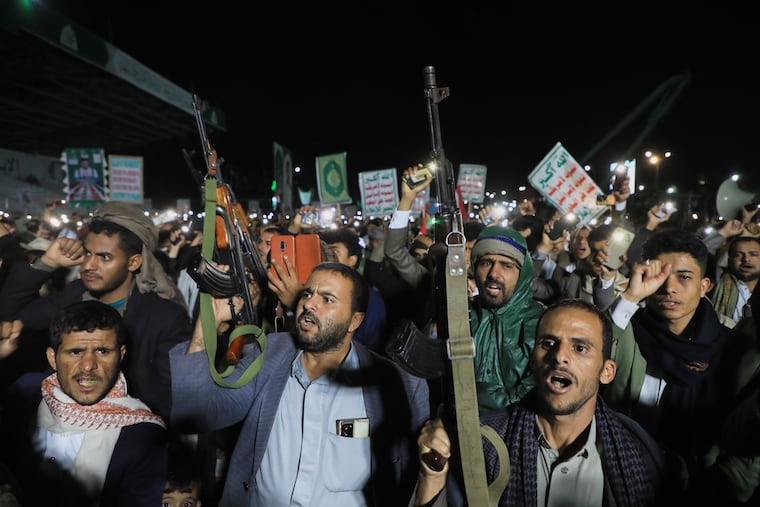
AMMAN, Jordan — As the U.S.-Israeli war against Iran opened with the killing of the Iranian supreme leader, Ayatollah Ali Khamenei, President Donald Trump said the bombing would continue “throughout the week, or, as long as necessary to achieve our objective of PEACE THROUGHOUT THE MIDDLE EAST AND, INDEED, THE WORLD!”
More than six months later, turmoil in the Middle East is only growing, while Trump seems to have no path out of the quagmire.
As of Friday, two of the most important corridors for global energy shipments — the Strait of Hormuz, gateway to the Persian Gulf, and the Bab al-Mandab Strait, at the mouth of the Red Sea — were largely closed, respectively under control of the Iranian regime and the Houthis, Iran’s proxy in Yemen.
Also on Friday, Iraqi militants allied with Iran struck Saudi Arabia’s East-West pipeline, through which the Saudis had been rerouting oil to bypass the blocked Strait of Hormuz.
The global economy, already battered, is reeling. On Feb. 27, the day before the U.S.-Israeli bombing campaign began, the price of oil opened at just over $70 per barrel. On Friday, it briefly hit $110.
A gallon of gasoline in the United States now costs $4.30 on average, compared to $2.98 when the war began, according to AAA.
With U.S. munition stocks depleted and American bases in the region at constant risk of being targeted by airstrikes, the Trump administration has shifted away from military action to a financial pressure campaign branded Operation Economic Outcast.
But while there are signs that a U.S. naval blockade is squeezing the Iranian economy, with inflation soaring, the currency collapsing, and acute fuel shortages, the regime, now led by Khamenei’s son, Ayatollah Mojtaba Khamenei, remains firmly in control. And the recent military successes of Iran’s proxies suggest Tehran’s leverage has only increased in recent days.
“This is the moment that Iran has been preparing for and building toward for years,” said Adam Baron, a fellow with the Future Security Program at New America, a Washington think tank, who studies the Houthis. “It is as if a trigger has been pulled and the regional network activated.”
“Even if the conflict has weakened Iran, which it has, one of the biggest takeaways five or 10 years from now will be how strong, integrated, and adaptable Iran’s regional network has proven to be at exactly the moment that it needed it.”
Trump, visiting Ireland to attend the Irish Open golf tournament, which is being staged at one of his resorts there, dismissed questions about the blocked waterways.
Asked about the developments in Yemen that appeared to choke off Saudi Arabia’s remaining outlet for oil exports, Trump said he had spoken by phone with Crown Prince Mohammed bin Salman and that everything would be “fine and dandy.”
“Everything will work out just fine,” Trump said. “It’s all going to work out fine.”
In Dublin, where hundreds of anti-war demonstrators gathered to protest his visit, Trump said he believed that Iran was responsible for the attack on Saudi Arabia’s East-West pipeline.
“I think they are — probably they are. They are on the balls of their feet right now,” he said, adding that he was not concerned by the advances of Iranian-backed Houthi fighters along Yemen’s Red Sea coast, suggesting their target was Saudi Arabia.
“The Houthis called us and they don’t want to fight with us,” Trump said. “They don’t want us to go after them and would much prefer not having us involved, and they’re letting most ships go through. It’s just one country they’re not too happy with. And we’ll get that straightened out.”
Saudi Arabia, however, is arguably Washington’s most important Gulf ally. And even before the pipeline was hit by drones, Saudi oil exports last month reached their lowest point in more than a decade.
The conflict in Yemen is an example of how the situation in the region has deteriorated since the start of the U.S.-Israeli war on Iran.
In February, Yemen’s long civil war was on pause, thanks to a tenuous but still intact U.N.-brokered ceasefire. Fighting has now roared back to life.
A Yemeni official who is part of the internationally recognized, Saudi-backed coalition government said there is desire for the Trump administration to intervene militarily against the Houthis, as it did in 2025.
Trump’s comments on Saturday, however, suggested that was unlikely.
Meanwhile, Israel has ramped up its strikes in southern Lebanon, threatening a fragile U.S.-brokered ceasefire there.
Ways out of the quagmire are difficult to discern.
With the war becoming a liability for Republicans ahead of the midterm congressional elections, Trump has used recent appearances, including at a GOP midterm convention and at a 9/11 memorial on Friday, to defend his decision to attack Iran.
Saudi Arabia may feel compelled to step up military action against the Houthis, to keep oil exports flowing. Riyadh, so far, seems to be moving cautiously.
In a statement early Saturday, Saudi Arabia’s foreign ministry said it would refrain from retaliating against the Iraq-based militias to give Baghdad time to address the problem.
The rest of the Middle East, particularly nations in the Persian Gulf and Jordan, which host U.S. forces, have paid a steep price for a war that its leaders actively sought to avoid.
Since February, Iran has intermittently lobbed missiles and drones at Gulf nations and Jordan, saying it is targeting U.S. military forces but at times hitting civilian infrastructure.
When leaders from across the Gulf convened last week at a conference in Abu Dhabi, capital of the United Arab Emirates, discussion centered not on when the war would end, but on how to find a way through the morass.
In Jordan, which over the past week was the target of 20 Iranian drones, there is immense fatigue — and confusion over what would constitute a good outcome.
“We are in the middle of a war that we don’t want to see anyone win,” said Oraib Rantawi, a senior adviser with the Amman-based Al Quds Center for Political Studies, explaining that Jordanians don’t want to see a strong Iran, holding sway over the region, nor an all-powerful Israel.
“We are under pressure,” Rantawi said. “And we are in the middle.”