Osprey chicks are starving at the Jersey Shore, study says
An Atlantic County University team monitored 27 osprey nests along the Mullica River and Great Bay.
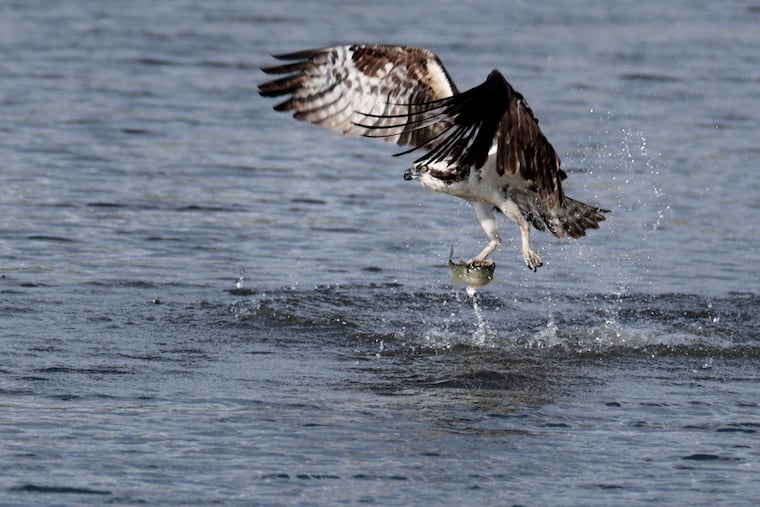
An icon of Jersey Shore waterways is in peril, according to a Stockton University study.
The osprey, a raptor that feeds primarily on fish, was reclassified from “threatened” to “stable” by New Jersey’s Department of Environmental Protection’s Fish and Wildlife agency, but a recent study by Atlantic County University, whose mascot is the osprey, found staggering declines along the Mullica River and Great Bay.
Biology students and instructors at the school monitored 27 osprey nests along the Mullica River and Great Bay this year and discovered that chicks were surviving at a dismal rate. During the first survey, in May, the team counted 54 eggs and three chicks. During the final survey, last month, there were nine fledged chicks, an 85% loss.
Melanie Schroer, a biology instructor at the school, said the study’s results were alarming.
“The broader context here is that osprey nest productivity is declining. Nesting success has taken a huge hit, not only in my little part of the world, but also New Jersey, and much of the East Coast, and so, of course, everyone wants to figure out what’s going on,” Schroer said in a statement. “This population has been recovering for 50 years, and it’s been doing great, and then just the last handful of years, not so much anymore.”
Last year, the Conserve Wildlife Foundation of New Jersey found that osprey nest productivity had its steepest decline in decades, with 57% of active nests failing to produce any young.
Both studies mentioned fluctuations in food sources, particularly the Atlantic menhaden, also known as “bunker” as a potential issue for the empty nests. Shroer, of Stockton, said researchers noticed that adult ospreys were bringing more flounder to their nests as opposed to menhaden, their typical food source. Menhaden, Schroer said, pack more calories.
“So they’re putting in more work and bringing back fewer calories, fewer resources for their young,” she said.
Menhaden are considered a “keystone species,” vital to a slew of foodchains up and down the east coast, feeding everything from whales, to game fish, to coastal birds like osprey. Commercial fishermen harvest vast quantities of menhaden for animal feed and human supplements, particularly in the Chesapeake Bay. Advocates of the Chesapeake are calling for as much as a 50% reduction in menhaden harvests.
Last year, when New Jersey reclassified ospreys as stable, officials noted how pesticides had decimated populations, with only 50 nests, statewide, in the 1970s. Those numbers had rebounded to 800 by 2023.
Schroer said Stockton’s study reveals a questionable future, however, as those adults age out.
“There are still many adults in the ecosystem, ” she said, “but if the nest productivity declines as it has been in the last couple years, there won’t be enough young birds to replace the older ones and sustain the population.”