Anti-ICE activists question why Philly police showed up at their meeting. The department is investigating.
“I don’t know a reason that would have justified the officer walking into the premises,” a police staff inspector said.
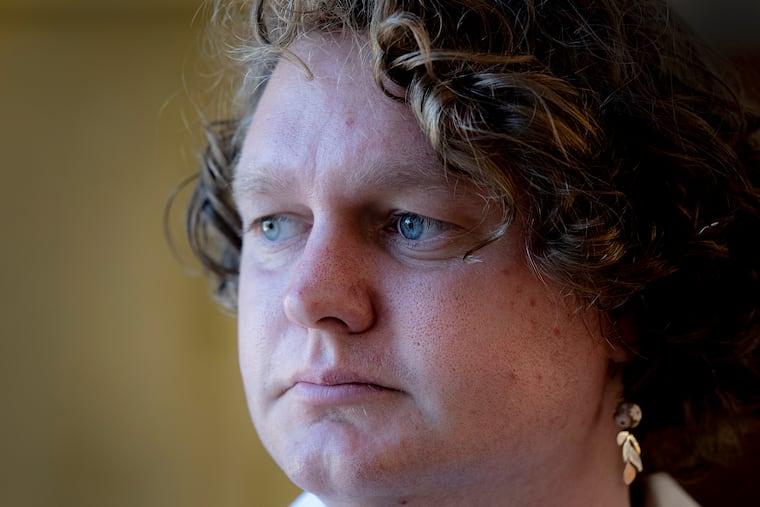
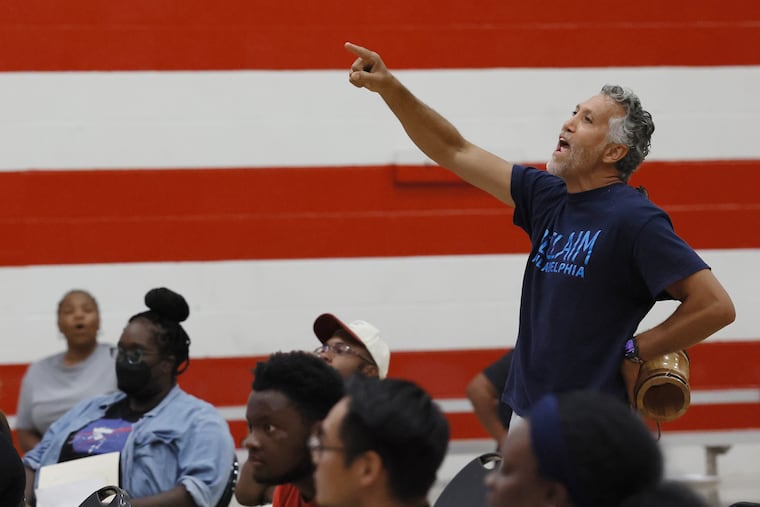
The Rev. Jay Bergen was at the sign-in table inside the Friends Center, where No ICE Philly was holding its regular public meeting last week, when a police civil affairs officer appeared.
Bergen asked what was happening, and said the officer responded, “We’re just here to make sure everyone’s safe.”
The activist group was preparing to serve cake, to celebrate its one-year anniversary.
Bergen, who leads No ICE Philly, was concerned that the officer brought his gun into the Center City facility, which includes a Quaker meetinghouse. The pastor said he walked the officer down the hall to the door, explaining that he could attend the public meeting if he wished ― then noticed a second civil affairs officer outside.
The two officers stayed there, watching, for the duration of the three-hour gathering, Bergen said, their presence leaving those inside feeling confused, intimidated, and surveilled.
“Who gave the order, and what was the goal?” Bergen asked in an interview. “Why are we more of a threat than ICE agents are? … It’s another instance of the Philadelphia police being interested in targeting Philadelphians instead of protecting Philadelphians.”
The police department said in a statement last week that “the Sept. 9 event was identified as a scheduled protest.” Civil affairs officers routinely attend demonstrations as part of their duty to public safety and the First Amendment, and “their presence was not specific to No ICE Philly,” the statement said.
But on Monday, Staff Inspector Frank Palumbo, who oversees the civil affairs unit, said he would open an investigation into the matter.
Palumbo said he did not know why an officer would have entered the Friends Center. That would be outside department policy, he said, unless there was a disturbance inside.
If the group had gathered outdoors, Palumbo said, the department would have sent more officers ― including some in uniform. It did not do so, he said, because “there was no indication whatsoever that there would be destruction of property, violence, or anything that would even result in civil disorder.”
He added, “This will not continue to occur.”
Civil affairs units are specialized teams of officers designed to act as neutral liaisons between sides during what might be contentious protests, labor actions, or big public gatherings. Like other officers, they always carry their guns while on duty.
In Philadelphia, the police department says, civil affairs officers operate in a diplomatic and impartial capacity to ensure that constitutional rights are protected for all. The officers prioritize protection of life and property while preventing vandalism, assaults, or other illegal acts not covered by First Amendment rights, the department says.
Niles Wilson of the Center for Policing Equity, a California-based research and reform group, said a key question of any investigation into the matter should be why the officers were at the meeting at all.
“What intelligence did the police department have that would either lead these officers to do this, or were these officers acting on their own?” he asked. “That needs to be answered.”
The stakes reach beyond any particular meeting, he said.
A civil affairs unit is an asset, one that can help “towards transparency and building trust between the police department and the community,” Wilson said. But “anytime the public trust is lost in that service, then it disrupts public safety everywhere.”
Philadelphia civil affairs officers are commonly present at demonstrations led by No ICE Philly, which in the last year has emerged as perhaps the boldest and most visible of the city’s pro-immigrant organizations.
Its members and supporters have been cited or arrested by different police agencies as they carried out peaceful civil disobedience, including attempting to block federal government vehicles from exiting the U.S. Immigration and Customs Enforcement office in Center City.
In one chaotic scene this year, activists were handcuffed and physically removed from the foyer area at the Philadelphia Sheriff’s Office, where they staged a sit-in to demand that Sheriff Rochelle Bilal help stop ICE arrests at the Criminal Justice Center. No ICE Philly holds a weekly “noise demonstration” outside ICE headquarters at Eighth and Cherry Streets, banging drums and blowing whistles to raise awareness and disrupt the work of agents inside.
The Sept. 9 gathering, however, was a regular meeting, generally held twice a month, open to all, and advertised in advance on social media. Other meetings have drawn far more people than the 60 or so present at this one, organizers said, which made the police presence puzzling.
“It felt kind of like a threat, like, ‘We’re watching,’” said Em Auerbach, a group member who attended. “It made people feel on edge.”
As the meeting was ending, she said, one of the officers approached a Friends Center employee at the front desk and asked: “Are you good? Do you need anything?”
The worker answered that she was fine, Auerbach said.
No ICE Philly members waited for the employee to finish her work, and then everyone left together, she said.
“It was weird,” she said of the officers’ presence. “I think they were there to intimidate us. … Unless there was a threat against our group, I don’t think this was a good use of taxpayer funds.”
Bergen described at one point asking the officers, “‘Why are you surveilling us?’ They said, ‘We’re not surveilling.’ I said, ‘That’s what a body camera is for.’”
The pastor said that as people entered the meeting, they said the police officers had asked who they were and why they were there.
Palumbo said if that happened, it would fall outside department policy, that even at combative street demonstrations people generally are not asked their names “unless it is necessary to determine who they are for the purposes of an investigation. This was not an investigation.”
Palumbo said the relationship between the police and No ICE Philly has been cordial. He estimated that police have cited protesters twice in the last year, issuing citations with $100 penalties that are similar to parking tickets.
Those citations, he said, are “the most extreme police enforcement we’ve ever done with this group.”