No blood or DNA from missing women was found in Olney house, sources say
This week police began excavating a pipe beneath the property to search for more evidence.
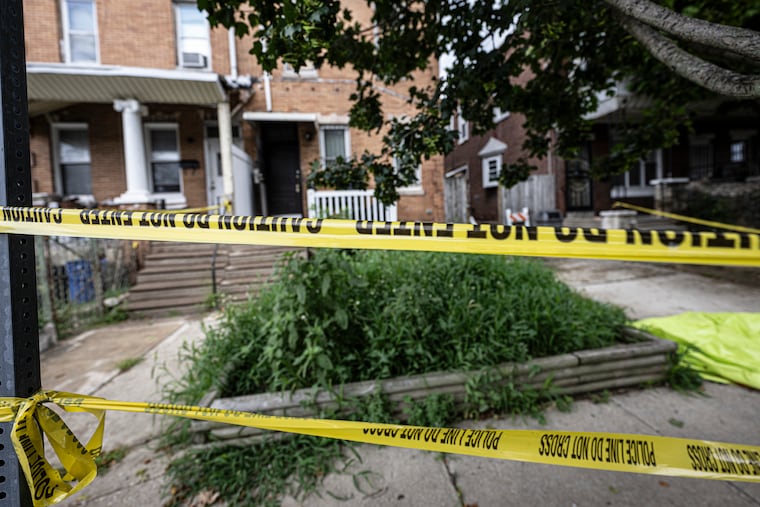
What initially appeared to be a significant amount of blood inside the Olney home tied to a missing persons investigation was not real blood, according to law enforcement sources.
Forensic testing conducted so far also has found no DNA belonging to the two missing women at the center of the evolving investigation, the sources said.
Philadelphia police and FBI agents began searching the home of Eugene Horsch last month after police arrested him with a woman carrying a fake ID in the name of Blair Tonzelli, a woman struggling with drug addiction who was last seen at the property in 2022. The probe also renewed interest in another missing person, Amy McHale, the ex-wife of Eugene’s father, who was last seen in 2016 at the same house on West Chew Avenue.
But detectives did not find the DNA of either woman on items tested so far, and while preliminary tests indicated that a significant amount of blood was present in the house, subsequent forensic tests came back negative, said the sources, who spoke on the condition of anonymity to discuss an ongoing case.
The Philadelphia Police Department did not immediately respond to a request for comment Friday.
This week police began excavating a pipe beneath the property to search for more evidence. And FBI agents are examining hundreds of pages of handwritten and typed documents, CDs, videos, and text messages for clues related to the missing women, the sources said.
Police arrested Horsch on June 19 near Independence Mall with drugs, guns, and various other weapons, as well as a phony U.S. Drug Enforcement Administration badge in the name of “Eugene Frederick Steiner.” He remains in federal custody on charges related to those offenses but has not been accused of any crimes in connection to the missing women.
Horsch, 44, was incarcerated for a previous drug conviction at the time McHale’s family reported her missing in 2016. But his father, Raymond “R.C” Horsch, who died in May 2025, has become another focal point of the investigation.
Raymond Horsch was an erotic photographer and filmmaker whose career in the porn industry dates to the 1970s. His work depicted graphic sexual violence and simulated death scenes, often involving women in addiction. Some scenes used what appeared to be prop blood. Horsch also penned semi-autobiographical novels that featured sadomasochists and serial killers.
While the forensic testing has not shown that any real violence took place, investigators continue to examine other evidence found in the home, including unpublished film and writing, law enforcement sources said. One of those items is a handwritten note that describes hurting people and references the serial killer Ted Bundy.
Shortly after Raymond Horsch’s death last year, a fire led police to search the property and arrest Eugene after they found a drug manufacturing operation and several illegal firearms.
When police searched the property again last month, they found additional drugs and guns, as well as hidden compartments, vats filled with chemicals, and a 55-gallon drum with connections to water lines in the basement.
When police arrested Eugene Horsch near Independence Mall in his black BMW, a woman with him showed police a fake ID in Tonzelli’s name. According to an affidavit of probable cause to search the Olney home, the woman told police that she did not know Tonzelli. She said Eugene never harmed her, but he told her he knew the chemicals needed to dissolve human bodies.
Testing of the pipe excavated from the property this week remains ongoing.

The Inquirer’s journalism is supported, in part, by the Lenfest Institute for Journalism and readers like you. News and editorial content are created independently of The Inquirer’s donors. Gifts to support The Inquirer’s high-impact journalism can be made at inquirer.com/donate. A list of Lenfest Institute donors can be found at lenfestinstitute.org/supporters.