Philadelphia police and FBI to begin excavating Olney house in connection to missing women case
Philadelphia Water Department will assist federal and local investigators by unearthing a pipe under the boarded-up property on the 400 block of West Chew Avenue as part of the widening probe.
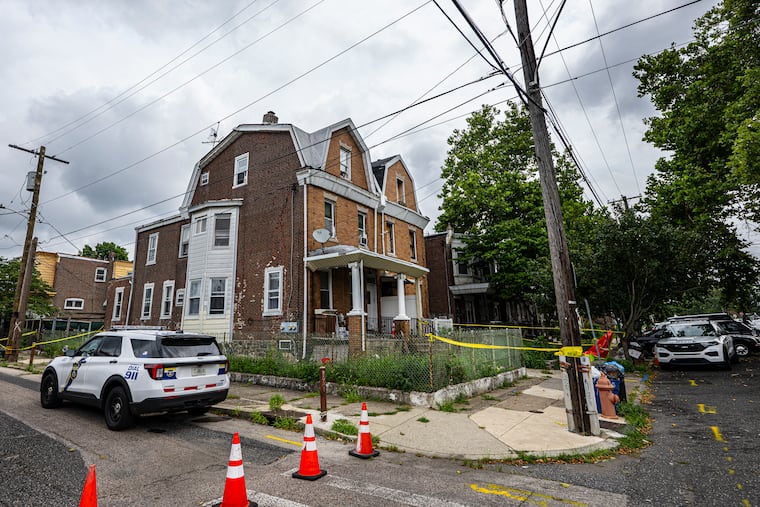
The Philadelphia Police Department and the FBI are to begin excavating part of the Olney house that has been at the center of a monthlong investigation into at least two missing persons, law enforcement officials said Monday.
Sgt. Eric Gripp, a police department spokesperson, confirmed that the Philadelphia Water Department would assist federal and local officials by unearthing a pipe under the property on the 400 block of West Chew Avenue as part of the widening probe.
“The general scope of the dig is to excavate and remove a pipe that will be subsequently examined by FBI and PPD forensics for any evidence that may be present,” said Gripp, who declined to provide a timetable for the work.
The excavation is the latest development in a case that has generated widespread interest since last month, when authorities connected the crumbling twin home to the disappearance of at least two women over the last decade.
Federal prosecutors have charged the owner of the property, Eugene Albert Horsch, 44, with carrying illegal firearms and fake federal law enforcement credentials.
Police apprehended Horsch on June 19 near Independence Mall with drugs, guns, and various other weapons, as well as a phony U.S. Drug Enforcement Administration badge. A woman who was with him at the time was carrying a fake ID in the name of Blair Tonzelli, a woman struggling with drug addiction who was last seen in 2022 at Horsch’s home.
The monthlong search of Horsch’s property has turned up an array of evidence, authorities say: hidden compartments, vats filled with chemicals, a 55-gallon drum with connections to water lines in the basement, and what police sources described as “a significant amount” of blood.
Forensic testing of the evidence found in the home remains ongoing, and police have yet to confirm whether the blood is human. Horsch has not been charged with any violent crimes in the current case.
Investigators also found Tonzelli’s bank card, other fake IDs in her name, and an unsigned, handwritten letter that appeared to describe hurting people and referenced the serial killer Ted Bundy, according to the affidavit of probable cause to search the home that was obtained by The Inquirer.
The probe grew more complicated when investigators learned that Amy McHale, the ex-wife of Horsch’s late father, Raymond Horsch, was also last seen at the Olney property in 2016, according to her family.
And adding to complexity of the circumstances is Raymond Horsch’s unusual career as an erotic filmmaker and writer, whose work fixated on sadomasochist themes, serial killers, and women struggling with drug addiction. He died in August 2025.
It remains unclear if authorities have linked any of the evidence in the house to foul play involving the missing women.
Jerome Brown, a lawyer for the Horsch family, has denied any connection to McHale’s disappearance, saying that she had struggled with addiction and mental health issues. Eugene Horsch was incarcerated at the time of her 2016 disappearance, according to state prison officials.
Eugene Horsch has a lengthy criminal background involving multiple drug convictions, including one linked to the discovery of a marijuana-growing operation after a house fire last year. After the latest search, investigators recovered numerous chemicals also suspected of being used in drug production.
The department did not provide an estimated cost for the dig.
Questions about the investigation have swelled among neighbors in Olney, as the probe continues in its second month. Two police cruisers have been stationed around the property 24-7 to prevent anyone from tampering with the active crime scene.
At a crowded community meeting in the basement of an Olney billiards hall this month, 35th District Police Capt. Walter Burks tried to ease anxieties, refuting erroneous reports on social media that falsely claimed police had discovered multiple dead bodies in the property.
Burks emphasized the house “does not pose a threat to the community” while acknowledging that he could not answer specific questions.
“I know you all see the cars outside,” he said. “You know it’s something serious. It’s an active crime scene we have to protect.”

The Inquirer’s journalism is supported, in part, by the Lenfest Institute for Journalism and readers like you. News and editorial content are created independently of The Inquirer’s donors. Gifts to support The Inquirer’s high-impact journalism can be made at inquirer.com/donate. A list of Lenfest Institute donors can be found at lenfestinstitute.org/supporters.