A new live stream camera at the Liberty Bell increases access, but raises questions for privacy experts
The new Liberty Bell stream has racked up more than a quarter million streams since it was installed about a month ago, according to EarthCam's CEO.
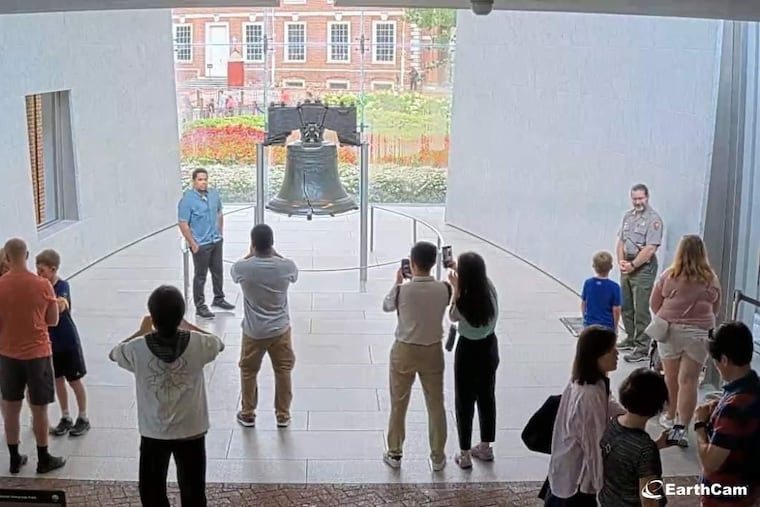
Strangers took photos of families in front of the Liberty Bell, as others took close-up photos of the iconic symbol of U.S. independence.
A little boy in blue shorts and curly hair ran up to the bell to point out the crack. A National Park Service staffer looked at his watch. It was almost closing time at the Liberty Bell Center and the crowd began to dwindle as 5 p.m. approached Tuesday.
The boy posed next to a little girl for the last photo of the day, and the room cleared.
The bell received a reprieve from visitors until 9 a.m. Wednesday, when it all started back up again.
These moments were captured by a new camera that transmits a 24-7 live stream of the Liberty Bell on EarthCam, a website that live streams various iconic sites around the world.
“At Independence National Historical Park, the livestream provides the public with a real-time virtual view of one of the nation’s most iconic historic sites, expanding public access and engagement,” said a spokesperson for Independence National Historical Park in a statement.
The Liberty Bell live stream is Philadelphia’s second on EarthCam. A camera set at the Franklin Institute that points toward the Central Library of the Free Library of Philadelphia on the Benjamin Franklin Parkway has been live on the internet since 2018.
The camera pointing at the Revolutionary-era relic was set up ahead of the United States’ 250th anniversary celebration earlier this month, and adds to the website’s collection of iconic travel destinations that includes Times Square in New York City, the Temple Bar in Dublin, and the crosswalk at Abbey Road, London. There is also a camera streaming Andy Warhol’s grave in Bethel Park, Pa., outside Pittsburgh.
The streams, while an effort to increase access to historic sites, also raise questions for surveillance experts and are part of a growing number of live streams in public places.
“The general trend of video surveillance [is] becoming pretty ubiquitous in common public spaces and across cities,” said Jake Laperruque, deputy director of the Security and Surveillance Project at the nonprofit Center for Democracy and Technology.
EarthCam, a New Jersey-based web-camera technology company, installed the Liberty Bell camera and live stream as part of a donation of 250 cameras for the United States’ 250th birthday.
“Taking people to that park and showing that view is amazing,” said Brian Cury, EarthCam’s founder and CEO.
The Liberty Bell cam has racked up more than a quarter million streams since it was installed about a month ago, Cury said, including 80,000 virtual visits on July Fourth.
Cury said EarthCam donated the camera to the National Park Service at no cost. The company streams from national parks throughout the country, including the Flight 93 National Memorial in the Shanksville, Pa., area.
The streams are a way to bring iconic sites to people in a way that is more compelling than a photo, Cury said. And hopefully, he said, they can entice people to step outside.
“There are lots of kids that should get out of the house and go explore our amazing country,” the CEO said. “But they are online.”
Visitors to the EarthCam website can view the live stream, a video archive of the last 24 hours, and a collection of still images from previous days since the camera has been installed (a “hall of fame” of sorts, Cury says.)
Still images from recent days show the bell at night, families visiting, and groups gathering in front of the bell for photos.
Also on the “hall of fame”: a park ranger taking a photo of a law enforcement officer in a black uniform posing in front of the bell after hours.
Some surveillance experts say the archive raises privacy concerns, especially because people are identifiable in the image.
“The longer those pictures are kept, the more it makes me uneasy,” said Rachel Levinson-Waldman, director of the Brennan Center for Justice’s Liberty and National Security Program.
“The more it’s susceptible to even a private company just collecting those pictures and using them for some other purpose,” she said. “Or just people scrolling through and seeing the pictures for who knows what purposes people might use them.”
There is no information posted at the site about the live stream, but a security sign at the center’s entrance advises: “video surveillance in effect.” Online, the live stream is advertised via a small link at the top of the National Park Service’s Liberty Bell web page.
EarthCam does not place cameras in private locations where people have an expectation of privacy, Cury said. And the camera itself — on the wall in front of the bell — is not hidden, he said. Visitors, the CEO said, view the camera as an attraction.
“When you are looking at a lot of our cameras,” Cury said, “people are standing in front of them and waving.”