Black winemakers are few and far between. These Philly-area business owners are working to boost their ranks.
The Philly Black Wine and Spirits Fest, held at Girard College Saturday, is aimed at making wine approachable and promoting Black winemakers, its founder said.
Four years ago, Keyanna Wilson’s family opened a winery in Hatboro to develop new wines and cultivate a new generation of Black winemakers.
Through Cyrenity Sips Winery, Wilson’s family aims to boost the number of Black winemakers in Pennsylvania by 15 in the next 15 years. To accomplish this mission, they are identifying entrepreneurs and supporting their entry into the industry through a nonprofit.
“It’s making those connections, teaching people how to make wine, the process of it, the social skills,” said Wilson, who owns Aurora’s Vines, a brand launched by Cyrenity Sips.
She was among the sellers at the fourth Philly Black Wine and Spirits Fest at Girard College in North Philadelphia Saturday.
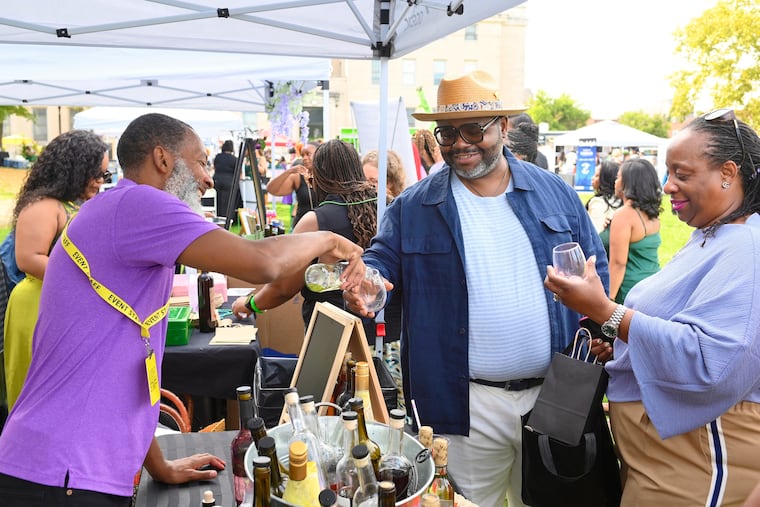
Inside Founders Hall and outside at booths sprawled across the boarding school’s lawn, guests sipped wines, bought bottles and sampled food from different vendors, while a DJ spun music from a stage.
Sonia “Sunny” Blount, the event’s founder and owner of Kabila Events, said she launched the festival four years ago in part to promote Black-owned businesses in a white-dominated industry.
Inspired by the “history and richness” of a wine tasting event at a vineyard in Barcelona, Blount, a Mount Airy native and Temple University graduate, said she wanted to bring that experience to Philadelphia, while also spotlighting Black-owned wine and spirits makers.
Black ownership remains rare in the wine business
As of 2020, fewer than 1% of American winemakers and winery owners were Black, according to the Association of African American Vintners.
Some of that is due to challenges faced by many Black-owned businesses, Blount said.
“There’s a lot of bureaucracy, a lack of resources and access to capital,” she said.
But it also reflects a less tangible barrier, related to perceptions of the wine industry and inclusivity, she said.
People want to experience wine “in a way that is approachable,” Blount said. “If it’s all historically been one way, there has been a bit more of a challenge in trying to get people interested.”
Saturday’s event, however, had an eager audience. Many dressed up in purple, gold, and green in keeping with the event’s Mardi Gras theme, “From Bourbon Street to Broad Street.”
“We needed a weekend out,” said Shavonne Carter, who attended with her friend April Howard. The Brookhaven residents were enjoying tasting the variety of wines and shopping. Carter bought perfume, while Howard bought a craft syrup for cocktails.
While the friends said they had gone to other festivals featuring Black-owned businesses, Saturday’s was on “a larger scale,” Howard said.
“It’s a work of love,” Howard said of the vendors. “These are regular people. This is their dream, and it’s nice to be able to support them.”
Charles and Lakisha Honesty, who live in Washington, D.C., said they bought tickets to the event after seeing an Instagram post.
“We’re not wine-every-day people,” Charles Honesty said, but they were drawn by the promise of a fun event. The couple were enjoying samples from Hedon State Wines, a business also from Washington, D.C., that had a booth set up.
Michael Goode, Hedon State’s managing partner, said he started getting interested in wine after going out to eat and feeling intimidated by a restaurant wine list.
He started going to wine school after work, where he was “the only brown person in the room,” he said.
Blount hopes the festival will expand to different cities and eventually “provide some space for education and resources for people who want to get into the industry.”
There’s a “lack of knowledge” around what it takes to start a winery, Wilson said, including navigating the liquor laws in Pennsylvania.
But it’s doable, said Wilson, who specializes in wines with unconventional flavors — like blackberry and mango green tea. “I would come up with these crazy concepts and ideas, and my family was like, ‘You should start a business around that,’” she said. On Saturday, attendees were lining up to try her new sangrias, including a strawberry watermelon version.
Wilson, whose business sources fruit from New Jersey and grapes from California, said she often encounters people who don’t think they like wine, but as she introduces them to “more fruity flavors, everybody’s palates usually open.”
She hopes more Black winemakers will open their minds to the possibilities of joining the industry.
“If you have the ambition to come behind it, we’ll get you there,” Wilson said.