Trump has started a dumb trade war with Canada that threatens U.S. jobs and security
The president’s insults to Canada’s sovereignty and military have threatened ties between two countries long bound together by friendship and trade.
A U.S. president must work hard to rupture a relationship with a neighboring country that has been America’s closest economic, security, and people-to-people partner for decades.
Leave it to Donald Trump.
He has just started a new trade war with Canada that will hurt the U.S. economy, batter our auto industry, and undermine American farmers over his irrational love of tariffs and obsession with turning the Great White North into the 51st state.
The Wall Street Journal called the president’s first round of tariffs last year against Canada “the dumbest trade war in history,” and opined that “it got dumber” recently as the administration escalated with new tariffs.
However, Trump has not been able to cow a defiant Prime Minister Mark Carney. “We recognized from the start that America has changed,” Carney said. “We recognize that sometimes, its signature is written in pencil.” A reference to the White House tactic of adding conditions at the last minute to documents already agreed to, or in some cases, deals that have already been signed.
“We were not prepared to compromise our sovereignty,” the Canadian leader added. “You’re at war when you’re attacked, and we got attacked.” Americans should be asking how in the hell Trump has managed to turn America’s closest friend into a reluctant enemy.
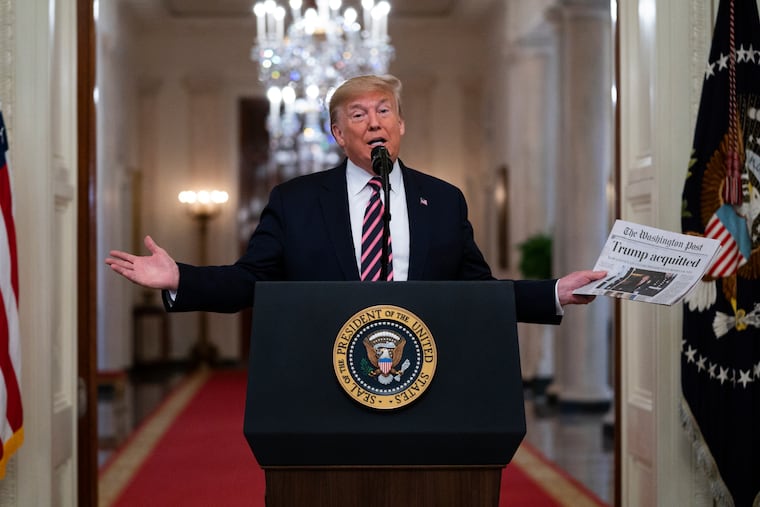
A major part of the problem is Trump’s constant stream of insults. Rather than rethink serious responses after the talks broke down, Trump spewed out slurs against Canadian officials and the Canadian military.
» READ MORE: Trump’s Ukraine negotiators are too chicken to visit Kyiv and support its independence | Trudy Rubin
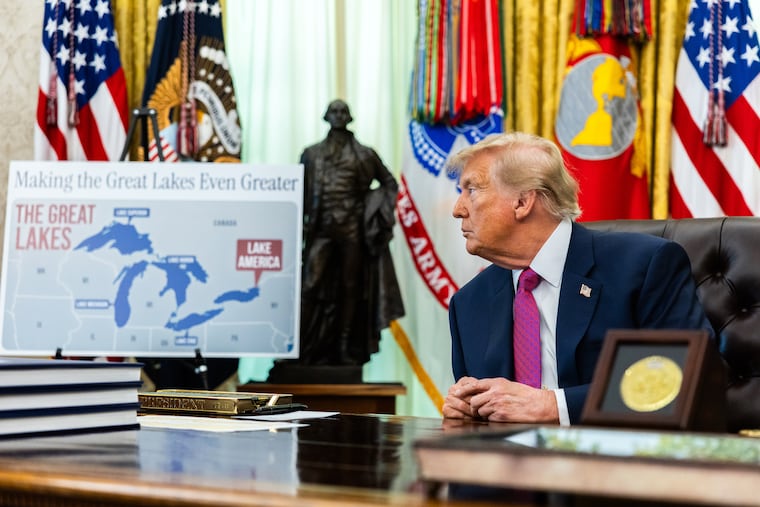
Then the peevish POTUS signed an executive order Thursday to change the name of Lake Ontario to “Lake America,” one more childish follow-up to continued White House insistence that Canada should officially accede to the USA. (In the same vein, Vice President JD Vance recently called Canada a “state,” and then referred to his gaffe as a “Freudian slip.”)
But the punch line that laid bare Trump’s imperial attitude toward our neighbors — as he has made so clear in his threats to occupy Greenland — was a post declaring, “WE DON’T NEED CANADA, THEY NEED US!”
“That is demonstrably not true,” said the former U.S. ambassador to Canada, and Philadelphian, David Cohen. After Mexico, Canada is our second-largest trading partner, and the things Canada provides are hard to obtain elsewhere.
“The United States absolutely needs Canadian aluminum. Canada is the No. 1 source of imported energy to the United States by a wide margin, in particular oil, which Canada sells at a discount,” Cohen said.
Sixty-three percent of American crude oil imports come from Canada. Midwestern U.S. refineries are designed to handle Canadian heavy crude, according to the U.S. government, and couldn’t easily switch to other sources.
Canada is a key exporter of electricity to New York and the Northeast. Carney has not yet threatened to cut off energy exports, although Quebec’s premier has said everything “is on the table.”
Indeed, contrary to Trump’s insistence that the Canadians are cheating us, if you eliminate Canada’s energy exports, the United States has a trade surplus with our northern neighbor. “It would be more expensive and inconvenient to buy elsewhere,” Cohen told me, “and cost U.S. jobs. The United States benefits massively [from these exports].”
Thirty-seven U.S. states, including Pennsylvania, have Canada as their largest export destination.
Then there is potash, a mineral that is essential for fertilizer. “The U.S. has very limited reserves,” said Cohen, “and U.S. farmers need potash.” He added that potash exports are critical to the agricultural economy in Pennsylvania. Canada is one of the three largest potash producers in the world, the other two being Russia and Belarus. Does Trump want to rely on Vladimir Putin for this essential mineral?
The key here, Cohen explained, is the symbiotic relationship between Canada, the United States — and Mexico. The car industries are totally intertwined, for example, with parts moving back and forth across borders several times. Trump’s tariffs will be brutal for Detroit’s auto industry, and likely cost many U.S. jobs.
“The North American economy functions more productively as a combined presence than if it were just separate,” Cohen noted. “Trying to find replacements for Canadian goods would be worse for American businesses, jobs, and GDP.”
» READ MORE: Trump ignores joint efforts by his favorite dictators to undermine U.S. security | Trudy Rubin
Similarly, there is a critical military relationship between Canada and the United States (even as Trump keeps grossly insulting the Canadian military, ignoring the many lives Canadians lost supporting the United States in Afghanistan).
Although Canada has underinvested in its defense spending and is only now stepping up, “Canada is the most important partner we have in growing our continental defense against Russia and China,” Cohen said. Canadian partnership is critical for defense in the Arctic given Canada’s vast Arctic territorial spread.
So Trump’s approach to our northern NATO ally is disastrous, unnecessarily alienating a population that is intimately bound with ours, and acting against U.S. economic interests for no reason. The United States-Mexico-Canada Agreement that already exists, known as the USMCA, can be updated to handle new concerns, but Trump’s attempts to lord it over Canadians are an egocentric blunder with grave long-term risk.
Cohen believes the relationship could be rebuilt under a new administration, “but you would have to pay respect to Canadian sovereignty.” He said a new president in 2028 should make his first phone call and first foreign trip to Canada.
“There is nothing wrong with apologizing when [our leadership] has done something which is not in the best interest of the country.”
Of course, Trump’s name-calling and disrespect for friends has ruptured relations and trust with close allies in Europe and Asia that will probably be even harder to rebuild than the ties with our close neighbor. Yet, future relations with Canada will be the bellwether for whether America can recover the critical alliances this administration has heedlessly ripped apart.