Why Pennsylvanians should celebrate disability pride
Disability Pride Philly chose this year’s theme with precision: “We Belong Here and We’re Here to Stay.” This theme could not be more urgent or timely.
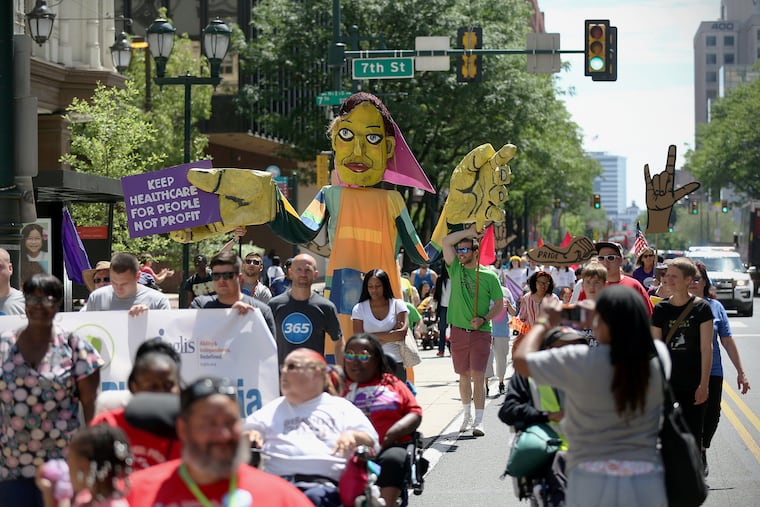
A few Saturdays ago, I ventured down to the Ben Franklin Parkway to attend and volunteer at Disability Pride Philly. This parade and festival launches more than a month of celebrations: July marks Disability Pride Month, honoring the Americans with Disabilities Act’s passage on July 26, 1990.
To some, “disability pride” sounds like an oxymoron, or a niche idea that may not touch them. As a person with multiple disabilities, I can tell you that disability pride matters more than you might think.
Accessible education, technology, rehabilitation, and civil rights protections let me live fully integrated into my workplace, community, and family. I hold a master’s degree and a doctorate. I do research on overlooked and unexamined issues that affect pediatricians and their patients. I live the life I choose, in the home I choose, with the job, hobbies, and community that I choose. These may seem like obvious rights for anyone to have. They are not.
Disability Pride Philly chose this year’s theme with precision: “We Belong Here and We’re Here to Stay.” This theme could not be more urgent or timely.
For most of American history, society separated people with disabilities like me from their families, schools, workplaces, and communities and placed them in institutions. Institutionalization confines children and adults with disabilities to restricted residential settings, cut off from family and community.
Institutions breed lack of oversight, abuse, insufficient care, and the systematic segregation of disabled people from society at large. Decades of evidence now show that people thrive when they receive support in their homes and communities.
Disability pride rests on one central argument: Whomever you are, regardless of your body, mind, or circumstances, all of us deserve dignity, choice, joy, and freedom. The disability rights movement spent generations fighting for laws to guarantee this. Those legal protections now face a coordinated challenge.
On June 18, the U.S. Department of Justice’s Office of Legal Counsel released a memo that claims the U.S. Supreme Court’s landmark 1999 decision in Olmstead v. L.C. did not require states to provide services in community settings rather than institutions. That interpretation contradicts 27 years of court decisions, federal enforcement, and disability rights advocacy grounded in the principle that unnecessary segregation of disabled people violates federal law.
The memo did not appear in a vacuum. Six states pursue active litigation in Texas v. Kennedy, a case that seeks to strip federal disability protections.
Two days before the memo dropped, the U.S. Department of Education announced plans to shift key disability and civil rights offices — including the Office for Civil Rights — out of Education and into other agencies. For Pennsylvania, where young people with disabilities make up a substantial share of the student population, this transfer reaches beyond bureaucratic reshuffling. It will affect families, schools, and students across the commonwealth.
Disability stands alone as the one minority group that anyone can join at any point in life, so this issue eventually touches all of us.
A common assumption links these actions: home and community-based services cost too much, stretch too thin, or prove too difficult to sustain. When community supports seem unavailable, institutions get framed as the responsible alternative. But this scarcity did not arise on its own; it was manufactured.
Pennsylvania itself shows a different way.
Over decades, Pennsylvania moved steadily away from institutional settings and toward community integration.
When leaders invest in home and community-based services, people thrive. Earlier this year, the Shapiro administration announced that Pennsylvania cut its emergency waiting list for intellectual disability and autism services by 31%, and reached the lowest direct support professional vacancy rate in more than a decade.
The Pennsylvania Developmental Disabilities Council also supported innovative housing initiatives that help people with disabilities live in their communities rather than institutions. Several Pennsylvania counties expanded access to home and community-based supports, allowing more than 42,000 Pennsylvanians to receive services in their homes and communities; some counties eliminated their emergency waiting lists entirely.
These successes happened because Pennsylvania chose to fund home and community-based services. They matter nationally because they expose a flaw at the heart of the federal argument. Researchers document what they call the “Olmstead effect”: states that invest in home and community-based services see fewer people confined to institutions or at risk of landing in one.
Disability stands alone as the one minority group designation that anyone can join at any point in life, so this issue may eventually touch all of us. Aging, illness, and injury make disability part of the human experience. The policies behind community living, accessible education, and civil rights protections reach beyond abstract legal debates. They determine whether you, me, and the people we love can live independently, participate in our communities, and exercise meaningful choice over our own lives.
This July, Disability Pride Month offers a concrete ask: learn about the disability rights movement and the policies that make community life possible. Speak up when these hard-won rights come under threat. And when policymakers claim that community inclusion costs too much or seems unrealistic, remember Pennsylvania’s example: When we invest, inclusion works.
Hannah Anderson is a writer and researcher and the founder of Learning Design Collective LLC. She lives with multiple disabilities, including vision and hearing impairment.