While our country mourned the thousands dead in New York, we Arab Americans also had to mourn our place in American society
The pressure our community has faced since 2001 has made us stronger in a lot of ways. It forced us to build real, lasting ties with our religious allies.
Like every American who lived that fateful day, I can vividly remember where I was on Sept. 11, 2001.
I was in the middle of chairing a hearing as a city civil service commissioner when my administrative assistant burst into the room. She told me a plane had hit the World Trade Center in New York. I postponed the hearing immediately.
But unlike millions of Americans who were frozen in place watching the heartbreaking visuals of the second plane hitting the second tower, I was already on the phone with the Philadelphia Police Department, the Philadelphia School District, and the Human Relations Commission.
I knew there would be an immediate backlash against the Arab and Muslim American community.
Like every other minority community in this country’s history, our community knew too well the playbook that is deployed following a tragedy. The provocations from talking heads on television, the incendiary questions expedited by the broader 24/7 media landscape, even the inflammatory comments made by elected officials — the very people who were supposed to protect us.
I could see it coming. In America, we always search for an enemy to blame, and sadly, on Sept. 11, 2001, Arab and Muslim Americans were the ones unfairly blamed.
In those first few days, thanks in part to our partners in law enforcement and our wider community outreach, we managed to head off the worst of it for the Arab and Muslim American community in Philadelphia. We had some threats and attacks on stores, and some people were targeted with violence. But even though that was horrific and traumatizing, in comparison to others, in Philadelphia our community was surprisingly fortunate.
Across the country, Arab American businesses and mosques were literally burned to the ground. Arab Americans were arrested, and some were held for a long period of time without charge. Other Arab Americans — and those perceived to be Arab — faced targeted violence and, horrifically, a few people were murdered.
These serious hate crimes and attacks by both lone actors and, sadly, also the government, were widely underreported by the media, then and now. Our community still feels that pain every day.
We weren’t even given the time to mourn the tragedy ourselves, including the many victims on 9/11 who themselves were Arab and Muslim Americans.
While our country mourned the thousands dead in New York, we as Arab Americans also had to mourn our place in American society, which has never recovered. It was the way the country changed after 9/11 that has been so difficult for our community. It was a transformation that hit every American, but it felt targeted at us.
The response to 9/11 fundamentally shifted what the U.S. stood for. We were dragged into two devastating wars, first in Afghanistan, and then in Iraq. Those conflicts took hundreds of thousands of innocent Afghan and Iraqi lives and thousands of our own soldiers.
Then came the Transportation Security Administration, a government organization that utilized racial profiling in what never once felt like “random” checks.
The Patriot Act expanded government spying into the private lives of all Americans, but particularly Arab and Muslim Americans, who faced extraordinary government surveillance.
Other law enforcement agencies followed, with their own prejudiced practices, especially the New York Police Department, which started sending undercover agents into mosques to record worship services. Their “Demographic Unit” went to gatherings, restaurants, and clubs to survey the community. They made lists of our businesses and started infiltrating student groups.
On top of that, the federal government started the NSEERS program, forcing thousands of men visiting the U.S. from Muslim-majority countries to be fingerprinted and registered like criminals. No terrorists were found among those profiled.
We also now know the extent to which the government used torture against mainly Arab and Muslim prisoners at black sites, and most notoriously at Guantánamo Bay. We now know that many of those prisoners were innocent and had nothing to do with 9/11, let alone al-Qaeda. That didn’t stop the CIA and its contractors, all of whom escaped justice for their role in the torture program, from using waterboarding and extraordinary rendition on these prisoners, all while denying their basic rights.
After 9/11, if you were Arab or Muslim, there was no such thing as being innocent until proven guilty anymore.
Even now, more than a dozen men are still sitting in Guantánamo Bay without ever facing a trial, due in part to the very torture program the government once tried to say was necessary.
And in the decades since, some things have gotten worse.
There continue to be travel bans targeting people from predominantly Arab and Muslim nations.
Groups in places like Texas are trying to ban Sharia law — a grotesque, Islamophobic distortion that pretends Sharia is a legal system challenging the Constitution rather than a set of guidelines for moral and ethical conduct in a religious context.
And attempts to silence and censure Arab American voices, particularly on issues like Palestine, continue at universities, corporations, and state capitals across the country.
It hasn’t all been dark, though.
The pressure our community has faced since 2001 has made us stronger in a lot of ways. It forced us to build real, lasting ties with our religious allies, especially our Jewish and Christian neighbors. That’s how the Interfaith Center of Philadelphia got its start.
It solidified our political presence, too.
Now, we have more leaders than ever standing up for our inclusion in the city and the state. Many elected leaders have rallied to support us, and our community has the greatest number of people elected to local, state, and federal offices we’ve ever seen.
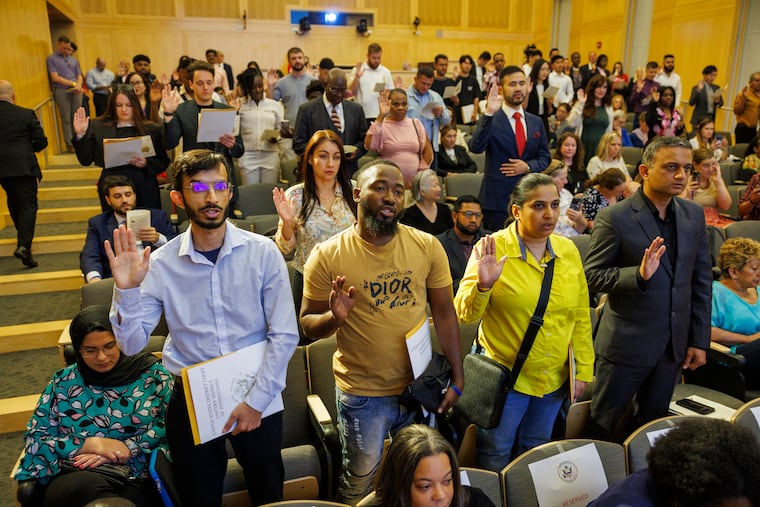
By working together with allies to make the U.S. freer, and to protect the importance of what it means to be an American citizen, Sept. 11 showed the resilience of our community.
I could not be prouder of that.
Twenty-five years ago, even as those terrorists tried to break us, and others inside our own country tried to divide us, America prevailed.
We nearly lost our democracy on that fateful day, as our democratic system was hijacked in the name of “security.” But we, as Americans, came together.
And today we must continue to live the words of the great Benjamin Franklin: “Those who would give up essential liberty, to purchase a little temporary safety, deserve neither liberty nor safety.”
Marwan Kreidie teaches political science at West Chester University and is the executive director of the Philadelphia Arab-American Development Corps.