The Case for Impeachment: If Trump’s misconduct is not impeachable, nothing is
The Founding Fathers did not foresee that political expediency and lack of nerve could thwart the Constitution’s mandate for the removal of an unfit or rogue president for wanton lawlessness.
This essay is part of a series called ‘The Case for Impeachment,’ which illuminates how Donald Trump has trampled the rule of law and is a clear and present danger to the republic.
Let’s start with the obvious: The chances of removing President Trump from office are slim.
The Constitution requires a two-thirds majority of senators for impeachment convictions. Trump’s acquittals in two previous impeachment trials were possible because most Senate Republicans opposed his conviction. With the support of only 34 Republicans, Trump is practically immune from impeachment, conviction, and removal.
The failure of impeachment to meaningfully check corrupt or tyrannical presidents, because of partisan acquittals, may be the Constitution’s greatest modern failure. It is a betrayal of the principles that inspired the Declaration of Independence and the Constitution.
No kings
Fundamental to our founding is the idea that presidents are not kings — that no one is above the law, unaccountable for wrongdoing, or wields unchecked power.
That principle was fundamental to American independence. As the Declaration of Independence proclaimed: “The history of the present King of Great Britain is a history of repeated injuries and usurpations, all having in direct object the establishment of an absolute Tyranny over these States.”
Reciting a “long train of abuses and usurpations” and a “design” to place the American colonies “under absolute Despotism,” the declaration concluded that a king “whose character is... marked by every act which may define a Tyrant, is unfit to be the ruler of a free people.”
That same spirit drove the Constitution’s framers to make presidents accountable through impeachment. As James Madison wrote in The Federalist No. 47, “[t]he accumulation of all powers, legislative, executive, and judiciary, in the same hands . . . [may] justly be pronounced the very definition of tyranny.”
Madison approvingly quoted Thomas Jefferson, the declaration’s primary author, in The Federalist No. 48: “An elective despotism is not the government we fought for [T]he powers of government should be so divided and balanced among several bodies of magistracy as that no one could transcend their legal limits without being effectually checked and restrained by the others.’”
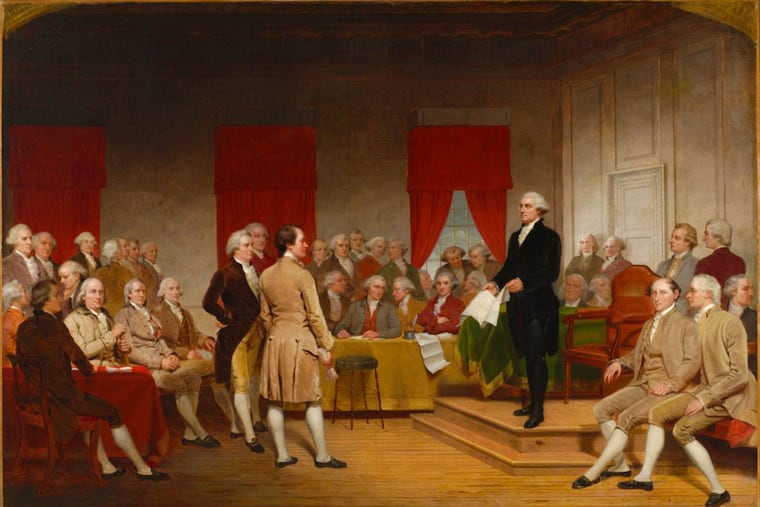
At the constitutional convention, George Mason foreshadowed Madison’s concerns: “No point is of more importance than that the right of impeachment should be continued. Shall any man be above Justice? Above all shall that man be above it, who can commit the most extensive injustice?”
The Constitution’s standard for impeachment — “Treason, Bribery, or other high Crimes and Misdemeanors” — is broad but not vague: Each term has a clear meaning drawn from longstanding English legal practice. Taken together, they embrace a wide range of culpable misconduct not limited to statutory crimes.
That Trump has committed impeachable offenses is indisputable.
Impeachable offenses included deliberate violations of the Constitution; willful departures from sworn duty; abuses of power; self-dealing; bribery; corruption; any compromise of public interest for personal gain; being in the pay of foreign powers; or betraying national interests in foreign dealings.
As Alexander Hamilton explained in The Federalist, impeachment could “never be tied down by such strict rules, either in the delineation of the offense by the prosecutors or in the construction of it by the judges, as in common cases serve to limit the discretion of courts in favor of personal security.” Congress has complete discretion over the rules, most procedures, and grounds (however, the House frames them) for impeachment proceedings.
Indisputable evidence
That Trump has committed impeachable offenses is indisputable. He has repeatedly violated the Constitution, usurped power, defied laws and judicial rulings, failed to execute laws, abused the pardon power, abused prosecutorial powers to target political enemies, issued executive orders and coerced “deals” targeting First Amendment freedoms, denied due process, started wars with other nations without congressional authorization, threatened and abandoned friendly nations and alliances, and engaged in corrupt self-dealing for financial, personal, and political gain to unprecedented degrees.
Trump’s misconduct is at the center of the constitutional bullseye of impeachable wrongdoing — encompassing the core types, severity, and number of misdeeds the standard was designed to cover.
If Trump’s misconduct does not warrant impeachment, nothing does.
Constitutional constraints are meaningless if unenforced. If presidents are free to act as tyrants, the rule of law in America, including the Constitution, is dead. While President Trump’s successful impeachment and conviction seems beyond reach today, circumstances do change — sometimes dramatically and suddenly, making what had once been politically impossible newly achievable and even imperative.
We should stand ready to act.
Michael J. Gerhardt is a constitutional law professor at the University of North Carolina — Chapel Hill and author of several leading treatises on impeachment, including a new paperback edition of his book, “The Law of Presidential Impeachment: A Guide for the Engaged Citizen.” Michael Stokes Paulsen is the distinguished university chair and professor of law at the University of St. Thomas.

Inquirer Opinion Newsletter