Dave McCormick dreams of strengthening science, but Trump is researchers’ worst nightmare | Editorial
The Pennsylvania senator’s gentle advocacy for NIH funding has had little apparent impact on the president he wholeheartedly supports.
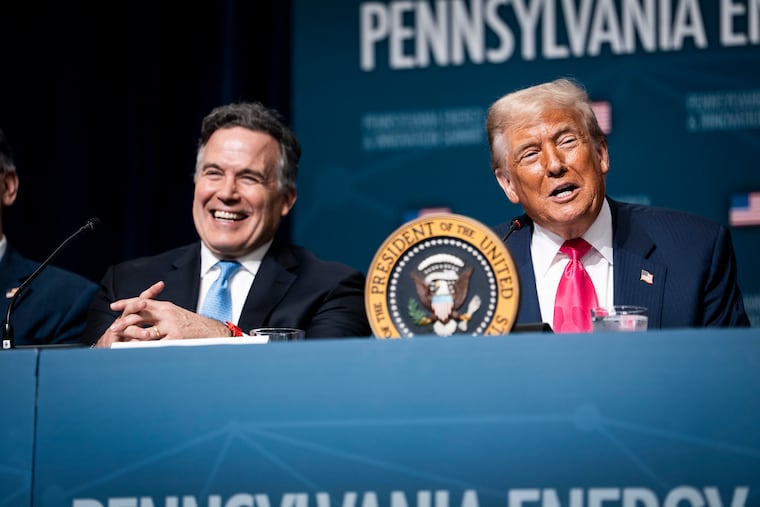
In a recently published op-ed extolling the lifesaving virtues of federally funded research at institutions such as Children’s Hospital of Philadelphia, Sen. Dave McCormick called for doubling funding for the National Institutes of Health.
Good luck with that.
The Pennsylvania Republican is certainly right about the human and material value of scientific and medical research, particularly in the state he represents, where NIH spending supports more than 21,000 jobs and $5 billion in economic activity. But his call for “more science, not less” could hardly be more at odds with the agenda of the president he “supports 100%.”
A layperson could read McCormick’s entire epistle and come away with the impression that Donald Trump had nothing to do with the research challenges he cites. The senator criticizes the Biden administration for letting politics affect science, the NIH for bureaucracy and opacity, and the Office of Management and Budget — without mentioning that it’s an arm of the White House — for an attempt to eviscerate the national research budget. But Trump comes in only for praise for having “rightly reassessed” some grants and “rightly called” for a new golden age of American science.
With golden ages like this, who needs the dark ages? The Trump administration has undertaken an all-out, sustained, and unprecedented assault on research that has reduced the courts and Congress to damage control at best. Anyone calling for this regime to double NIH funding might as well throw in a heartfelt plea for Middle East diplomacy, clean government, and free trade.
» READ MORE: Philadelphia shouldn’t give up on the Academy of Natural Sciences’ historic museum | Editorial
The administration has, in fact, proposed slashing the budget for the institutes, which underwrite most of the world’s biomedical research, by more than 40%, or about $20 billion, this fiscal year, a ruinous idea Congress fortunately ignored. Not to be diverted from its backward path, the administration has achieved the same goal by failing to distribute the money Congress appropriated in a timely fashion, causing disarray in the institutions and programs that rely on the funding. Elon Musk’s so-called Department of Government Efficiency, which McCormick defended, set the tone by firing NIH staff and slowing down grants for political reasons.
The slow-walking has presented particular challenges to continuing programs, which rely on suddenly unreliable annual renewals of vital funding. The administration has also canceled or frozen thousands of grants from the NIH and the National Science Foundation, reducing the number of awards by about a quarter compared with the Biden administration. It further tried to cap overhead costs, freeze funding en masse, and subject grant decisions to an overtly political process controlled by the White House. Those measures were turned back or held off by the courts and Congress, but the impression of a continuing war on science is unmistakable.
» READ MORE: New Jersey Gov. Mikie Sherrill has set an ethical example for a corrupt era | Editorial
McCormick has certainly contributed his share of not-very-sternly-worded letters objecting to some of this. As he noted in his op-ed, he and a few of his Republican colleagues recently implored administration officials to “carefully consider the potential effects” of canceling research midstream and “consider, where appropriate, opportunities to bring existing research projects into alignment with current priorities instead of terminating ongoing awards.”
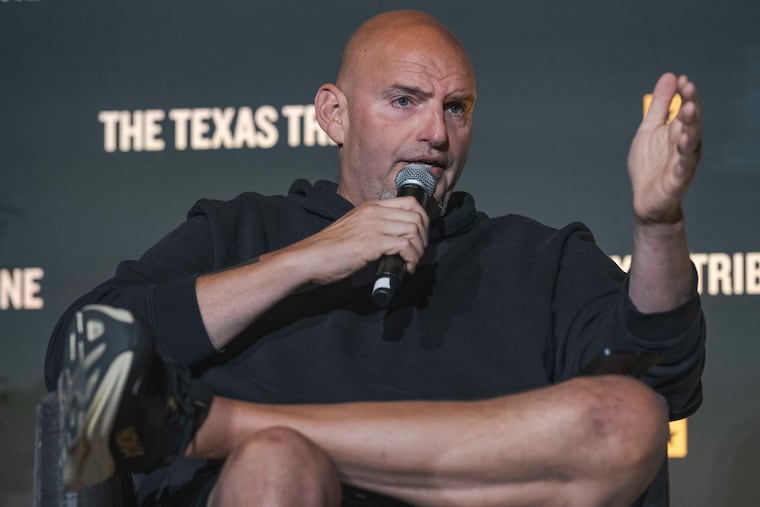
The senator also joined Democrat John Fetterman, Pennsylvania’s other senator and emerging McCormick superfan, in an earlier expression of senatorial “concern with the pace of grant awards” to NIH Director Jay Bhattacharya, urging him to “move expeditiously to obligate all … appropriated funds.” More recently, the odd couple penned another letter respectfully requesting a briefing from Health and Human Services Secretary Robert F. Kennedy Jr. on his rationale for abruptly canceling 150 grants for healthcare quality research at CHOP, the University of Pittsburgh, and other institutions across the country. They noted that the sudden evaporation of all that funding “could create uncertainty around federal research support.”
The prospects that such legislative hand-wringing will meaningfully affect the administration’s course are vanishingly slim. Trump knows he can count on McCormick when he needs him, after all: The senator votes for the president’s agenda 100% of the time — enough to make longtime Republican leader Mitch McConnell look like a maverick.
Sure, twice as much funding for research would be nice. For the remainder of this administration, however, McCormick would do well to focus on fighting hard for the funding in place instead of musing about what he can’t possibly deliver.