Krasner’s candor problem started with his first exoneration win
In 2024, a judge said the district attorney “had no good faith basis” for accusing prosecutors of misconduct in securing the 2018 release of a man convicted of murder.
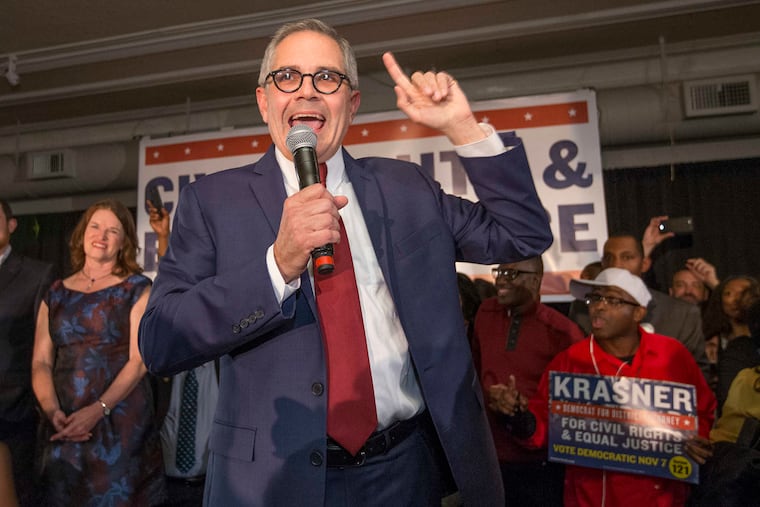
A number of judges have called out District Attorney Larry Krasner’s office for lying and sloppy lawyering in several recent exoneration cases.
A supervisor in Krasner’s office was disbarred last year for repeatedly lying while attempting to overturn a death penalty conviction. In June, another former supervisor was suspended from the region’s federal courts for three years for her role in attempting to mislead a judge in the same case. Last month, a former assistant district attorney said she was pressured to lie in court and instead resigned.
But judges have raised concerns about a lack of candor dating back to the first exoneration Krasner secured after he became Philadelphia’s chief prosecutor in 2018, according to a review of judicial rulings, court transcripts, as well as internal district attorney’s office emails and other documents obtained through discovery in a lawsuit and shared with The Inquirer.
Exoneration cases often take years to litigate. But just six weeks after Krasner was sworn in, his office vacated the first-degree murder conviction of Dontia Patterson. He was set free three months later.
Patterson had spent 11 years in prison after being convicted in the shooting death of Antwine Jackson. Patterson’s first trial ended in a hung jury with an 11-1 vote in 2008, but he was convicted at a second trial the following year based largely on the testimony of two eyewitnesses.
The Pennsylvania Innocence Project, along with pro bono lawyers, began working on Patterson’s post-conviction appeal well before Krasner was elected as district attorney on a promise to end mass incarceration and reexamine past cases. The focus of the group’s claim was ineffective defense counsel.
But Krasner’s office offered a bolder theory: In addition to the ineffective counsel, it claimed prosecutors working under then-District Attorney Lynne Abraham and police withheld evidence that would have bolstered Patterson’s defense.
In May 2018, Anthony Voci, then the chief of Krasner’s homicide unit, signed a legal motion that called Patterson’s conviction “an egregious example of police and prosecutorial misconduct” and moved to drop the charges.
Along the way, Voci began coordinating with the DA’s press officer to spread the word to the media. “I think this could be a great story for our office to tell,” Ben Waxman, then the DA’s director of communications, wrote in an email to Voci on Feb. 28, 2018.
The district attorney’s office did not respond to requests to interview Krasner and Voci.
» READ MORE: Larry Krasner’s exoneration push faces a reckoning | Paul Davies
Three months after Waxman’s email, in May 2018, Voci made a stirring speech in court that referenced the Declaration of Independence’s guarantees of life, liberty, and the pursuit of happiness and excoriated the former prosecutors, saying they were required to be right, sure, and fair.
Richard Sax, the former prosecutor who oversaw Patterson’s conviction, denied any wrongdoing. He said jurors concluded Patterson was guilty beyond a reasonable doubt, and a previous appeal of the conviction was denied. He called Krasner’s exoneration of Patterson “a horrific travesty of justice.”
Beth McCaffery, a former prosecutor who oversaw the first trial that ended in a hung jury, was offended by the attack on her character by Krasner’s office, and decided to fight to clear her name.
McCaffery filed a Right-to-Know request in 2020 seeking access to the case file, which she believed would show she operated by the book. Krasner’s office initially denied the request, claiming the information was not public, even though it had shared the files with researchers at the New York University School of Law.
At a hearing last year, McCaffery testified that she kept detailed notes and records of her cases that would show she acted properly.
Voci, who signed the motion that blamed the former prosecutors, also took the stand. By then, his story had shifted.
McCaffery’s attorney, Bryan Lentz, wanted to find out what sort of independent investigation Krasner’s office undertook before deciding to free Patterson.
“Before signing the motion, what did you do?” Lentz asked. “What did you review personally to assure yourself of the facts in this motion?”
Voci responded, “Virtually nothing.”
Turns out, prosecutors didn’t interview the two eyewitnesses from the trial or the former prosecutors who tried the cases. They didn’t interview a police officer who lived near the shooting, heard the gunshots, and saw a man fleeing the scene.
However, Voci did sit in on a PowerPoint presentation by attorneys from the Pennsylvania Innocence Project that focused on Patterson’s ineffective legal counsel, which the DA’s office largely adopted.
To be sure, a case could have been made that Patterson, who was 17 at the time of the killing, should not spend his life behind bars. Or that his defense counsel was inadequate, and that eyewitness misidentifications have been found to be a major reason for many wrongful convictions.
But Voci — who had previously criticized the prosecutors in court — testified that he didn’t believe everything he said.
“Were you onboard with accusing Beth McCaffery of prosecutorial misconduct?” Lentz asked.
“No,” Voci said.
“But you signed the motion anyway, right?” Lentz asked.
“I did,” Voci said.
Voci revealed something even more stunning: “I didn’t draft this motion, and I didn’t review it before I signed it.”
That would appear to violate the Pennsylvania Rule of Criminal Procedure, which makes clear that an attorney signing a motion certifies that he or she has read the document and believes the facts as stated.
Ed Cameron, who spent nearly 40 years in the district attorney’s office prosecuting mainly homicide cases, sent an email to Voci at 7:36 a.m. the day after Patterson was released. He said he was “up all night” and proceeded to question the exoneration.
“A lot of mistakes and misstatements were made in the ‘investigation’ and filing by our Office,” Cameron wrote, adding that he was never consulted about the motion to exonerate Patterson and blame the former prosecutors. After Cameron died in 2020, he was praised for his honesty and experience handling high-profile cases.
Voci’s testimony echoes a similar issue playing out in a separate exoneration case that is before U.S. District Judge Paul S. Diamond.
In that case, one of Krasner’s former assistant district attorneys, Jaclyn Mason, testified that the DA’s office failed to do any independent investigation in another exoneration case involving a convicted murderer and instead accepted the arguments provided by the Pennsylvania Innocence Project.
Mason testified she signed the legal document asserting the man’s conviction should be thrown out, but didn’t independently examine all the evidence. Instead, Mason testified, she followed the orders of her supervisor, Matthew Stiegler, who she said told her, “‘If it’s good enough for the Innocence Project, it’s good enough for me.’” That case is ongoing.
Like Mason, Voci testified that he was just following orders, and that another lawyer in the office, Patricia Cummings, wrote the Patterson motion.
Krasner hired Cummings in January 2018 — the same month he was sworn in — to oversee the city’s Conviction Integrity Unit, which was set up to review old cases for wrongful convictions. She came from Dallas, where she started a similar unit, and reported to Krasner.
Cummings maintained a separate role while working in Krasner’s office as a research scholar at NYU School of Law — the same place that was granted access to the DA’s case files McCaffery had requested.
Cummings helped research and draft a 180-page report released by NYU that detailed a long history of prosecutorial misconduct in Philadelphia, an apparent conflict of interest that seemingly undermines the report’s independence.
Cummings had an opportunity to defend Patterson’s exoneration and the NYU report at McCaffery’s Right-to-Know hearing. But when called to testify, she failed to show up. (Cummings did not respond to questions I emailed her.)
McCaffery sued Cummings and NYU for defamation. The case was dismissed and is now on appeal in the U.S. Court of Appeals for the Third Circuit.
Separately, McCaffery’s effort to clear her name dragged on in court for four years. In March 2024, Common Pleas Court Judge Anne Marie Coyle issued a stemwinder of an opinion that stretched for 149 pages and found Krasner’s office unfairly accused McCaffery and Sax of misconduct.
The judge said the claims by Krasner’s office that the two former prosecutors illegally withheld evidence to secure a wrongful conviction were “intentionally and maliciously created” and “had no good faith basis.”
Coyle listed 11 scathing findings involving Patterson’s exoneration and the efforts to fight McCaffery’s Right-to-Know request, including that Krasner’s office “misplaced and/or destroyed requested records and relevant evidence.” She found the DA’s office “dishonorably publicly maligned” McCaffery and Sax.
The judge’s opinion echoed a recent finding by the state Supreme Court in a separate exoneration case when she found “the DA’s office demonstrated a patterned lack of candor” to the courts through “misstatements” and by “omitting salient” facts related to the post-conviction review of Patterson’s case and McCaffery’s Right-to-Know appeal.
Coyle said a culture existed within Krasner’s office “to denigrate prior prosecutors” and “prior administrations.”
She fined Krasner’s office $120,000 and called on an appellate court to impose more penalties. The DA’s office is appealing to the Commonwealth Court of Pennsylvania.
After Patterson’s release, he sued the city and received $1.7 million in a settlement for his time in prison. In 2023, Patterson was arrested for selling drugs in Kensington. He struck a plea deal with prosecutors in Krasner’s office and received two years probation.
The Pennsylvania Innocence Project stands by its efforts to exonerate Patterson.
“Before the Pennsylvania Innocence Project agrees to take a case, we conduct a thorough, often yearslong review of the facts and the record,” Nilam A. Sanghvi, the Innocence Project’s legal director, said in a statement. “In this case, the facts pointed to Dontia Patterson’s innocence, and his exoneration was the just result. We will continue to pursue justice for our wrongfully convicted clients based on the facts.”
Krasner, a former defense attorney, has long railed against what he considered a win-at-all-cost mentality among police and prosecutors in the city. While Philadelphia has a fraught history of overreach by officers of the law and officers of the court, the remedy for any past abuses isn’t more of the same.