What I learned in Ukraine: Kyiv has the tech brilliance to force Russia to the table — if Trump would stop backing the Kremlin
The president fails to understand that stopping the war means an alliance with Kyiv, not a partnership with Putin, writes Trudy Rubin from Ukraine.
KYIV, Ukraine — It’s not easy to get to Ukraine, where the airports have long been closed and where Russia is now targeting the country’s essential railway network, hitting tracks and destroying hundreds of locomotives.
On my sixth visit since 2022, I decided to fly to neighboring Moldova and taxi across the border, even though Moscow has been striking the crossings. Just after I entered the country, a Russian drone zeroed in on another international transit point just 30 minutes away, one which my driver had considered using.
The drone incinerated three travelers sitting in a bus.
In many ways, Ukraine has become a far more dangerous place since I was here in June 2025. During the last two months, a frustrated Vladimir Putin, whose army has been unable to advance on the ground, is trying to break the country’s morale from the air.
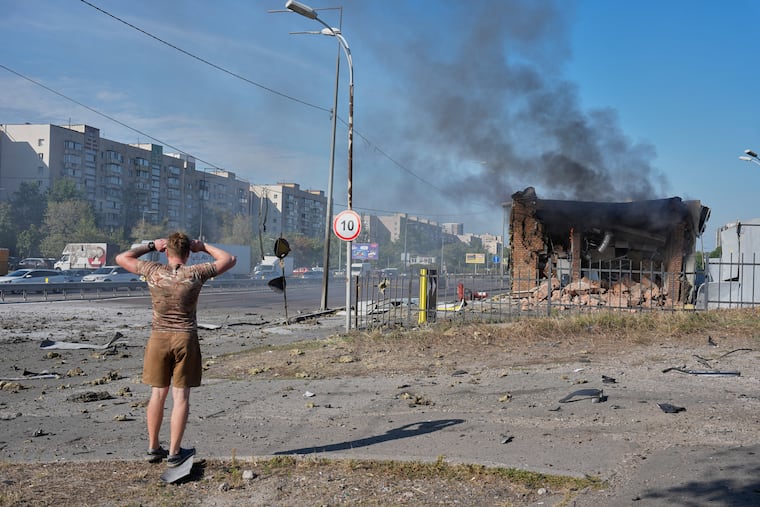
I saw the results of an unending torrent of Russian drones, cruise missiles, and top-line ballistic missiles - targeting road travel, blowing up highway gas stations, wrecking the ports from which Ukraine exports grain to the world, and hitting civilian apartment blocks in waves in Kyiv and other major cities. By systematically destroying the country’s electricity grid, Putin hopes to freeze urban Ukrainians this winter into turning against their government.
And yet, unlike many of the high-level U.S. and European invitees to the 22nd annual meeting of the Yalta European Strategy (YES) conference, held in Kyiv Sept. 11-12 and co-sponsored by the Viktor Pinchuk Foundation, I didn’t come away increasingly gloomy about Ukraine’s prospects.
Instead, talking with Ukraine’s top military commanders, its brilliant engineers and tech innovators, who have made the country the world’s most inventive drone powerhouse, I came away totally furious.
Furious because, despite Russia’s size and its mass production of Iranian Shahed drones souped-up with jet engines, I believe Ukraine’s deep strikes into Russia and even deeper smarts could ultimately force Putin to recognize that the war has become too costly.
Only one element is lacking: the full backing of a U.S. leader with the brains to recognize there can be no “peace deal” with a Kremlin czar who aims to undermine America with the same intensity as he seeks to subjugate Ukraine.
If the U.S. would only help Kyiv obtain enough Patriot interceptors to counter Russian ballistic missiles (the same interceptors Donald Trump is massively wasted in his war of choice with Iran), the Ukrainian David could outmaneuver the Russian Goliath. And, in so doing, America could also score a key strategic win.
There are several reasons why.
For starters, the resilience and inner strength I saw among ordinary Ukrainians is astonishing, even though they admit how frightened they are about the coming winter.
Take gas station workers, who are at terrible risk from Russian drones. I visited the scorched shell of an Ukrnafta gas station in Kyiv’s Holosiivskyi district, hours after it was hit on Sept. 10. Workers had been evacuated to a shelter before the drone struck. Female attendants (who asked not to be named) had already returned with sausage and cheese to feed the cleanup crew. Would they return to their jobs? I asked. “Of course,” was the quick reply.
Two days later, my translator and I visited an OKKO station, a roadside chain with an adjacent store and cafe that is popular for serving hot dogs and coffee free to anyone in uniform. OKKO has been a favorite target of Russian strikes, and while our tank was being filled, the workers got word that a Shahed might be approaching.
As customers ran for their cars, one worker fleeing the store screamed at the cashier who was processing my card, “Get out to the shelter!” She finished her job, told me she would never leave Ukraine, then ran out the back door. I ran to our car, and we quickly pulled out to the road.
I heard that same stoicism under fire expressed repeatedly as I traveled from Moldova to the Ukrainian port city of Odesa to Kyiv and back.
In the frequently hit, middle-class Kyiv district of Lukianivka, where many high-rise apartment buildings are pocked with blackened holes where drones did their dirty business, I walked by the rubble of a destroyed supermarket and shopping mall.
At a historic covered market that had taken a direct drone strike, women who had sold goat cheese, honey, fruit and vegetables, and clothing at indoor stalls had already relocated to tents outside the charred remains of the market.
Over and over I heard the same message: “Yes, we are frightened, but we won’t give our country to Putin.” Several of these women had husbands in the military, and a couple told me they might leave their apartments for the winter, but they weren’t running away.
A nearby McDonald’s, which has been struck several times by the Russians, had already been rebuilt and was full of young people buying Big Macs and fries.
Still, civilian steadfastness alone can’t defeat ballistic missiles and drones, and ordinary civilians in Kyiv and Odesa are stressed and distressed.
As my indomitable translator, Alla, told me, “A single mother, living in an eighth-floor apartment with two children and a mother who recently had a heart attack, is a full-time crisis manager.”
Schools are closed because of constant air raid alerts, and parents must devise games for frightened youngsters during blackouts, when clothes and quilts are piled on to avoid freezing.
This is where we come to the critical race between Ukraine’s tech innovators and Russians playing catch-up, as Ukraine incorporates of artificial intelligence into its drone and missile systems in order to use unmanned robots and upgraded drones to compensate for its shortage of man power. And as Ukrainians rush to perfect weapons systems that can counter Russia’s ability to destroy the infrastructure that enables civilians to survive.
I will write more about the progress in this area and my interviews with brilliant Ukrainian tech leaders in future columns. But let me sum up how they believe they can still force Putin to bend.
These super innovators said at the conference, and told me in private interviews, that they expect to be able to produce an interceptor drone to counter Russian jet engine-driven Shahed drones within a few months.
But there are two big caveats for real success. First, Ukraine still desperately needs more Patriot interceptors to counter Russian ballistic missiles. And second, Ukraine needs to massively scale up production of its anti-Shahed interceptors and other new drones in order to counter Russian numbers. This requires substantial foreign investment and joint production, most likely in Europe.
If Trump and Defense Secretary Pete Hegseth had any grasp of the new way of war in the 21st century, the Pentagon would long since have been signing contracts to jointly produce drones with Ukrainian companies — all of which constantly update their technology based on lessons from the front line. Given the destruction of key U.S. bases in the Mideast, which were undefended against Iranian Shaheds, Hegseth should be begging for immediate Ukrainian help.
When former Secretary of the Army Dan Driscoll — who understands Ukrainian drone warfare well but was recently pushed out by Trump — was asked at the strategy conference what the U.S. could learn from Ukraine, he replied: “We in the West have got to internalize these lessons [from Ukraine]. What you are doing here in a very scrappy, fast, iterative nature is what we must contort our systems to achieve at scale.
“The speed and scale of AI and [computing] that is about to hit these weapon systems will be an amazing opportunity for Ukraine to outrun the Russians, out-innovate them and out-partner them. We are a couple of months away from new solutions changing the very nature of how warfare will occur.”
Eric Schmidt, the former CEO and chairman of Google, who has been a pioneer in coproduction of drones with Ukraine, added: “Pretty much all of the traditional assumptions about war and particular devices are probably false now. Ships are big targets … These drones appear to be toys, but are extraordinarily powerful, especially when swarmed.”
Schmidt concluded that “after four and a half years of war, Ukraine knows what it is doing. The country is organized to win this. What’s missing? Money, and the second is scaling.”
Yet, as Schmidt knows well, and what remains a tragedy for the United States, Trump refuses to recognize how crucial a partnership with Ukraine is to helping the U.S. military in Iran, and to instilling the new Pentagon mentality required for wars of the future. Which, no matter what Hegseth believes, has little to do with the size of the average soldier’s waistline or testosterone levels.
The main message of the YES conference was that the U.S. and Ukraine can both win — if the White House recognizes the need for partnership in the fight against the new axis of adversaries: Russia, China, North Korea, and Iran. What is maddening is Trump’s refusal to recognize the true win-win solution lies not between Kyiv and Moscow, but between the United States and Ukraine.