Can Bryson Stott save his future with the Phillies after his 3 playoff collapses and 3 seasons of mediocrity?
Once the leadoff hitter of the future, Stott is hitting .162 in the last three playoff runs and a power-free .252 in last three regular seasons. A free agent after next season, will he stay around?
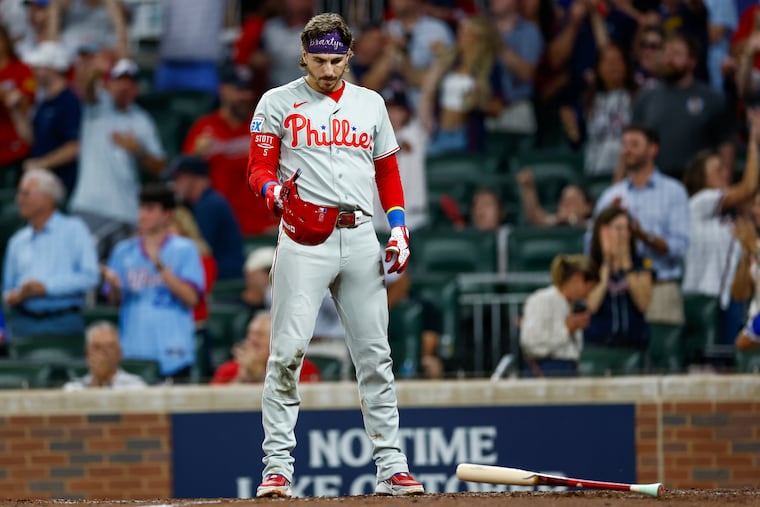
Considering the efficiency he has shown at second base, the brilliance he’s shown at third base, his capacity to play shortstop, his durability, his affability, and his age, Bryson Stott surely will be in somebody’s lineup for at least the next five years.
Should it be the Phillies’ lineup?
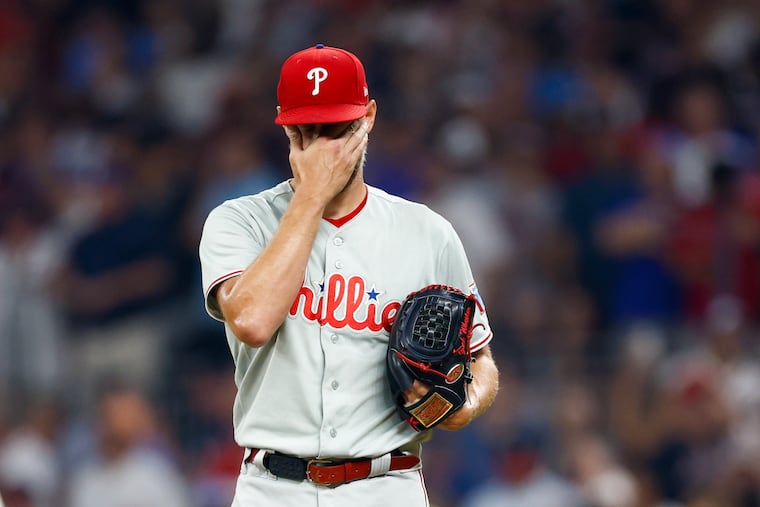
On Thursday, Stott was among the last of the Phillies to shower and dress after the Game 3 wild-card loss in Atlanta ended their season. But then, it’s always more of a challenge to get ready when you’re carrying the weight of personal failure on your shoulders with your future in doubt.
» READ MORE: Hayes: Trea Turner is the Phillies’ biggest problem. He knows it: ‘A lot of that is on me.’
Stott, who will be 29 on Tuesday, is entering his final season of arbitration and will be a free agent in 2028 (all of this assumes, perhaps naively, that the 2027 season will not be affected by labor strife.)
He might not be expensive, but, if he continues to sputter, will Stott even be worth the roster spot for a Phillies team already heavily invested in contending for a title for the next five to seven years? As expensive, aging players like Trea Turner and J.T. Realmuto and their diminishing contributions are sure to occupy spots in the lineup, can the Phillies afford to carry even one player who isn’t dynamic at the plate?
Stott’s fun to watch. He is 100% baseball player. His aura is the closest thing the Phillies have had to Chase Utley’s since Ut was traded in 2015, all scruff and gristle muscle and bone and unsettling ferocity, possessed of baseball knowledge beyond his years and baseball instinct beyond his peers.
Nevertheless, considering Stott’s pedestrian offensive production in the recent regular seasons and his disappearances in the recent playoffs, it’s fair to question whether a player like Stott should be in any lineup intent on winning in October, particularly considering Stott’s last three Octobers.
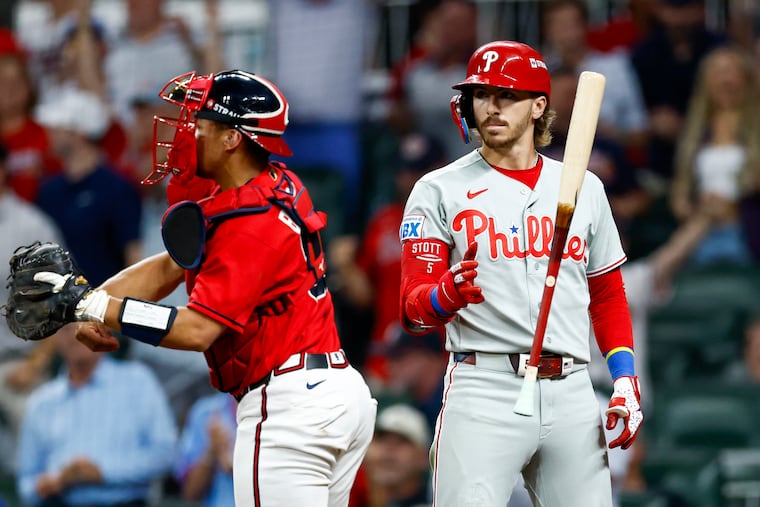
Stott is 6-for-37 in the Phillies’ losses in their first-round collapses of 2024, 2025, and 2026. That’s a .162 average, and it has been consistent: He managed just two hits in each of those series. He has no home runs. Two RBIs. Thirteen strikeouts.
This does not meet expectations.
» READ MORE: Will Don Mattingly return? That’s ‘Dave’s decision,’ the first of many facing Dombrowski
He was a first-round pick in 2019 who, at one point, was considered an option to lead off a lineup ahead of a batting champion, an MVP, and a home run king. It’s his baseball DNA. Stott hit leadoff at both UNLV and in the minor leagues. In his second big-league season, 2023, Stott batted leadoff 39 times in a lineup that included monied, veteran leadoff hitters Turner, who’d won a batting title, and Kyle Schwarber, who’d led the National League in home runs.
Stott finished 2023 with a .280 average, 15 home runs, and a brilliant future.
His future now is clouded.
Since 2023, Stott’s batting average is .252, he has averaged 11.2 home runs, and he hasn’t moved the needle in eons. He has batted leadoff just 48 times.
He’s the poster child for long, freezing-cold streaks: He hit .216 with a .638 OPS through his first 58 games this season, hit .301 with an .832 OPS in his next 70 games, then reverted to early-season form for the remainder.
His defense is the only thing that keeps him in the lineup, because, as Donna Summer sang, when he’s bad, he’s so, so bad.
“I tell the hitting coaches, if I can just hit .230 in my bad months, my overall numbers will look a lot better,” Stott said. At issue: “Trying to find ways to get out of those ruts, those bad months, as fast as possible.”
» READ MORE: Murphy: The same structural failures cost the Phillies again in the playoffs. The onus falls on Dave Dombrowski
That’s part of any hitter’s maturation. Pitchers find weaknesses and exploit them. The hitter must adjust in kind. Stott presents an intriguing history of weaknesses, though. In 2024, four-seam fastballs ate him up. Last year, sliders and curveballs. This season, curves and split-finger fastballs.
Stott studies. Maybe too much. That might be the issue with his postseason woes.
“You look at how a team pitches you all season and what they’re doing, and you plan going into a game,” Stott said. “Then you get to the playoffs and it could be a complete 180.”
And, after the first time not being served what you thought you’d be served ...
“Your initial thought is, ‘That was one at-bat. They’re gonna go back to what they did for 12 or 13 games.’ But sometimes they don’t,” Stott said. “Then, you’ve got to adjust on the fly. It’s just a giant cat-and-mouse game.”
In that metaphor, Stott mostly has been the mouse.
He pointed to his feeble plate appearance against Braves left-handed reliever Dylan Lee in Game 2. Moments before, Schwarber and Bryce Harper, the former MVP, had homered and tied the game. When Stott came to the plate, the afterglow of those heroics overshadowed how badly Stott was overmatched.
Lee threw Stott four fastballs that averaged about 94 mph. The first one was high, and he took it for ball one. The next three were in the top of the strike zone: take, foul, whiff, sit.
The cat ate the mouse.
“I’ve never faced Dylan Lee that I didn’t see a slider,” Stott said.
Entering that at-bat Stott was 2-for-4 against Lee, with a hit in each of his previous two plate appearances, but losing this sort of mind game has been typical for him in the last three playoff series.
» READ MORE: The Phillies’ dismal finish was a fitting end to a lackluster season
“I see sinkers and splitters and changeups from some of these guys all season, then see cutters and four-seamers that I didn’t see in the regular season,” Stott said. “So you want to stick to your plan going up there for that specific event, but sometimes it’s the complete wrong one.”
Every hitter faces this issue. The hitters who adjust are hitters who keep their spots on competitive teams. Stott has at least one more chance to adjust as a Phillie.
The hitters who can’t adjust?
If they aren’t a good fielder, then they start selling real estate.
If, like Stott, they’re 100% ballplayers, then they become placeholders on noncontenders until there’s no longer a spot on the roster for a light-hitting, 30-something, hard-nosed defensive specialist.