Spreading hope for homeowners
Teams reaching out to neighborhoods at risk bring an urgent message: A city program will help tackle foreclosures.
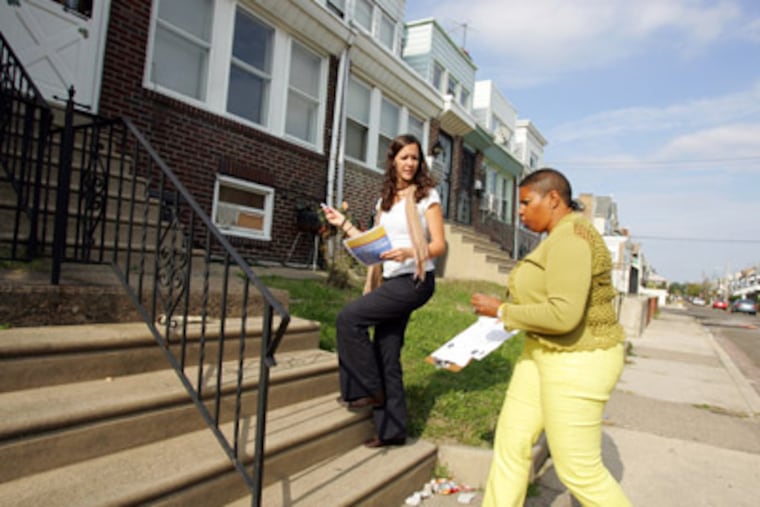
Emily Carlson and Edith Dixon were on the front lines last week of Philadelphia's effort to prevent financially struggling homeowners from losing their homes.
Armed with a list of homes headed for sheriff's sale, the two community organizers from Southwest Community Development Corp. went door to door, escorted for safety by Philadelphia police officer Joseph Young. They handed out information about the city's new program to forestall foreclosures. Homeowners who've missed payments can get legal counseling and go to a court session aimed at working something out with their mortgage companies.
The threesome wound through block after block of two-story rowhouses. Most of the houses looked clean and sturdy. Some streets were dotted with islands of the last of the summer's flowers. One hard block had a house emblazoned with red graffiti that profanely damned the police.
Some of the homeowners they sought had already given up, leaving their yards to grow tall and unruly and their mailboxes to bulge with bills. Elsewhere, they found frightened, angry tenants and homeowners who said they already had lawyers on the case. The trio arrived at one house with several small children just after Peco had shut off the electricity. At another, a woman sobbed.
"She had no hope that she was going to save her home," said Dixon, a former reporter, who started at the community development office three years ago.
She and Carlson left information about the city's Residential Mortgage Foreclosure Diversion Program and a reminder of hearing dates. There was also a brightly colored flyer with Mayor Nutter's picture on it. "Mayor Nutter wants you to keep your home!" it said.
"This is something you should take care of right away," Carlson told one young woman, who said she thought she had worked out a modification with her mortgage company. "It's real easy," Carlson added soothingly. "You just have to call the number right away."
Carlson said people often are suspicious. "They don't trust that this is a free program," she said. "It sounds too good to be true."
The city started the door-to-door program in May. It's making the extra effort, in part, to protect neighborhoods from blight. "From the perspective of a city of neighborhoods, it's not good to have these houses vacant," said Terry Gillen, senior adviser to the mayor.
She said work by teams like Dixon and Carlson had increased the odds 10 percent that homeowners would go to conciliation hearings. If the teams make face-to-face contact, homeowners are twice as likely to use the city program.
Thirty percent to 50 percent of homeowners have been missing their court dates, Gillen said. "A lot of these people, we believe, aren't opening their mail."
The number of names on the program's sheriff's sale list rose to about 900 last month, Gillen said, from 400 earlier in the year. Much of the increase stems from the city's trying to intervene earlier in the process, but housing advocates expect higher numbers of foreclosures this year as balloon interest payments kick in. Calls to the program's hotline, which arranges for counseling, have risen from 250 a month earlier in the year to 750 a month.
The city has budgeted an additional $2 million this fiscal year for counseling and a loan-reduction program, Gillen said. It needs an additional $250,000 for outreach over the next six months, she said, and is seeking outside help for half of that. "We're now talking to foundations and banks about whether they would help us to underwrite some of this."
Emily Carlson is 25, a native of St. Paul, Minn., with a degree in social work from the University of Iowa and long, wavy brown hair. Her teammate is twice Carlson's age, worked as a sportswriter, and has shorn most of her hair. When they're not visiting homeowners, Carlson works on beautification and employment projects. Dixon writes for the Southwest Community Development Corp. newspaper and focuses on crime and zoning issues.
Homeowners already tormented by bill collectors do not always open their doors to Carlson and Dixon. Some are immigrants from war-torn African countries. "They're used to being put out in the middle of the night," Carlson said.
Young's presence also gets some hearts racing.
"You all scared the dog out of me when I saw that police car," one woman said when she came to the door. "I thought it was one of my grandchildren."
She said she had hired a lawyer to deal with the mortgage. "I thought everything was OK."
Another woman was so upset about the foreclosure that she was afraid she was going to pass out, she said. "This is ridiculous. I feel I'm being harassed." She also said she thought she'd worked things out with the mortgage company.
"I wouldn't get too worried about it right away," Carlson told her.
Gillen said the city's lists might not reflect recent deals, but homeowners should make sure that their mortgage companies have contacted the city to confirm they are no longer in foreclosure.
Anna Satchell, 66, told the team her mortgage was only $240 a month. "I don't have any money," she said, "and I don't have any help in here."
Jonel Rutledge was one of the renters who was at a loss to deal with her landlord. "The last time I talked to him was two months ago," she told Carlson and Dixon. "I have a headache because, What's going to happen? They can come and put a lock on this, and I can't get in."
Dixon said some people, fearful of neighborhood gossip, invited them in. They're not supposed to go.
"Come inside, I got such nosy neighbors," one woman told her.
"I've been to a couple houses on this block," Dixon said she told her.
"Oh, yeah?" the woman said. "Which ones?"