Obama wants more regulation of Internet providers
WASHINGTON - President Obama on Monday embraced a radical change in how the government treats Internet service, coming down on the side of consumer activists who fear that slower download speeds and higher costs, but angering Republicans and the nation's cable giants, who say the plan would kill jobs.
WASHINGTON - President Obama on Monday embraced a radical change in how the government treats Internet service, coming down on the side of consumer activists who fear that slower download speeds and higher costs, but angering Republicans and the nation's cable giants, who say the plan would kill jobs.
Obama called on the Federal Communications Commission to more heavily regulate Internet providers and treat broadband much as it would any other public utility. He said the FCC should prohibit Internet providers such as Comcast, Verizon, and AT&T from charging data hogs like Netflix extra to move their content more quickly.
"For almost a century, our law has recognized that companies who connect you to the world have special obligations not to exploit the monopoly they enjoy over access in and out of your home or business," Obama said in a statement. "That is why a phone call from a customer of one phone company can reliably reach a customer of a different one, and why you will not be penalized solely for calling someone who is using another provider. It is common sense that the same philosophy should guide any service that is based on the transmission of information - whether a phone call or a packet of data."
This approach is exactly what telecommunications and cable industry lobbyists have spent months fighting against - and why stocks of those companies fell Monday.
David L. Cohen, executive vice president of Comcast Corp., said in a statement that reclassifying broadband regulation would be "a radical reversal that would harm investment and innovation, as today's immediate stock market reaction demonstrates."
AT&T on Monday threatened legal action if the FCC adopted Obama's plan. Similar statements were released by Time Warner Cable Inc. and several industry groups, including CTIA-the Wireless Association, USTelecom, the Telecommunications Industry Association, and Broadband for America.
The FCC, an independent regulatory body led by political appointees, is nearing a decision on whether broadband providers should be allowed to cut deals with the content providers, but is stumbling over the legal complexities.
"We are stunned the president would abandon the long-standing bipartisan policy of lightly regulating the Internet and call for extreme" regulation, said Michael Powell, president and CEO of the National Cable and Telecommunications Association, the primary lobbying arm of the cable industry, which supplies much of the nation's Internet access.
This "tectonic shift in national policy, should it be adopted, would create devastating results," Powell added.
Netflix swung behind Obama, posting to its Facebook page that "consumers should pick winners and losers on the Internet, not broadband gatekeepers."
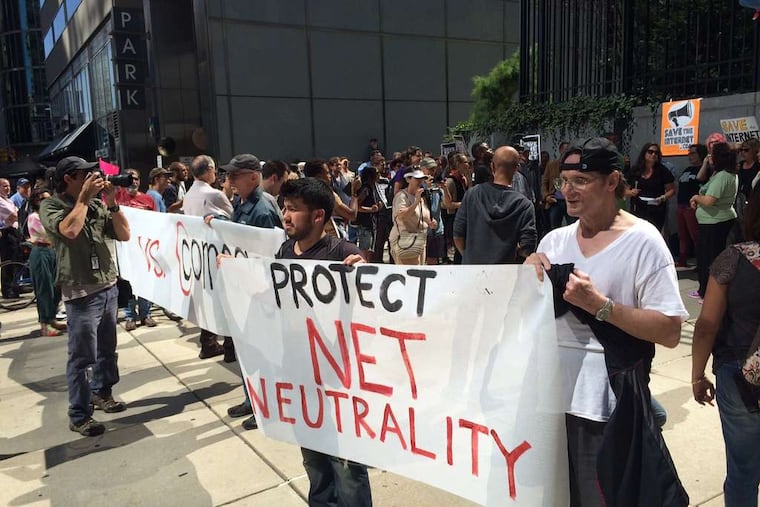
"Net neutrality" is the idea that Internet service providers should not block, slow, or manipulate data moving across their networks. As long as content is not against the law, such as child pornography or pirated music, a file or video posted on one site will load generally at the same speed as a similarly sized file or video on another site.
In 2010, the FCC embraced the concept in a rule. But last January, a federal appeals court struck down the regulation because the court said the FCC did not technically have the legal authority to tell broadband providers how to manage their networks.
The uncertainty has prompted the public to file about 3.7 million comments with the FCC - more than double the number filed after Janet Jackson's infamous wardrobe malfunction at the 2004 Super Bowl.
Many Republicans including House Speaker John Boehner (R., Ohio) and Senate GOP leader Mitch McConnell of Kentucky sided with industry in denouncing the plan as government overreach.
" 'Net neutrality' is Obamacare for the Internet," declared Sen. Ted Cruz (R., Texas), a tea party favorite, on Twitter. "The Internet should not operate at the speed of government."
The Internet Association, which represents content providers including Netflix, Twitter, eBay, and Google, applauded Obama's proposal.
FCC Chairman Tom Wheeler has said he is open to a "hybrid" approach that would draw from both Title II of the 1934 law and the 1996 Telecommunications Act. On Monday, Wheeler said he welcomed the president's comments, but suggested that Obama's proposal was easier said than done.
"The more deeply we examined the issues around the various legal options, the more it has become plain that there is more work to do," Wheeler said.
The FCC is under no deadline to make a decision. The president's statement all but guarantees that the major cable companies will spend the next few months trying to encourage Congress to step in to protect their interests. Internet activists are hoping that Obama's position will go a long way, even as his popularity among his party has waned.
"When the leader of the free world says the Internet should remain free, that's a game changer," said Sen. Edward Markey (D., Mass.).