At school districts, turnover at the top
It's become a ritual as much a part of fall as the Eagles' opener and growing piles of leaves - a brand-new superintendent greets students on the first day of classes, often bearing big promises.

It's become a ritual as much a part of fall as the Eagles' opener and growing piles of leaves - a brand-new superintendent greets students on the first day of classes, often bearing big promises.
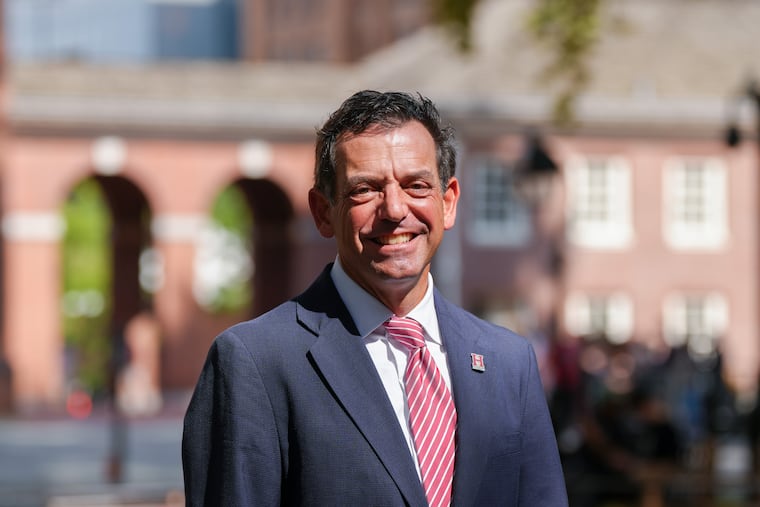
Some come with a flourish of pomp and circumstance, such as Council Rock School District's new chief, Robert Fraser, whose tenure started with a theatrically staged assembly centered on the theme of "hope and dreams."
Others promise a quiet transition, such as Samuel Lee at the Bensalem School District, who said, "If I wasn't here, things would have opened up exactly the same as if I was."
For all their different approaches, school superintendents have shared a common trait: They have tended not to stay very long - despite generous compensation packages.
For the 2014-15 school year, superintendents in Bucks, Chester, Delaware, and Montgomery Counties on average were making $187,000 annually, an Inquirer analysis found, in a league with the salaries of Govs. Wolf and Christie.
Yet, in Lower Bucks County alone, five of eight districts have new superintendents this school year.
Nationally, the average tenure for a superintendent is three to four years, according to a Brookings Institution study.
Jim Buckheit, executive director of the Pennsylvania Association of School Administrators, said about 300, or 60 percent, of the state's districts have seen change at the top in the last five years.
Experts cite several reasons, including increasing pressure to improve standardized-test scores, dealing with fiscal problems, and addressing newer issues such as cyber-bullying.
The turnover has led to expensive and draining searches for new leaders, and has stimulated a debate among education experts as to whether a superintendent really can make a difference in how well students learn.
Grover Whitehurst, a Brookings senior fellow in economic studies, said that in a 2014 study, he and his fellow researchers were unable to identify any superintendents who had made a substantial impact on individual student achievement.
In fact, Whitehurst said, parents looking for a quality education should "worry least" about who's in charge of the district and focus more on the quality of teachers and principals.
That said, Whitehurst added that a good superintendent can motivate teachers - who typically are the biggest factor in achievement - and that the Brookings report didn't look at the other potential positives of a strong manager in the corner office.
Other education researchers argue that a superintendent can have an impact on classroom achievement.
John DeFlaminis, who was chief of the Radnor Township School District for 17 years and is now executive director of the Penn Center for Educational Leadership, said a good superintendent is often the one who takes a measured approach, to grasp what is already working well in a district before launching new initiatives.
It doesn't always happen that way.
"Some superintendents go into a place and believe they've got to make changes right away," DeFlaminis noted, "That's really poor-quality leadership that does that."
"The best thing for anybody to focus on is the best possible instruction for the students," said Jennifer Polinchock, new acting superintendent at Centennial. She said her main focus will be adjusting the elementary school curriculum to align with changes in standardized tests.
Chris McGinley, the former Lower Merion Area School District superintendent who is now an associate professor in policy, organizational, and leadership studies at Temple, said the university is seeing fewer enrollees in superintendent-training courses.
"The job is increasingly accountable and increasingly demanding," he said. "I know there are less people vying for that top position."
In Council Rock, Fraser said that he believes he can make a difference by encouraging excellence in every facet of school operations and creating a climate that will lead to better instruction.
"The chief tone-setter in any school district is going to be the superintendent," Fraser said. "You have the opportunity to set a tone every single day that you show up in a school district. You do that by making sure there's a culture of teamwork, and togetherness, and commitment to excellence."
Fraser said that in starting the new school year, he rolled out his "hope and dreams" theme in a teacher assembly, which included musical performances and a classroom tableau, and created a Twitter feed - @CRhopeanddreams - that has grown to 1,000 followers to further drill home the message.
"It creates a sense of community, a sense of optimism," the Council Rock superintendent said. "It's one of numerous examples of the impact that a superintendent can have."
A short distance away in Bensalem, new schools chief Lee - who worked most recently in Bristol Township but has lived in Bensalem for 30 years, said that things have been running well under experienced teachers and principals and that he sees no need for radical change.
"The systems by and large are well developed and designed," Lee said. "My charge here is to build on strengths and assets that already exist."
Lee's approach lines up with what Brookings' Whitehurst described as a best practice for most new superintendents.
"The more radical a superintendent is, the less likely they will hold on to that job," he said.
"Most of them aren't about rocking the boat . . . because school boards are about protecting the status quo."
610-313-8232
@kathyboccella