Fine works, obscure narrative
How much can you read into the postcards and other ephemera that artists pin to their studio walls and refrigerators? You can, at the very least, assume the artist admired the image on the card and wanted to save it. And that's about all I would make of the mementos the 12 Philadelphia-connected artists in the Tower Gallery's exhibition, "Finding a Form: Influences in Figurative Painting," gave its director to display together on a wall, as a key to their influences. Mounted haphazardly, probably to simulate their former casual studio placement, they're not even easy to see.
How much can you read into the postcards and other ephemera that artists pin to their studio walls and refrigerators? You can, at the very least, assume the artist admired the image on the card and wanted to save it. And that's about all I would make of the mementos the 12 Philadelphia-connected artists in the Tower Gallery's exhibition, "Finding a Form: Influences in Figurative Painting," gave its director to display together on a wall, as a key to their influences. Mounted haphazardly, probably to simulate their former casual studio placement, they're not even easy to see.
The paintings they gave her, on the other hand, will absorb your attention immediately.
Unlike the bits of ephemera, each artist was asked to submit only one painting revealing his or her influences. The result of that stipulation, interestingly, is work that is almost exclusively in a psychological vein. The influences are negligible, though, mostly too subtle to single out.
Alex Kanevsky's painting of a nude man with a spiraling brushstroke obscuring his face, made me think of certain Francis Bacon paintings; Martha Mayer Erlebacher's painting of two nude men encountering each other on a path reminded me vaguely of Botticelli, and Mark Shetabi's painting of a building had Gerhard Richter-ish overtones. Scott Noel is an artist who has clearly learned from many masters of representational painting.
All the works are fraught with meaning. Susan Moore's large, riveting Couple (2006) is not a happy one. The face of a frowning woman is paired with the head of a man whose face is turned away. Joan Wadleigh Curran's Assisted Living (2006), a Medusa-like mass of gray frayed ropes or wires hanging on a broken chain-link fence, is terrifying. The creepiest of the paintings - and the most psychologically compelling - is Tina Newberry's L'il Traveller, which depicts a woman sitting naked from the waist down with a hobby horse perched in front of her.
Ben Kamihira, who died in 2004, is the only artist represented by two works, another of this show's inconsistencies. Both, a watercolor and an oil painting, were selected by his family. The painting The Green Balloon, which won a prize at the National Academy of Design in 1970, the year he painted it, is the most mysterious work in the exhibition, featuring a nude female figure, a dog and a young (dressed) girl sitting inside a steamer trunk posed to suggest a dream.
Sidney Goodman's imposing Smoke (2001-2003), of a cropped view of a man's head with smoke billowing up in the sky behind him, is also baffling, but slightly disturbing, too. Is he a terrorist?
I'm not quite sure what Jane Irish and Randall Exon, both excellent painters, were doing in this show - Shetabi and Curran seemed a stretch, too, for that matter - but I liked their contributions.
Something got a little lost in translation, in other words, but the art held its own.
Needlework
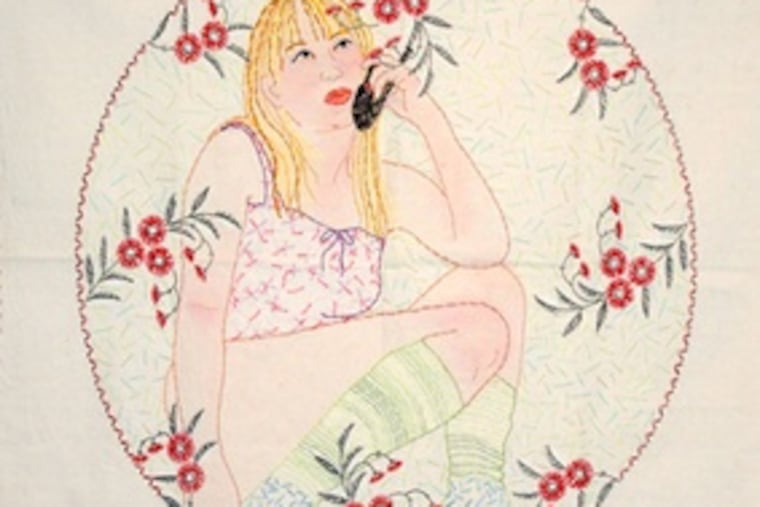
A number of Orly Cogan's naughty "bachelor girl" embroideries at Projects Gallery are clever and endearing, while others look too hastily conceived and made. But the half of this show that is carefully executed is well worth seeing.
Cogan stitches images of girls having fun in their underwear (and sometimes out, or partly out) on vintage linens, such as tablecloths and napkins. "Voice Mail" shows a blonde Venus listening wistfully to someone on the other end of her cell phone, while the embroidery "Noah's Playpen" depicts numerous girls posing suggestively with cute stuffed animals interspersed randomly.
The only problem with Cogan's whimsical narratives is her tendency to stick to the tried-and-true (is it possible that bad girls have only so many bad habits?) and that some are not sewn as beautifully as others.
Embroidery is not a forgiving medium.
But Cogan is definitely onto something. She makes Paris, Lindsay and Britney look like the singing nuns.