Domestic scenes reflect an artist who feels at peace
Sarah McEneaney has a knack for conjuring domestic warmth, but a substantial number of her paintings of the last 10 years have not been exactly cozy. In her typically straightforward, slightly grave fashion - a style reminiscent of both Horace Pippin and
Sarah McEneaney has a knack for conjuring domestic warmth, but a substantial number of her paintings of the last 10 years have not been exactly cozy. In her typically straightforward, slightly grave fashion - a style reminiscent of both Horace Pippin and early Alice Neel - the artist has chronicled, among other things, her experiences with rape and breast cancer. Seen against McEneaney's primary, childlike color palette, her muted portrayals of herself facing her own anxieties have seemed all the more painfully exposed.
Life appears mellower now. McEneaney's recent paintings at Locks, which form her first Philadelphia show since her 2004 ICA retrospective, are all about her house, her studio, her garden, her trips, and her dog and two cats. The sense of peace and contentment these modestly scaled works radiate is surprisingly magnetic. Suddenly, one's own life looks too helter-skelter.
A living-room scene shows McEneaney reading as a dog and a cat nap nearby; in her studio, she lies in a hammock, one leg dangling as if to stroke her dog with her sock-covered foot. In bed at night, she adjusts a blanket with one hand while her other arm encircles a cat, as a second cat sprawls on a dresser and a dog lies in the doorway like a benign, beagle-ish Cerberus.
Every room in McEneaney's house has its tidy arrangements of things. Office shelves are filled with translucent plastic boxes marked "Taxes," "Press," and the like. A door is a virtual bulletin board for drawings, cards for friends' exhibitions, an Obama poster. Paintings of places she's visited - seemingly remote, tropical spots - are restful and idyllic, but also less personal; it is McEneaney's own world in Philadelphia, so microscopic in its detail, that continues to be endlessly fascinating.
Upstairs at Locks, Ellen Harvey, British-born and based in New York, has the equivalent of a midcareer survey.
Harvey's site-specific installation
Mirror
, a reverse engraving on mirror copying the Pennsylvania Academy of the Fine Arts' Frank Furness- and George Hewitt-designed stairhall, was exhibited there in 2005-06. She marks her return to Philadelphia with a group of paintings and installations that are similarly brainy, carefully crafted and ambitious.
Museum of Failure
, shown in this year's Whitney Biennial, comprises a mirrored Plexiglas wall on which Harvey - alluding to all the art that will never make it through museums' doors (much less into their collections) - has mounted numerous decorative empty frames.
One such frame, however, surrounds a rectangle cut into the Plexiglas, allowing a view of paintings by Harvey - all self-portraits of her in her studio - hanging on a wall behind and parallel to the Plexiglas.
Likewise,
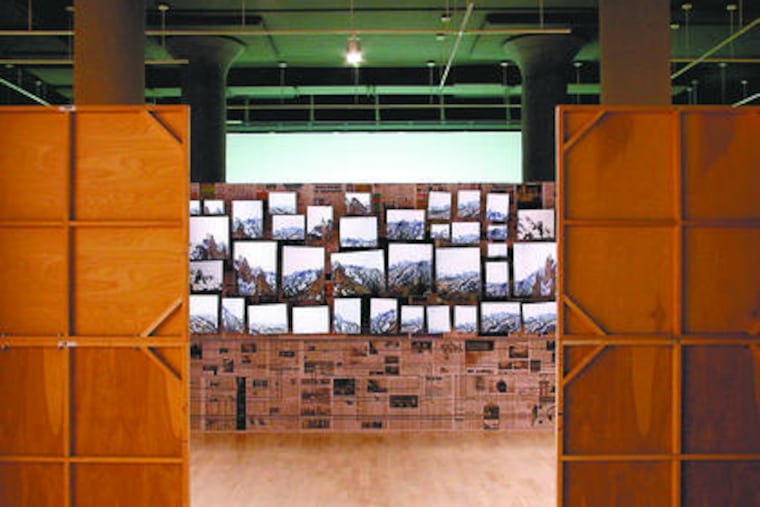
The Room of Sublime Wallpaper
, constructed in the center of the gallery, appears to display landscape paintings, but the paintings turn out to be mirrors reflecting a hidden painted panel.
Harvey's facility with various materials is impressive, as are her strategies, but her art's dependence on other art and architecture makes the whole exercise a little numbing when you see several installations in close proximity, as you do here. Art seems too self-important, too self-referential and, ultimately, unworthy of such rapt attention. Viewers can best appreciate the brilliance of Harvey's installations when they are displayed alone, as
Mirror
was.
Past is present
Dana Hargrove's latest bodies of paintings and works on paper at Bridgette Mayer Gallery, made during a residency at Greatmore Studios in South Africa, are abstract meditations on globalization, apartheid, colonialism and war as filtered through her new understanding of her Scottish family's history in Rhodesia, now Zimbabwe.
Her series of "Spike" paintings on paper initially look like shapes based on decorative ironwork - which they in fact are. But they also represent the potentially murderous spikes she saw on fences around properties in Cape Town.
Another series, of acrylic paintings on round panels, represents configurations of various American cities' US Airways terminals on partially camouflage-patterned backgrounds that appear to be based on maps of the United States. Terrorism and 9/11 would seem the obvious reference, but 1960s modernism comes to mind, too.
A video projection of 1950s and '60s-era slides of Hargrove's relatives in Rhodesia, coupled with a recent soundtrack she made of some of those still-living relatives viewing the slides for the first time in decades and trying to recall the events and people they see, is a poignant insight into her paintings and fascinating in its own right.