Philadelphia researchers look for signs of climate change in Mongolia
The age of exploration is not dead. Over the next six weeks, Robert M. Peck and colleagues from the Academy of Natural Sciences and the University of Pennsylvania will be traveling in Mongolia, reconnecting with herdsmen Peck met 17 years ago and checking for evidence of climate change. Peck blogs about his travels in the land once ruled by Genghis Khan, beginning Monday at www.philly.com/treks
The age of exploration is not dead. Over the next six weeks, Robert M. Peck and colleagues from the Academy of Natural Sciences and the University of Pennsylvania will be traveling in Mongolia, reconnecting with herdsmen Peck met 17 years ago and checking for evidence of climate change. Peck blogs about his travels in the land once ruled by Genghis Khan, beginning Monday at www.philly.com/treks
It looked like a scene from the Middle Ages: hundreds of horsemen dressed in long, sashed robes galloping over an open grassland stretching to the horizon. Gathered at the edges of the unmarked course stood hundreds more, cheering, chatting, exchanging gossip, and seeing friends they had not encountered for exactly a year.
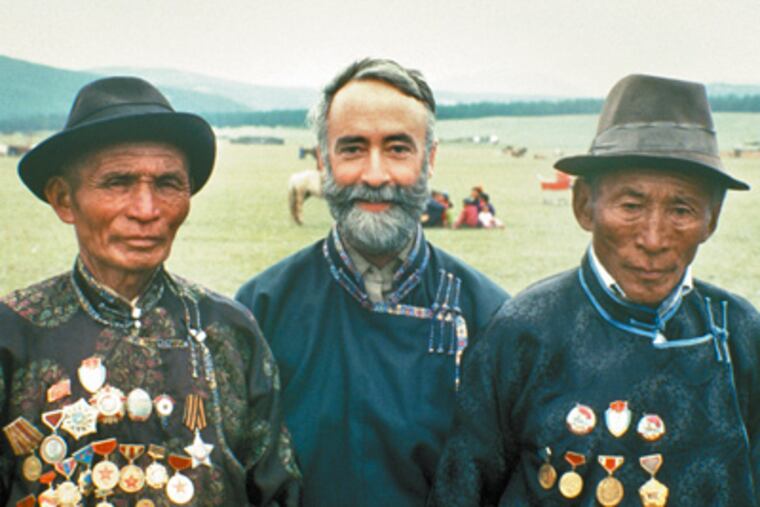
The year was 1994 and I was the only non-Mongolian at a three-day festival called Naadam dating to the 12th century in which Mongolians compete in horseback on riding, wrestling, and archery - three sports of strength, wisdom, and courage.
For the nomadic herdsmen of the isolated Darhaad Valley, the festival offered an opportunity to see friends, do business, and party on a grand scale.
Seventeen years ago, when Mongolia was just opening to the West after more than 70 years of isolation as a Soviet satellite, foreign visitors were rare in the Darhaad. Even today special permission must be sought to visit.
As part of a long-term photographic project of nomadic life in Central Asia, I am hoping to return to the scene of that great spectacle this summer. I will be seeking some of the people I met and photographed so long ago - to show them old images of themselves, to re-photograph them, and find out how the intervening decades have changed their lives.
Since that first trip, my colleagues at the academy and I have been traveling to Mongolia to study the wildlife and document the effects of climate change on native habitats and on the nomadic herdsmen who live on the harsh but fragile high plateau or "steppe."
Mongolia is an enormous country, more than twice the size of Texas, yet the human population is small, about 2.6 million people. Of these, about half live in the capital, Ulan Bator. Most of the rest are still tied closely to the land on which they graze sheep, goats, horses, yaks, and camels.
From 1923 to 1990, Mongolia was run by a communist government closely allied to the Soviet Union, its enormous northern neighbor. During this period, with a few exceptions, Western scientists were barred from entering the country, let alone conducting research there. With the collapse of the Soviet Union and the peaceful shift to democracy in the early 1990s, the country began to open to outsiders.
My friend and colleague Clyde Goulden and I were part of the first party from the academy to venture into the country. We went at the invitation of a charismatic Buddhist lama and member of the Buriatian parliament (Buriatia is a republic of the Russian federation just north of Mongolia). He wished to have the academy study the fresh water associated with Siberia's legendary Lake Baikal, the largest (by volume) and oldest (at 25 million years) freshwater lake in the world.
While we did spend some time at Lake Baikal on that first expedition in 1994, our attention was captured by a smaller (one-quarter the size) and younger (about four million years old) sister lake about 120 miles to the southwest in north-central Mongolia. Lake Hovsgol and its watersheds have been the focus of our attention ever since.
Measuring roughly 100 miles long and 30 miles wide, compared with Baikal's 500-mile length, Lake Hovsgol is arguably the most pristine lake in Asia. It has spectacularly clear and pure water through which one can see fish swimming about 25 feet below the surface. While Lake Baikal is remarkable for its size (it holds one-fifth of all the unfrozen fresh water on Earth) and unique wildlife (it boasts the only freshwater seals in the world), Lake Hovsgol is distinguished by its lack of commercial or industrial disturbance. There are no cities, factories, power plants or paper pulp mills. In 1994 there was not even a recreation industry near this spectacular lake - just one government-owned boat that made periodic trips between the tiny town of Hatgal at the southernmost point of the lake and the even smaller town of Hank at the northern tip of the lake, just miles from the Russian border.
So when we first visited Lake Hovsgol, we realized we had been afforded a rare opportunity to study evolution of organisms and ecosystems that have not felt the direct effects of human activity.
Working with Mongolian colleagues from the Mongolian Academy of Sciences and students and faculty from the National University in Ulan Bator, we mounted a series of research expeditions to the lake and its environs throughout the 1990s. These turned up many previously unrecorded insects, diatoms (single-cell aquatic plants) and shrimplike macro-invertebrates that helped us better understand Lake Hovsgol's long history and its relationship with Lake Baikal, of which it is one of the headwaters.
As with our academic partners, we were given a warm welcome by the local population, whose semi-nomadic lifestyle has helped to keep environmental impact to a minimum. With a rich oral tradition that goes back countless generations (well before the 13th-century ruler Genghis Khan), the herdsmen and their families have contributed invaluable local knowledge to our scientific studies. In recent years their observations of changing weather patterns have paralleled our more clinical observations of the same phenomenon.
This summer Goulden and colleagues from the National University and Penn will be continuing a multiyear study of climate change in Mongolia that combines instrument-based recording and analysis on the ground with first-person interviews with the herdsmen who live on the steppe. It is a powerful combination that brings local knowledge to a study of international significance.
The summer's work, while challenging, is sure to be eye-opening in many ways. For me, it will also provide a rare opportunity to return to a part of the world I have come to love over almost two decades of political, social, and environmental change. I will be recording my experiences in my journal and through this blog.