Pennsylvania measles outbreak appears to be slowing, but experts urge caution
The Pennsylvania outbreak is the nation's largest in decades, with more than 1,400 cases.
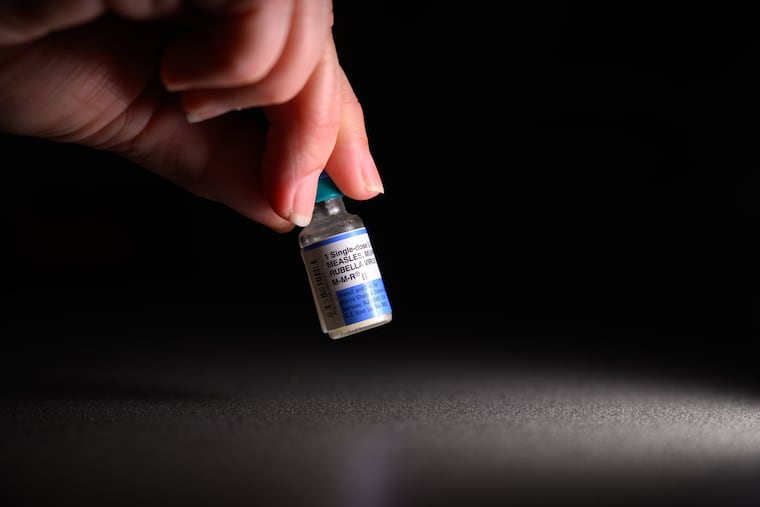
Pennsylvania’s record-breaking measles outbreak appears to be slowing down, though state health officials and experts say cases could spike again as cold weather sends people indoors with large pockets of undervaccinated people still vulnerable to viral spread.
Pennsylvania Health Secretary Debra Bogen said she would want to see the downward trend continue for “a couple more weeks” to feel confident that the outbreak is slowing down.
“A couple weeks of decline doesn’t mean it’s a pattern,” Bogen said. “We’re optimistic, but I’m not predicting what’s going to happen.”
What started as a handful of measles cases in Lancaster and Lebanon Counties, as Pennsylvania winter thawed to spring, had exploded to a public health crisis by summer.
The tally rapidly rose, with a staggering 150 new infections reported a week by mid-August.
By October, Pennsylvania was grappling with the nation’s largest measles outbreak in three decades, with more than 1,400 cases reported. The virus had spread to more than half of the state’s counties. Six deaths were linked to measles, and one in five people infected became so sick they needed hospital care.
The spread now appears to be slowing, even as the 74 new cases reported in the past week still lead the nation and represent a historic statewide high for a disease long considered eliminated in the U.S. through widespread vaccination.
The trend line reflected in an epidemic curve newly publicized by the state shows a real-time view of reported infections peaking in August, and declining steadily since in a classic bell curve.
This is not how measles has played out in other recent outbreaks, experts say. A highly contagious virus like measles typically tracks a different path, rising sharply, reaching a plateau, then declining in fits and starts.
Experts hypothesize that a combination of factors likely contributed to this unusual trajectory: The outbreak here has been heavily concentrated in rural communities where significant numbers of children and adults unvaccinated. The virus may have spread like wildfire there, but is now burning itself out, having infected everyone who was vulnerable.
» READ MORE: Measles is thought of as a childhood illness, but more Pa. adults are getting sick
A massive education and vaccination campaign by state and local health departments may also be slowing the spread of the highly contagious virus.
State public health leaders say they are cautiously optimistic. But experts warn that, so long as vulnerable pockets of unvaccinated individuals remain, measles will eventually resurge.
“It’s like any war — the enemy is always going to find weaknesses,” said Brian Castrucci, an epidemiologist and CEO of de Beaumont Foundation, a community health philanthropy outside Washington, D.C. “Measles is always going to be out there, looking for the next vulnerable community.”
» READ MORE: New vaccination data show hundreds of Philly-area schools vulnerable to a measles outbreak
Are measles cases slowing down in Pennsylvania?
An epidemic curve gives public health officials real-time data, week by week, on measles spread.
The curve logs measles cases by the date the patient developed measles’ telltale rash, which usually appears three to five days after the person starts exhibiting other symptoms, like a fever, cough, or runny nose.
If health officials don’t know when a person developed a rash, cases are logged based on the date a patient tested positive for measles. If that information isn’t available, cases are entered based on when they were reported to the state health department.
Pennsylvania Department of Health reported about 470 per month in August and September, with an average of more than 100 cases every week.
Weekly case counts have dropped since the first week of September, when the health department reported 143 new cases.
In all of October, Pennsylvania logged half as many measles cases as the previous two months — 238 cases. That number could still rise as more cases are reported in the coming weeks, since they are logged by date of rash onset.
Cases could begin rising again, as measles is among the respiratory viruses that typically spread more easily during cold weather because people spend more time inside.
Another limitation: The epidemic curve relies exclusively on infections that have been reported to authorities.
For months, experts and public health officials have noted that it’s likely many measles cases in Pennsylvania have not been reported. A Centers for Disease Control and Prevention “disease detective” is working with state health staffers to understand the true scope of the outbreak, Bogen said.
“We know the iceberg above the water. We don’t know the iceberg under the water,” she said.
An undercount of cases could help explain the precipitous drop in illness in recent weeks, said Rémy Pasco, research associate at the University of Colorado who helped develop a measles outbreak simulator based on school vaccination rates.
Recent measles outbreaks in Texas and South Carolina have declined more slowly, first plateauing, then rising and falling over an extended period of time.
In Pennsylvania, the epidemic curve is “too pretty,” Pasco said.
A textbook-perfect bell curve like that makes him wonder what could be missing, he said. For instance, perhaps the virus reached a community where reporting is significantly lagging or lacking.
“I think we’re going to see more up and down,” Pasco said.
A massive vaccination campaign
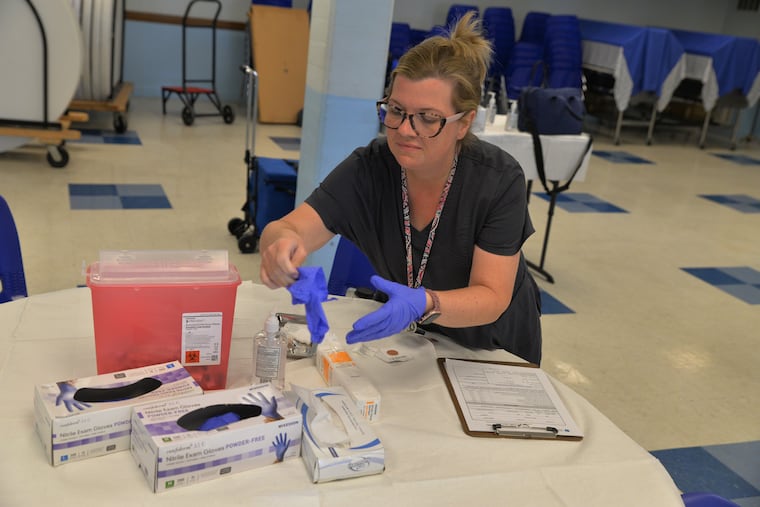
State health workers have given out about 10,700 doses of the measles, mumps, and rubella vaccine, since the outbreak began in April.
Other health providers across Pennsylvania normally give out about 25,000 doses of MMR a month. By August, they were dispensing double that.
And more parents are opting to give infants a “dose zero,” an early MMR shot at six to 11 months old. (Typically, babies receive their first MMR shot, which is 93% effective against the virus, at 12 months, and a second around 4 to 6 years old, offering 97% protection.)
In June, the state began recommending an accelerated vaccine schedule for children living in areas affected by measles; in October alone, more than 4,500 children got an early first dose, a 20-fold increase from January, when typically the shot would have been recommended only for children traveling to areas with measles.
Additionally, more than 12,000 children got an early second dose last month.
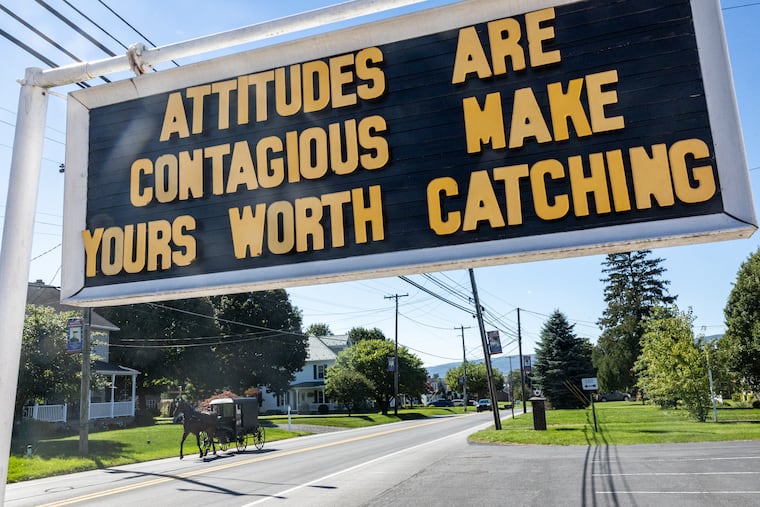
Public health workers have tailored their strategies to reach insulated communities, particularly Amish and Mennonite communities, that have historically been resistant to modern medicine, and are often distrustful of outsiders.
In Lancaster County, which has the most reported cases in the state, the health department consulted with Amish elders and religious leaders to develop a plan for reaching families that relies on word of mouth.
» READ MORE: Pa. measles vaccine messaging depends on word-of-mouth to reach the Amish community
They set up clinics in private homes and community centers with entrances not visible from the road, where people could get vaccinated without others their own community knowing, Jennifer Wallace, a pediatrician and the medical director of the state’s health centers, told The Inquirer last month.
“It all started with, ‘What are the communities we are trying to target, and how can we be respectful and work with them? Let’s not push what we think public health should be,’” Wallace said. “And it worked.”
In Chester County, which has the state’s third-highest case count at 93 cases, measles actively spread along the western border with Lancaster County but not widely beyond.
» READ MORE: Chester County has more measles cases than most entire states in the country
Even as cases are slowing here, county health leaders are preparing another outreach push that they hope will further contain the virus.
The health department is considering a mass mailer urging vaccination to send to some 4,000 households in western Chester County. County officials have not yet decided whether to send a mailer or what exactly it would say.
Targeting residences through the mail would be a new communications tactic in the department’s measles response, which has focused on messages tailored to specific communities. But health leaders believe this approach could be effective in western Chester County county because so many families there are unvaccinated, said Jeanne Franklin, the county’s health director.
The same approach could “fall on deaf ears” in eastern parts of the county, which have higher vaccination rates and would not necessarily benefit from a mailer urging people to get vaccinated, Franklin said. Instead, the health department is contacting individual schools with lower vaccination rates.
School district superintendents have “really stepped up” after Oxford Area High School, near the Lancaster border, closed for a day after a positive measles case. Under state policy, students and staff who are unvaccinated or cannot prove their vaccine status must remain out of school for 21 days after an exposure. School administrators decided to call off classes because they did not have vaccination records for enough of their staff.
Now, more schools are gathering those records in advance and drafting plans for how to respond if a measles case is identified, Franklin said.
“It sets the stage for anything else in the future,” she said.

-
Your questions about Pennsylvania’s measles outbreak, answered
-
Measles is thought of as a childhood illness, but more Pa. adults are getting sick
-
New vaccination data show hundreds of Philly-area schools vulnerable to a measles outbreak
-
Chester County has more measles cases than most entire states in the country
-
Pa. measles outbreak is nation’s worst, echoing deadly 1991 Philadelphia epidemic
-
Pa. measles vaccine messaging depends on word-of-mouth to reach the Amish community