[Writing] the play's the thing
It used to be that everybody wanted to be a director; now it turns out that everybody actually wants to be a playwright.
It used to be that everybody wanted to be a director; now it turns out that everybody actually wants to be a playwright.
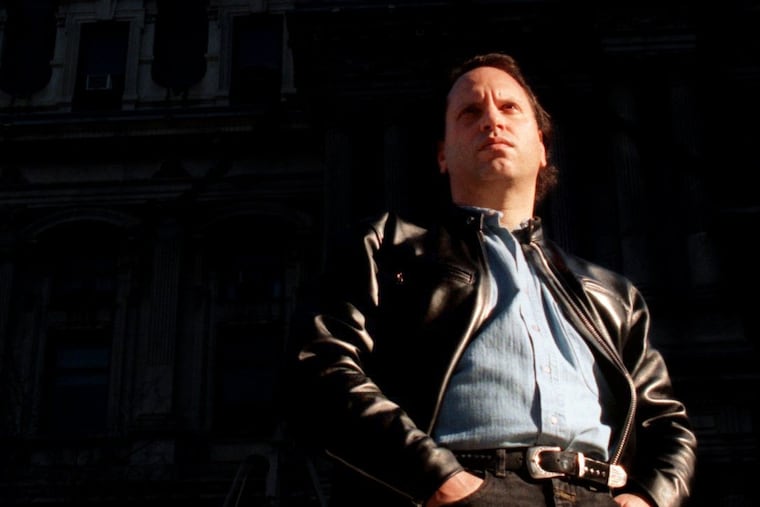
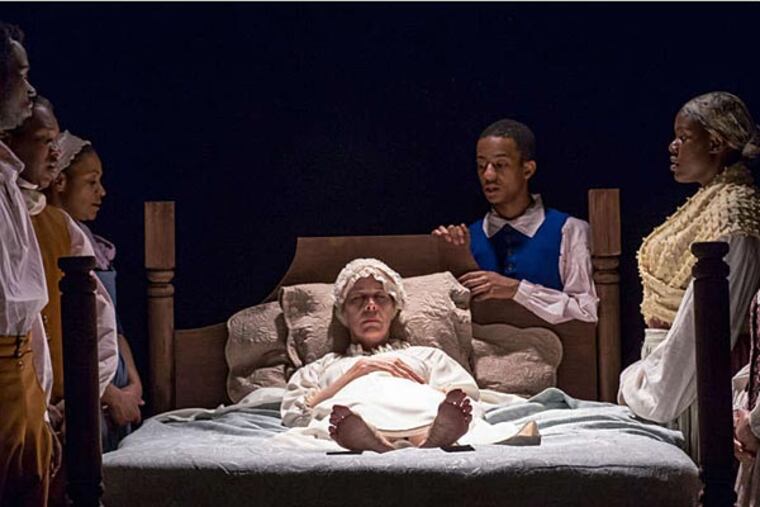
This week, Barrymore-winning actor James Ijames, 33, will see the opening of his new play, The Most Spectacularly Lamentable Trial of Miz Martha Washington, in a production by Flashpoint Theatre Company at the Off Broad Street Theatre.
And while his play is running here, he'll be down in Baltimore performing in a play written by another actor, West Philly's Colman Domingo, whose Wild With Happy is at Center Stage.
Actors who write, writers who act. There is plenty of precedent, from Shakespeare to Harold Pinter, Sam Shepard, Tracy Letts, and Christopher Durang.
The premise of Ijames' Miz Martha is that the widow Martha Washington is dying; her slaves know that the late president had specified in his will that they would all be freed when she died. This makes for an understandably tense household. One of Ijames's stage directions reads, "Imagine if the stereotypes you created suddenly became hyper-real and attacked you? That's what's going down here."
Is he talking about Martha's stereotypes? About his? About ours? All of the above: "I'm exposing stereotypes that are not true, indicting myself as well as the audience."
Ijames (a Welsh name that rhymes with times) started as a music major at Morehouse College, but discovered that he loved acting and was good at it (two memorable recent appearances were in the Wilma's Angels in America and the Arden's Superior Donuts; he won Barrymore Awards for both).
But he missed writing, and so sought help from mentors to pursue playwriting, not as a hobbyist, but as a component of his career. Playwright and Yale University professor Paula Vogel told him to "write the thing you think no one can do."
Miz Martha is an ambitious undertaking for a little theater company like Flashpoint: big cast, big fantasia style, big political provocation.
Ijames says, "When you're writing, you see the million-dollar Broadway budget, people flying in . . . ." And then, he added, summing up the Flashpoint production, "you see what can be done with a ton of imagination and passion."
Much of that stems from Thom Weaver, 36, Flashpoint's artistic director - and, surprise, a playwright. His 101.2, a "funny tragedy" about sports radio, debuted last week at Theatre Exile's Studio X-hibition, a program concentrating on Philly-focused works.
Weaver is also, perhaps foremost, a nationally known lighting designer, who most recently designed the stunning lighting for the Wilma's production of Paula Vogel's Don Juan Comes Home From Iraq. His lighting has won numerous prizes, including two Barrymore Awards, and he has designed the lighting for Miz Martha. He chose the play for the company's big-bang summer relaunch as it returns after a year's hiatus. He talks about lighting as creating "the air around the performers."
Weaver's commitment to Ijames' Miz Martha is intense: "It's about a human, particularly white, capacity to minimize, marginalize, and dehumanize others. We all too easily compartmentalize that time as morally unevolved, lionizing our founders and apologizing for their sins. The flaw in the system hasn't changed, only the results. I think that's what James so successfully creates with this play - a confrontation of the disease, not just the symptom."
Weaver's great-grandparents were in vaudeville, and his parents majored in theater. "I was always going to be in the theater," he says. "I've always felt that lighting was a skill set I use to tell stories.
But, he notes, " It's not the only tool. I write plays, design scenery, run a theater company. I have a passion for what I call the hyphenated-artist."
One way or another, theater seems to be a family business. Ijames says that when he sits down to write, he imagines a "private audience: my mother, my friends." Often he finds that "the cadence, the turn of phrase" in his dialogue in Miz Martha comes from his mother, grandmother, and aunt.
Quoting his grandmother, Ijames says, "Guilt is an empty emotion," adding that, as a playwright, change is more what he's after - "making the audience feel they're on the right side of history - until they're not. Society seemingly got better, but the legacy [of slavery] vibrates."
The play's point is summed up in a bit of dialogue near the end:
PRISCILLA: Hard work, openin' folks' eyes.
DOLL: Huh . . . you can say that again.
THEATER
The Most
Spectacularly
Lamentable
Trial of Miz Martha Washington
Through June 29
at the Off Broad
Street Theatre,
1636 Sansom St. www.flashpointtheatre.org
EndText