A wave of outages has Americans preparing for doomsday
A slew of seemingly unrelated outages, coupled with media reports both vague and menacing, have led to a groundswell of worry from Americans who said they’re preparing for worst-case scenarios.
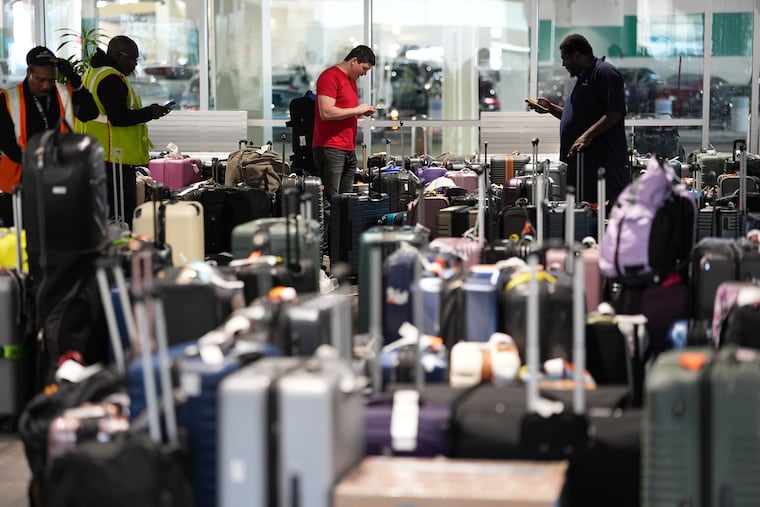
Canning fruits was a hobby for Korrie Roth until Microsoft Outlook went down. And then the planes stopped flying. And then Apple Pay froze up. And then the National Security Agency, whose responsibilities include defending the government from cyberattacks, reported its own mysterious outage.
“Now I’m prepping for survival,” said Roth, a 37-year-old IT specialist and mother of five, who lives in Greenwood, Indiana.
No explanation from the country’s leaders has soothed her.
President Donald Trump suggesting everything is “fine” on Tuesday lacked empathy, she thought. She was not feeling fine, and her social media feeds were full of panicked friends asking some version of: What is going on?
“You’re supposed to trust the government to give you information and protect you,” she said. “But we are worried, and the government is just like, ‘Oh, you’re silly.’”
Roth bought a crank radio and extra bottled water and checked in with someone she actually trusts right now — her father. He bought a portable generator during the Microsoft crash, he told her.
A slew of seemingly unrelated outages, coupled with media reports both vague and menacing, have led to a groundswell of worry from Americans who said they’re preparing for a bevy of worst-case scenarios: Widespread power outages? Electrical grid failure? The end of the world?
The political response has offered little clarity. Some Republicans have amplified suspicions that the outages are connected. “The American people can see everything happening with these service outages, and they feel like they’re not getting the whole story,” Sen. Rick Scott (R-Florida) wrote Tuesday on X, demanding transparency from companies and federal agencies.
Sen. Josh Hawley (R-Missouri) was more pointed. “If this is all a coincidence, it’s like the greatest coincidence in the history of the world,” he told reporters at the Capitol.
The administration, by contrast, has sought to tamp down speculation. Secretary of State Marco Rubio said Tuesday he understood why people are nervous but the government had “zero evidence” linking the outages. Director of National Intelligence Jay Clayton told the House Homeland Security Committee in a Wednesday hearing that while Americans are right to ask questions, “these are separate service outages associated with maintenance and technical changes. They are not a coordinated or state-sponsored attack.”
But on the internet, where “preppers” are sharing tips on Facebook groups and Reddit communities, nothing seems outside the realm of possibility — especially to people who have long maintained that they’re prepared for anything.
One 60-year-old retired aircraft mechanic restocked his pantry, adding a solar-based power station to charge electronics, 16 small propane tanks, a large propane tank and a portable heater. In the past month, he estimates he’s spent about $3,500 on additional supplies.
Though Camille Sibert, a 25-year-old stay-at-home mom in Indiana, said she’s been a prepper for three years, the week’s chaos has vindicated her decision to think ahead.
Amid news of the outages, she and her husband went to Walmart and bought canned goods, gallon jugs of water, vitamins and over-the-counter medication. They also filled up their vehicles with gas. “I try to avoid panic buying, but with everything going on in current events we’d rather be safe than sorry,” she said.
She used to think of prepping as a hypothetical, but it feels more real now. “It started as a scenario ... to think about and consider how I would respond and survive,” she said. “But now, so many odd things have happened recently that the thought of a power grid shutdown doesn’t seem so ‘crazy’ anymore.”
Whitney Phillips, a University of Oregon professor who studies information politics, said when people receive a barrage of alarming fragments from fractured sources, they often feel compelled to fill in the gaps to make sense of the news.
“There’s too much to sort through,” she said, “and then we’re making a kind of mental shortcut to try to just get through our days and make sense of things.”
Increased uncertainty, according to Phillips, can push people already inclined toward apocalyptic thinking further in that direction. “It doesn’t take very much to push them over that edge.”
But the proclivity to stock up isn’t isolated to those who consider themselves preppers.
David Bellinger, a senior analyst at the investment bank Mizuho Securities, noted in a Monday research report that shoppers have been swarming Costco in recent days with “emergency prep sales.” As of Sunday night, he noted, 21 of the 26 most expensive generators were sold out on the company’s website. Costco did not respond to a request for comment.
Two officials at the Federal Emergency Management Agency (FEMA), who spoke on the condition of anonymity because they were not authorized to speak to the media, said they were concerned themselves about the string of outages and were having trouble believing they were a coincidence.
One official described the barrage of messages they received from former high school classmates asking whether they should be prepping for a massive emergency; another said they took out extra cash.
“There is nothing on this scale that has happened before in this many sectors this close together,” one of the officials said. “This is scary and there is no leadership.” FEMA did not respond to a request for comment.
At a time of heightened uncertainty, leaders — of a company or a country — can ease anxiety with clear, detailed information, said John Rogula, a veteran crisis manager who is a principal at the global consultancy Baker Tilly’s risk advisory practice.
“You’re going to have a lot less panic if you have a plan,” he said. Those in charge set the tone, he added. Shrugging off concerns can amplify them. “You need to be transparent in regards to your readiness,” Rogula said.
While some Americans are rushing to prepare for a world without power, others have spent years laying the groundwork.
Shawn Hendrix, 49, a burly survivalist and former operations manager for the popular YouTuber MrBeast, describes himself as a self-sufficient homesteader who lives off the electric grid on a solar-powered farm full of animals.
From his farm in eastern North Carolina where he was “out moving cows,” he said the recent outages have not fazed him, because he’s been planning for decades.
“If it happens it won’t be one of these, ’oh no on this date X is going to happen, it will just happen,” he said. “Don’t be scared be prepared. Then just live your life. .”
Despite her own fears, Roth, the IT specialist who has been canning fruits and buying supplies, flew this week to Washington, D.C., for work.
The planes were flying again, the ground stop lifted, but delays were still rampant, and she kept checking her phone for updates.
“In the back of your mind, you’re like, well it’s probably going to be just fine,” Roth said. Then she paused. “But, what if it’s not?