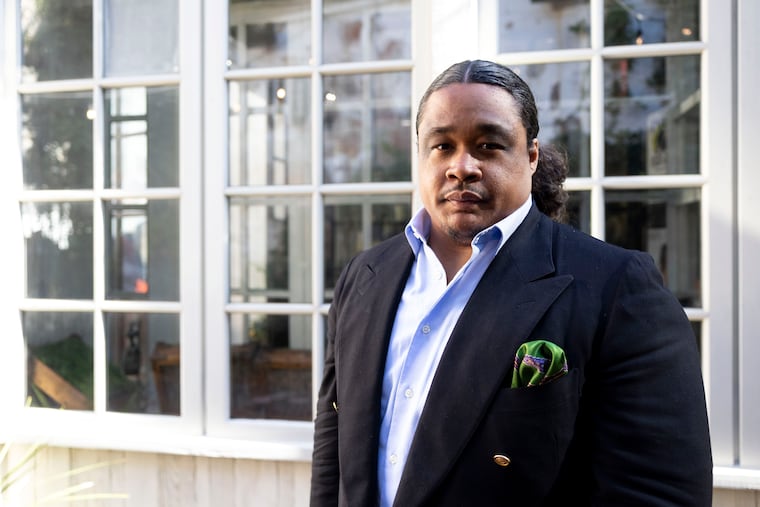
Scarlata with Chamber Orchestra
Though Sunday afternoon's Ein deutsches Requiem performed by the Chamber Orchestra of Philadelphia had some great moments - usually involving baritone soloist Randall Scarlata - its flawed presentation concept kept intruding.
Though Sunday afternoon's
Ein deutsches Requiem
performed by the Chamber Orchestra of Philadelphia had some great moments - usually involving baritone soloist Randall Scarlata - its flawed presentation concept kept intruding.
Conductor Ignat Solzhenitsyn didn't have the big, rich orchestra before him that you might expect in this piece, though that would not have been a problem by itself. Brahms' score is durable; there's even a two-piano version, arranged by the composer and released by King's Choir College a few years ago, that works gorgeously.
But that's a recording, and Solzhenitsyn had to grapple with the realities of the Kimmel's Perelman Theater. The orchestra was small, but the 58-voice Choral Arts Society of Philadelphia was pushed far back behind it on the deep stage and lacked the help of an acoustical shell; as a result, the sound tipped in the orchestra's favor, at one point making the poor tenor s sound like they were calling in their parts from a different room.
Solzhenitsyn made some attempts to slim down the orchestra's sound, but rather than simply asking the ensemble to play softer he often stripped the strings of vibrato. Sometimes, but not always. What place did this nod to an early-music sound have amid an orchestra of modern oboes, horns, and other instruments? Rather than clarifying textures, it simply created a neither-fish-nor-fowl problem.
His tempos were often quick, which was, in some places, beneficial. I liked the way he erased all possible breaks in sound in the first movement, "Selig sind, die da Leid tragen" ("Blessed are they that mourn . . . "). And he handed Susanna Phillips a sensibly moving tempo in her precarious solo, "Ihr habt nun Traurigkeit" ("And ye now therefore have sorrow . . ."), which was realized by the soprano in a lovely tone both secure and delicate.
The bigger solo part was handled by Scarlata, who flourished in the piece. He has a beautiful tone and the intelligence to shape it to the text. The baritone introduced a little breathiness at one point in "Herr, lehre doch mich" ("Lord, teach me that there must be an end of me . . ."), and then quickly turned his sound into something more focused and intense.
Some of Solzhenitsyn's breezy tempos undermined the drama, as in the last movement when the first-movement material reasserts itself. Rather than sounding fresh and surprising, that moment seemed merely too casual or unloved.
And still, even as it ended in this way, the piece had its usual effect of leaving the listener somehow changed.