Freed from doomsday rhetoric
Easy-paced approach to Book of Revelation decodes content, explores the history of Christianity.
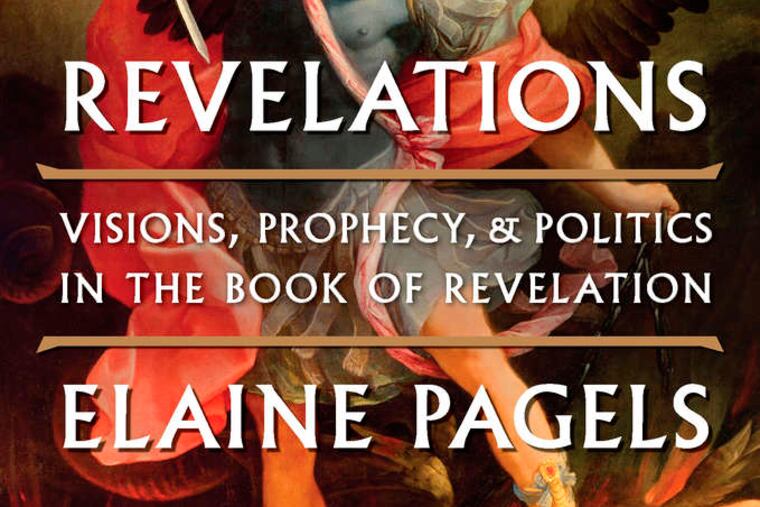
Visions, Prophecy, and Politics
in the Book of Revelation
By Elaine Pagels
Viking. 246 pp. $27.95.
nolead ends nolead begins
Reviewed by Hal Taussig
Elaine Pagels is perhaps the preeminent voice of biblical scholarship to the American public. With the best yet of her finely tuned prose for the general reader, her new book,
Revelations: Visions, Prophecy, and Politics in the Book of Revelation
, takes a significant step closer to confirming her in that role.
Turning her attention to biblical writings in a more focused manner than in any previous book, Pagels, a professor of religion at Princeton University, again rewards her readers with clear reports from scholarship and cogent analogies from contemporary American life.
On the surface, this book is about the Revelation to John, which she calls "the strangest book in the Bible." Her first chapter masterfully turns the choppy scenes and wild imagery of the last book of the Bible into a seamless pair of stories. She weaves together the sequence of action in Revelation with an extremely cogent review of the last 30 years of biblical scholarship on this book.
Her book, which Pagels will discuss Thursday night at the Free Library of Philadelphia, results in a satisfying portrait of the contents of Revelation and a conscientious report on how recent scholars have pieced together the first-century social context that Revelation addressed. She follows closely the work of other recent scholars in portraying Revelation as a dramatic call to resistance against the Roman empire and the empire's pretensions to be divinely ordained.
Pagels' book frees Revelation from doomsday rhetoric, and - as she did so cogently in her best-selling The Gnostic Gospels and Beyond Belief - releases the book from manipulative religious interpretations and allows a closer reading of Revelation itself. This patient and easy-paced historical approach to Revelation can undo anxieties about coded predictions of the world's end in our day and will allow the reader to see the historical integrity of the book in its ancient context.
But this is not Pagels' main achievement. Rather, her interest in Revelation becomes the occasion to narrate an approachable story about the emergence of Christianity in the first four centuries after Christ, crucially informed by some of the important breakthroughs in the scholarship of the last generation. I know of no other short book I would recommend more to gain an overview of how Christianity came into being. There are, of course, many places where I and other scholars can disagree on her details, but this accessible and brief narration (177 pages in all) of the big picture of early Christianity brings more good scholarship to a general reader than any other work on the subject. Both the major achievements and the writerly strategy of this portrait are worth describing.
Pagels' book is a readable and richly informing picture of Christianity's initial centuries. In just a bit more than 10 pages, Pagels gives a portrait of the apostle Paul, his place in the early Christian movement, and his relationship to the Greco-Roman and Jewish cultures of his day. Following the work of recent leading scholars, Pagels shows clearly what Paul's message was and where Christianity has often misunderstood him. She follows this with a similar brief illumination of the lesser-known, but very important, Ignatius of Antioch.
The only major part of this book in which Pagels returns to her longer-term interest in the recently discovered documents of early Christianity does incisive service to this book's broader project of portraying a more general picture of early Christianity and all its scriptures. Still attending to her thread of interest in Revelation, she introduces a set of "other revelations" from the first Christian centuries that parallel, complement, and contend with the Revelation to John. This treatment of eight other "revelations" alongside John's awakens the reader to what Pagels' Harvard colleague and occasional coauthor Karen King describes as the need for early Christian history to be written by consulting all the early Christian sources, not just those in the New Testament. But here, Pagels' book breaks in some ways with her earlier tendencies to portray the extracanonical discoveries as more creative and relevant to the modern reader than the New Testament books themselves. This new book reads the various revelations together, rather than in opposition to one another.
One of the most delicate moves Pagels makes is to paint a portrait of these four centuries that both follows and departs from what other scholars call the "master narrative" of early Christian history - the manipulative picture Christian interests have put together to make the rise of Christianity seem inevitable and a straight line from Jesus through the apostles to the church triumphant. These historians sternly critique the "master narrative" and call for a new approach to early Christian history, but such scholarly challenge to the conventional understanding of Christianity's emergence is very difficult for the typical lay reader to follow.
As she has done in her other works, Pagels introduces many aspects of both the "master narrative" and new critical ideas that challenge it. This allows her portrait to be clearer (and perhaps less disturbing) to the public than most scholars' work on how Christianity began.
Pagels successfully evokes the potential for extracting modern meaning from the ancient Christian documents without pursuing it explicitly. Don't expect prophetic, mystical, or visionary proclamation of Revelation from Pagels herself. Although she charts beautifully the way early Christians took inspiration from the Revelation of John to resist the oppression of the Roman empire, she does not, unlike other biblical scholars, deal with what empires Christians today need to resist. Rather, she matter-of-factly narrates how the original meanings of Revelation were changed finally to justify Christianity's own empire and, in her conclusion, finds more general meanings of hope and judgment in the Bible's final book.
Pagels knows the pulse of much of the American public and writes to its beat in a way that respects both the public and the scholarly career she has been devoted to. This latest book reminds us of our debt to her in this regard and of the extra energy created when she turns her attention to the books of the Bible.